
AI Agent vs Chatbot: Which One Actually Grows Revenue (And Which Is a Waste of Budget)?
This blog settles the AI agent vs chatbot debate with real 2026 data rather than marketing buzzwords. You’ll learn the...

 16 Mins Read
This guide compares eight AI chatbots for B2B websites on one measure: how well each one turns a website visitor into a qualified sales lead. It’s written in simple language, backed by current data, and organized so you can match a tool to your own situation.
KEY TAKEAWAYS
|
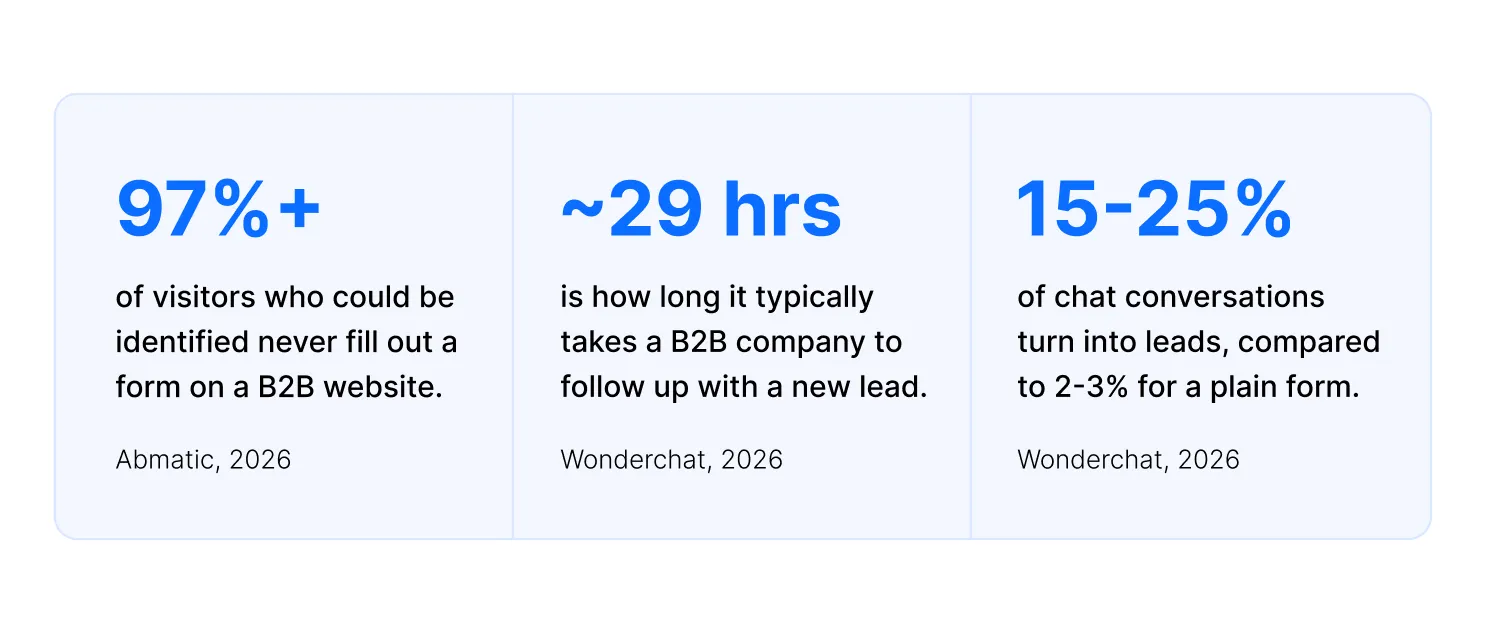
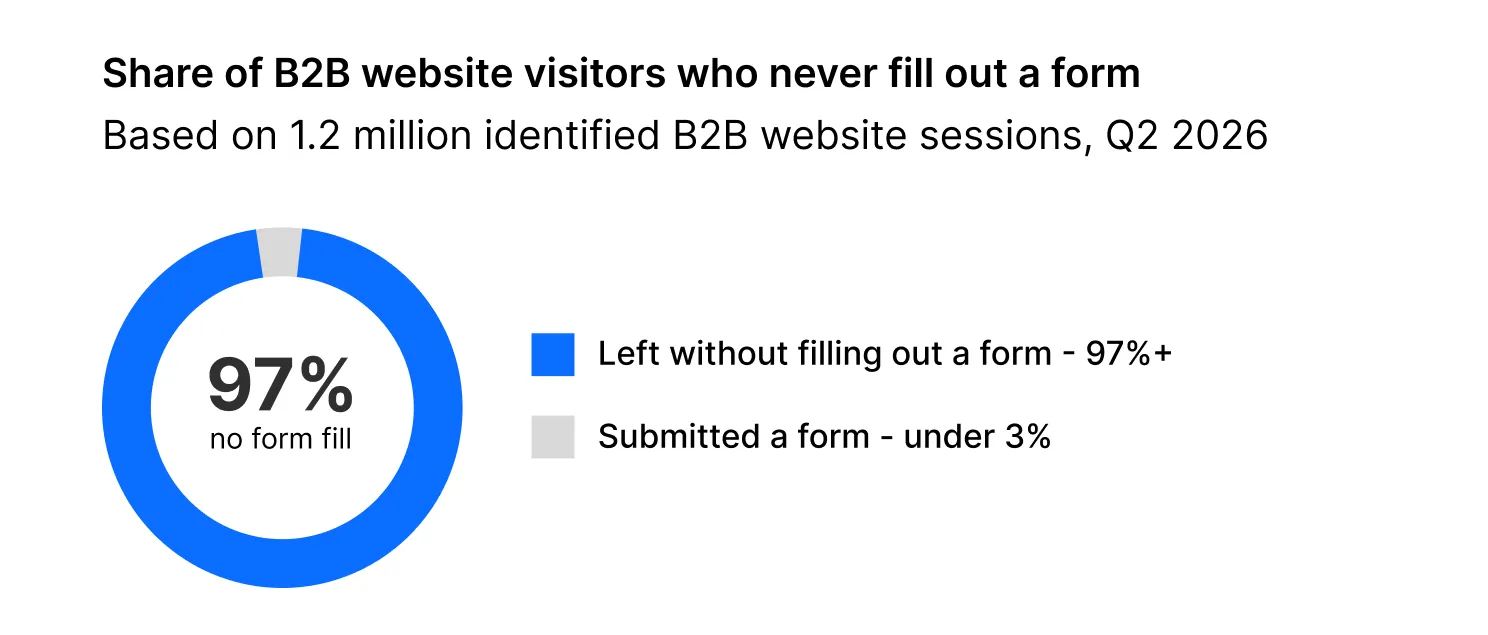
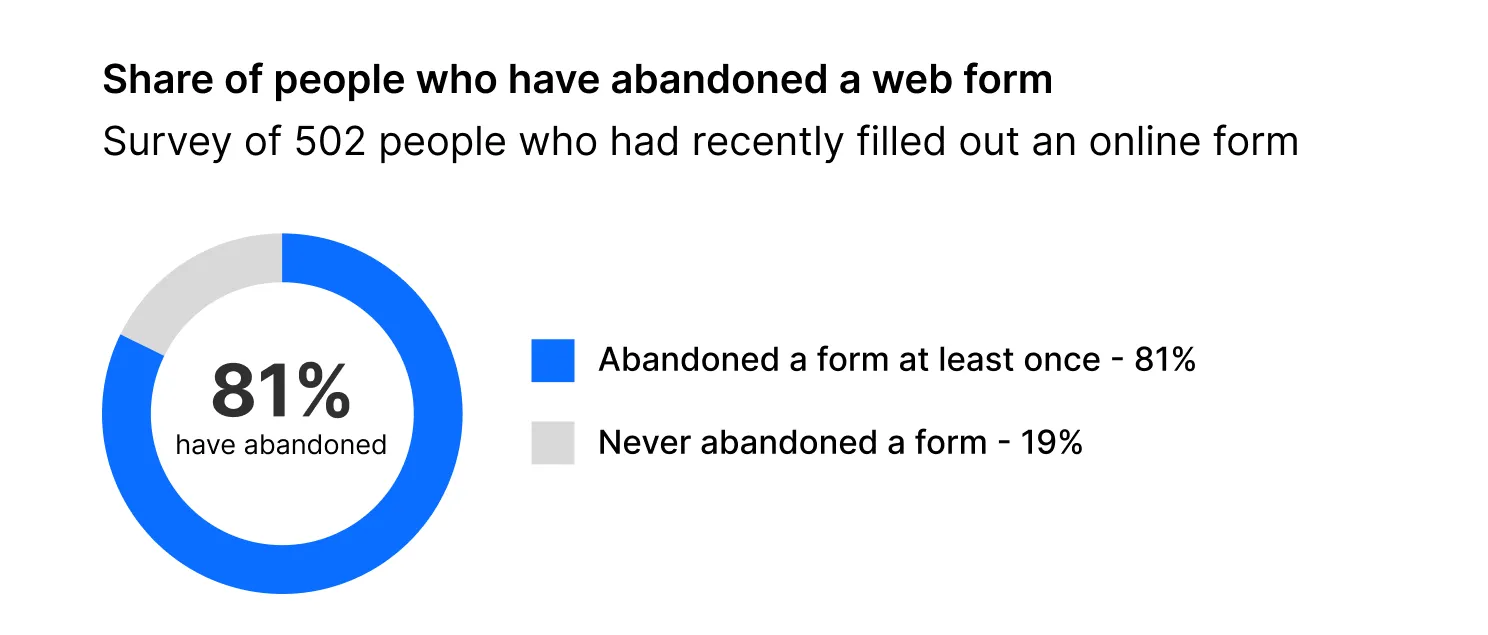
A B2B website typically gets a steady flow of visitors, but very few of them identify themselves. Recent data on 1.2 million identified B2B website sessions found that more than 97% never submitted a form. These visitors read pages, compare pricing, and research options, then leave without leaving any contact trail.
A chatbot addresses this gap directly. Instead of waiting for a visitor to fill out a form, it starts a conversation, asks a few relevant questions, determines whether the visitor is a good fit, and routes that information to sales in real time.
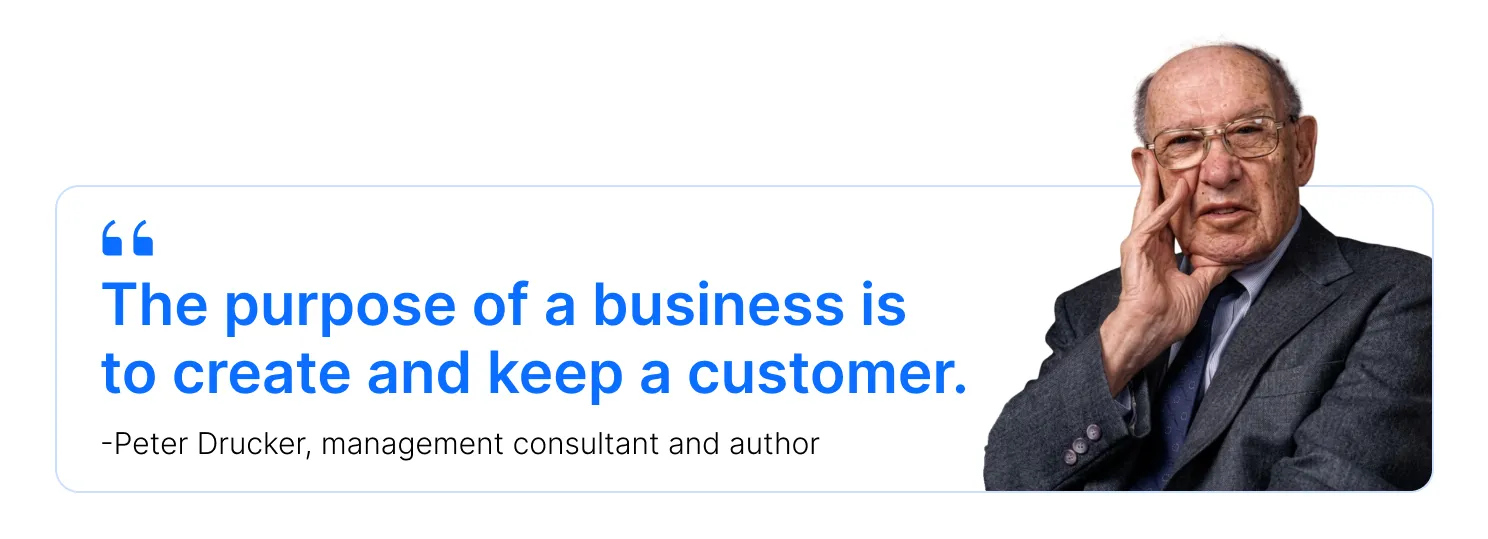
It’s a decades-old line, but it’s still the best filter for judging a chatbot. A tool that just answers questions is being helpful. A tool that turns a conversation into a customer is doing the actual job of your sales team.
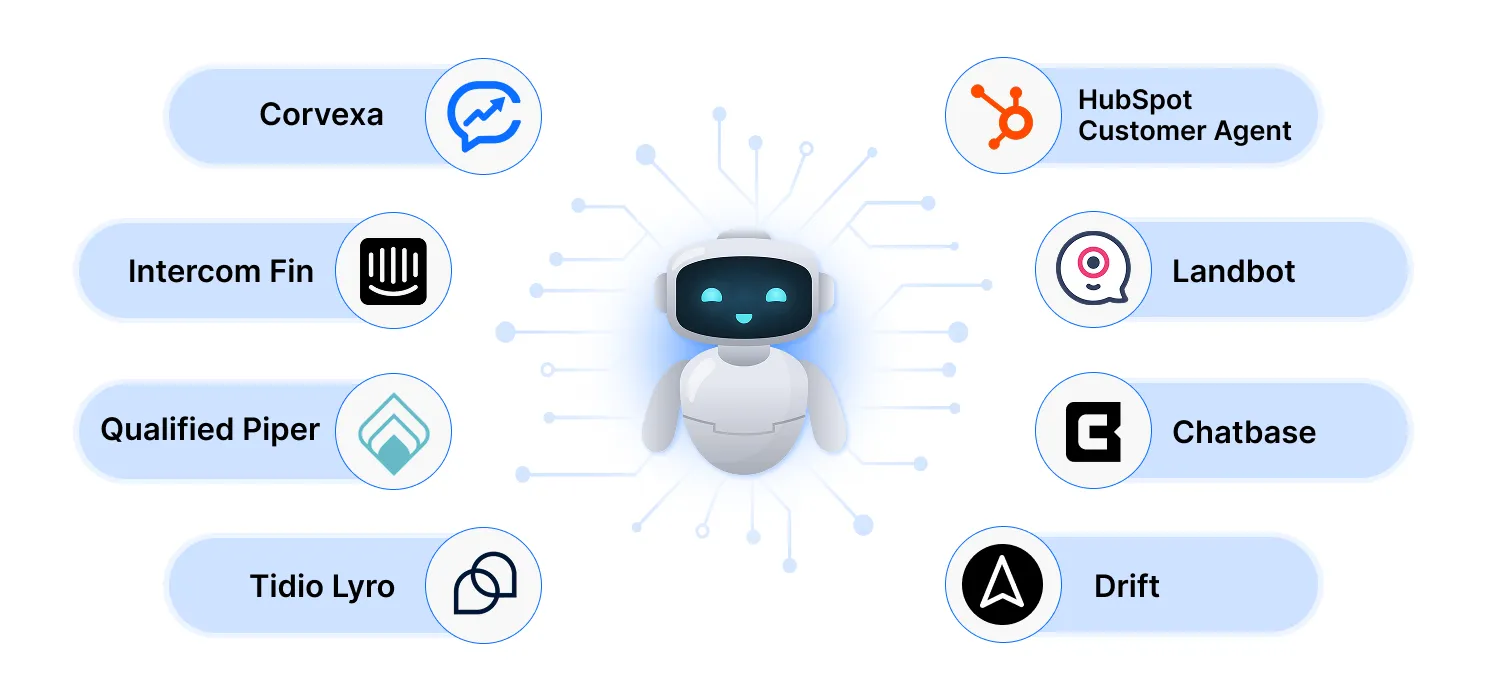
A B2B AI chatbot is software installed on a website that holds a live, guided conversation with visitors, instead of only presenting a static contact form.
For example, instead of asking:
- Name
- Company
- Message
a B2B AI chatbot might ask what the visitor is looking for, understand their requirements, answer questions about the product, identify whether they fit the company’s target customer, and then suggest the next step.
That next step could be:
B2B buying journeys are rarely as simple as: Visitor → chatbot → sale
A visitor might first arrive to understand a problem.
Then they might:
The chatbot needs to fit into that journey.
This is where lead qualification becomes important.
A chatbot that simply answers:
“Yes, we integrate with Salesforce.”
may be useful.
But a chatbot that can continue with:
“Are you currently using Salesforce?”
and then understand the visitor’s use case, qualification criteria, and preferred next step is much more useful to a B2B sales team.
That distinction is important when comparing the tools below.
Research shows 67% of B2B buyers prefer to research and compare options on their own before speaking with a salesperson.
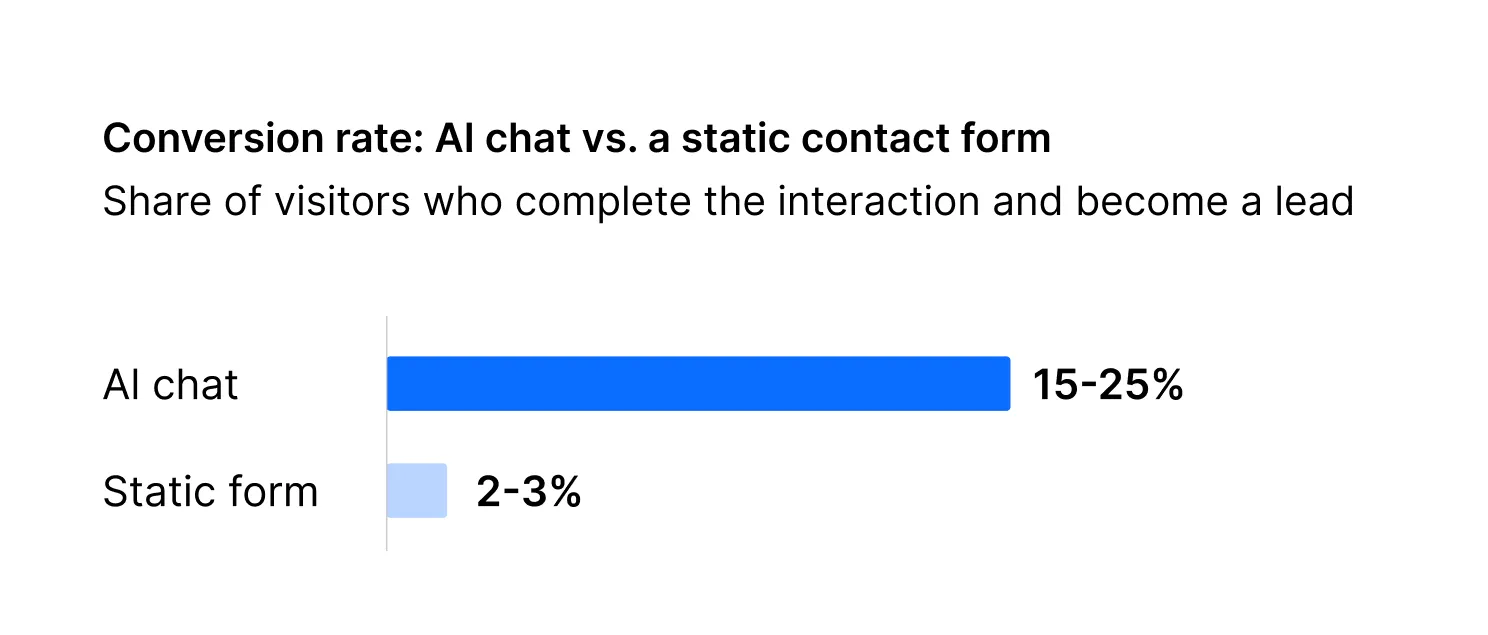
This is why conversation quality matters more than conversation volume. A chatbot that only answers the question it’s asked is helpful but limited. A chatbot that asks a relevant follow-up question and adjusts based on the answer is doing the qualifying work of a sales rep, and the data shows that approach converts at a meaningfully higher rate than a static form.
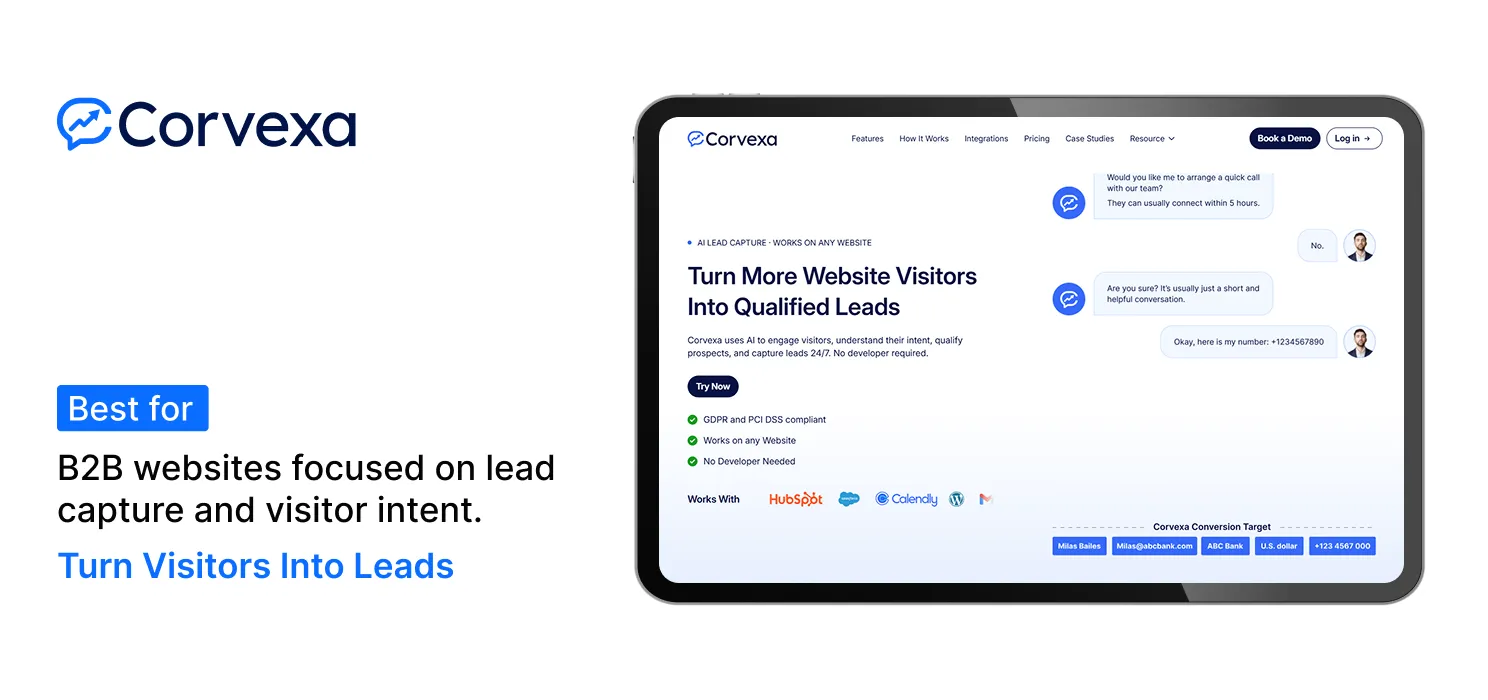
Best for: B2B websites focused on lead capture, qualification, and visitor intent
Corvexa is built specifically around the problem of turning website visitors into qualified leads.
Its positioning is straightforward: AI lead capture that works on any website. Corvexa engages visitors, understands their intent, qualifies prospects, and captures leads 24/7 without requiring a developer.
Instead of treating every visitor the same, Corvexa can use questions and intent signals to understand what a visitor actually wants.
What Corvexa can do
Its integrations page lists HubSpot, Salesforce, Calendly, email, the Corvexa dashboard, WhatsApp, Slack, Zoho, Google Calendar, GoHighLevel, custom CRM systems, and multiple website platforms.
Why B2B teams may consider Corvexa
The key difference is the emphasis on website visitor qualification rather than simply answering questions.
A B2B company can use the chatbot to move from: anonymous visitor → conversation → qualification → lead → sales action
That makes it particularly relevant for SaaS companies, agencies, professional services, technology companies, and other businesses where a website visit can become a sales opportunity.
Corvexa pricing
Pricing is structured around Starter, Pro, and Enterprise plans, with the Starter plan positioned for smaller businesses and conversation limits based on the selected plan.
The supplied site material also promotes a free trial with no credit card requirement, cancellation flexibility, and included setup.
Best fit: Companies that want their website chatbot to act as a lead qualification layer rather than just an FAQ assistant.
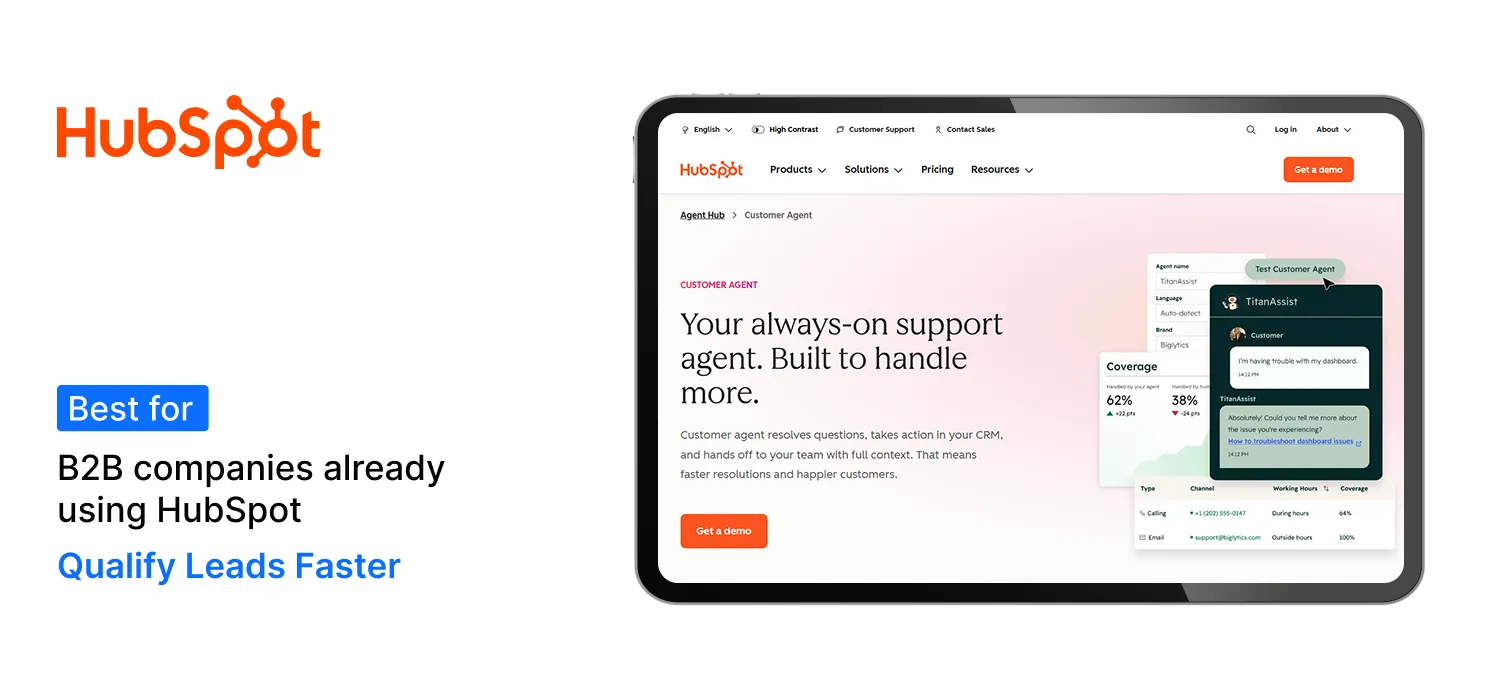
Best for: B2B companies already using HubSpot
HubSpot’s Customer Agent is closely connected to its broader CRM ecosystem.
The agent can engage visitors, answer questions, qualify prospects, capture contact information, and book meetings. HubSpot also allows businesses to define qualification criteria and configure the agent to evaluate and route prospects.
That CRM connection is the biggest reason a HubSpot-heavy sales organization may consider it.
Key capabilities
HubSpot also offers a chatbot builder that can create chatbot sequences without coding, qualify leads, book meetings, and use contact data from its Smart CRM.
Best fit: Businesses already invested heavily in HubSpot and looking for chatbot functionality inside the same ecosystem.
Watch out for: Teams that don’t use HubSpot may not get the same ecosystem advantage.
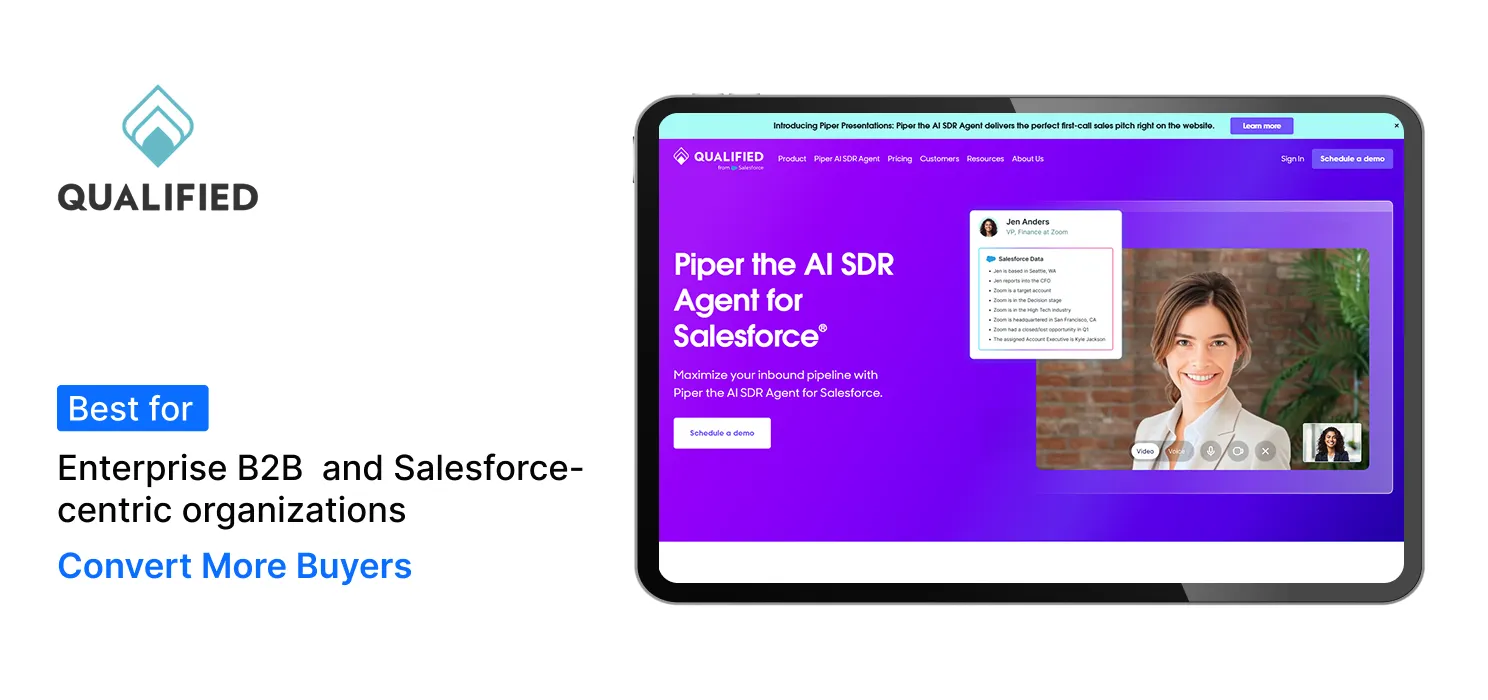
Best for: Enterprise B2B revenue teams and Salesforce-centric organizations
Qualified takes a more sales-focused approach.
Its AI SDR, Piper, engages website visitors, captures leads, and converts qualified buyers into pipeline. Qualified says Piper can work through video, voice, or live chat and connect website conversations with email follow-up.
The platform also focuses heavily on buyer context, qualification criteria, routing rules, and account information.
Key capabilities
Qualified reports that Piper has been adopted by more than 500 companies, according to its own website.
Best fit: Enterprise revenue teams with sophisticated account-based sales processes.
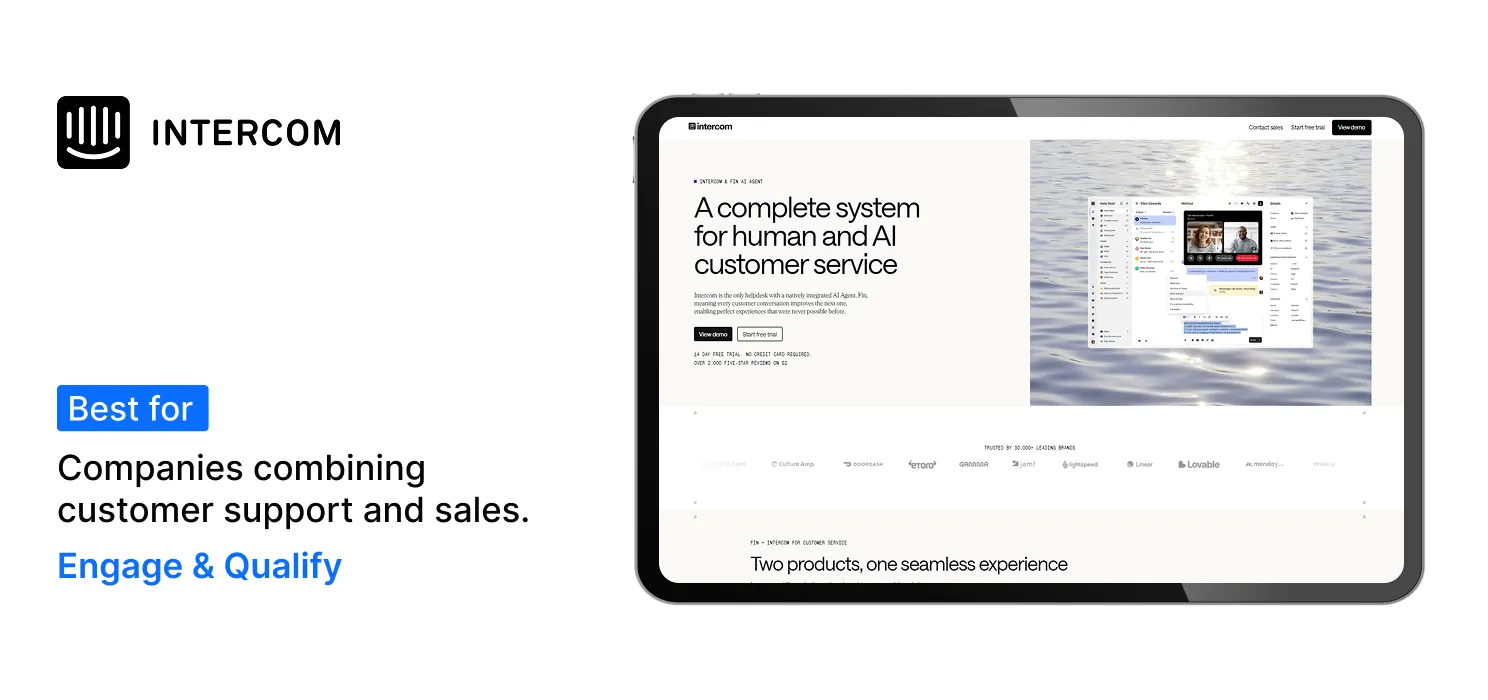
Best for: Companies that need both customer support and sales conversations
Intercom’s Fin has traditionally been associated with AI customer service, but its current positioning extends across the customer journey.
Intercom says Fin can switch between specialized roles, including service and sales. Its Sales role can engage prospects, conduct discovery, qualify them, book meetings, and sync with CRM systems.
Key capabilities
This makes Intercom interesting for businesses where the same conversational layer needs to support both prospects and existing customers.
Best fit: SaaS and product-led businesses where customer support and sales conversations need to live within the same platform.
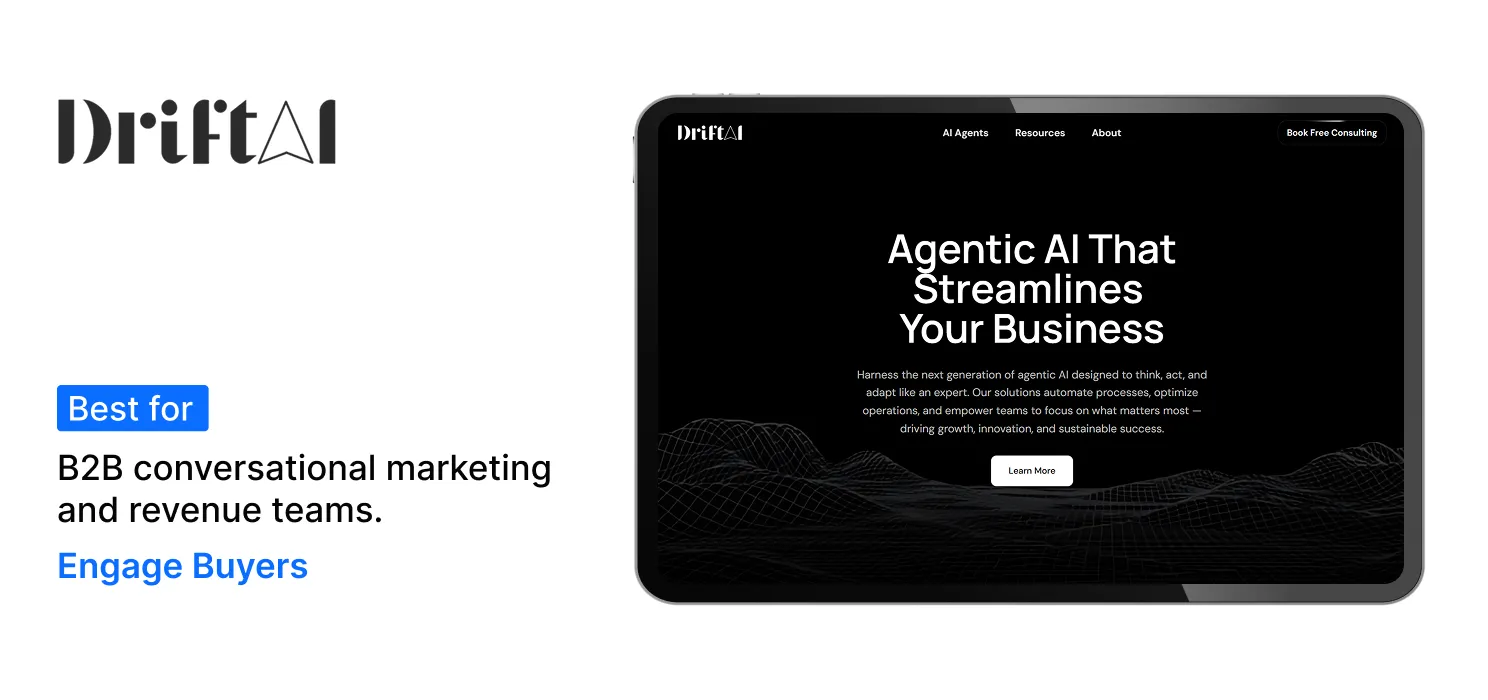
Best for: B2B conversational marketing and revenue teams
Drift remains a recognizable name in B2B conversational marketing.
Its current Bionic Chatbots are designed to answer website visitor questions, engage buyers, identify buying signals, and support revenue workflows. Salesloft says its Bionic Chatbots are trained on a company’s brand, content, and website and are designed to increase lead quality and conversions.
There is an important historical context buyers should know: Drift experienced a security incident in 2025 and was temporarily taken offline. Salesloft’s trust center says the Drift application was brought back online in September 2025 after remediation work, with additional integrations restored over time.
Best fit: Established B2B revenue teams already familiar with Drift’s conversational marketing approach.
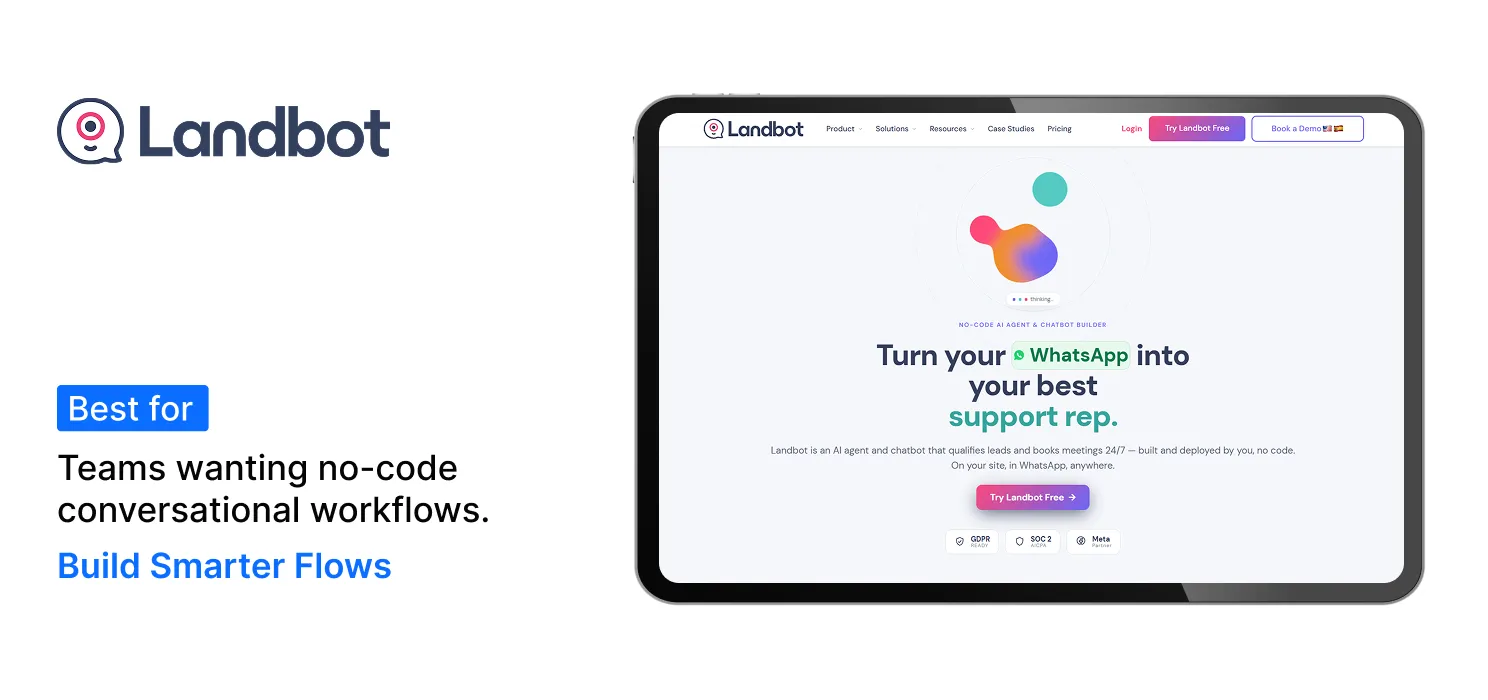
Best for: Teams that want no-code conversational workflows
Landbot combines AI agents with a visual chatbot builder.
Its current platform is designed for website and WhatsApp conversations, including lead qualification, meeting booking, CRM scoring, and sales workflows.
One useful distinction is that Landbot gives teams substantial control over how conversations are built.
It can be useful when a marketing or operations team wants to create and adjust its own conversational workflows without waiting for developers.
Key capabilities
Landbot says teams can create an AI agent using its visual builder or AI Copilot and deploy it without an engineering ticket.
Best fit: Marketing and revenue teams that want control over conversational flows without heavy development work.
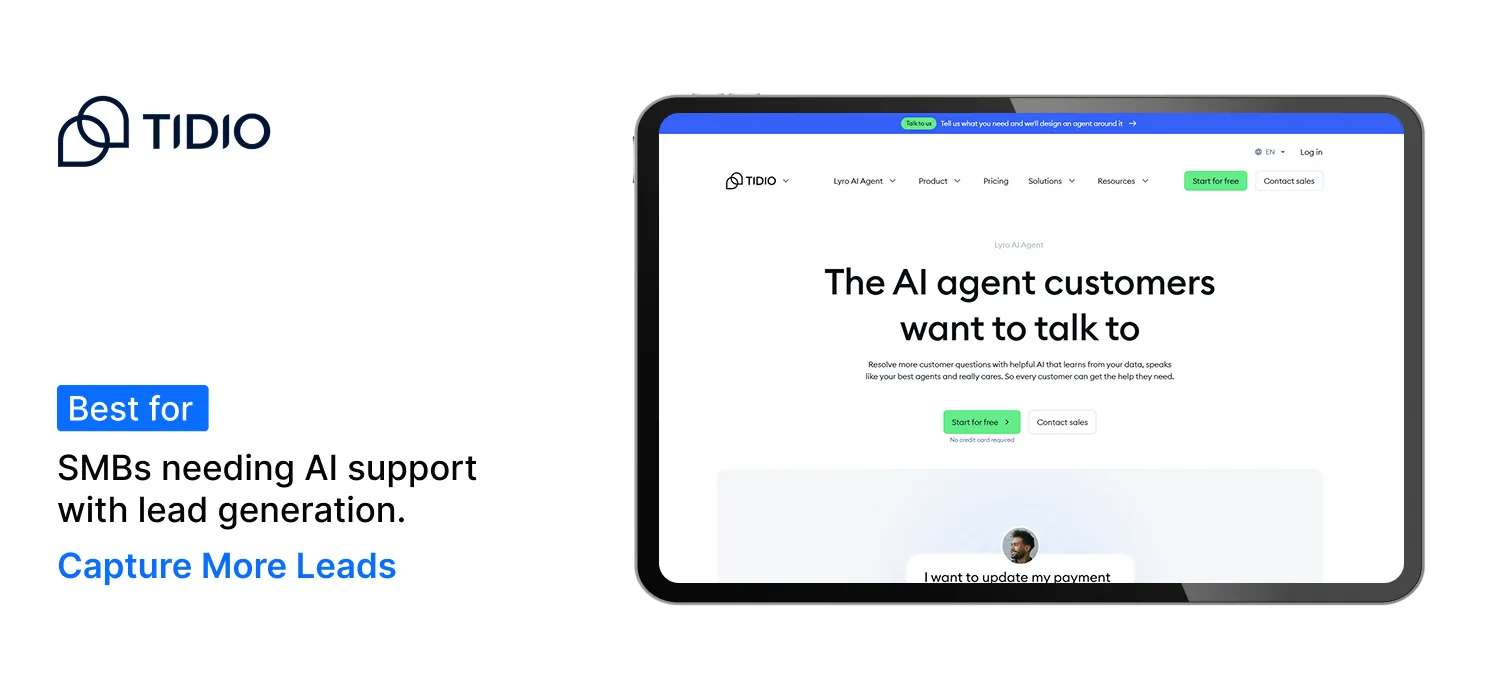
Best for: SMBs that need AI support with some lead-generation capability
Tidio’s Lyro is primarily positioned as a conversational AI agent for customer service, but it also supports lead generation and appointment workflows.
Tidio says Lyro can use company data sources, handle customer conversations, hand conversations to human agents, and collect prospect information.
Lyro can also proactively start conversations based on triggers, rather than waiting for visitors to ask a question.
Key capabilities
Tidio also provides a limited free Lyro quota for testing.
Best fit: Smaller teams that want customer support automation with lead-generation features.
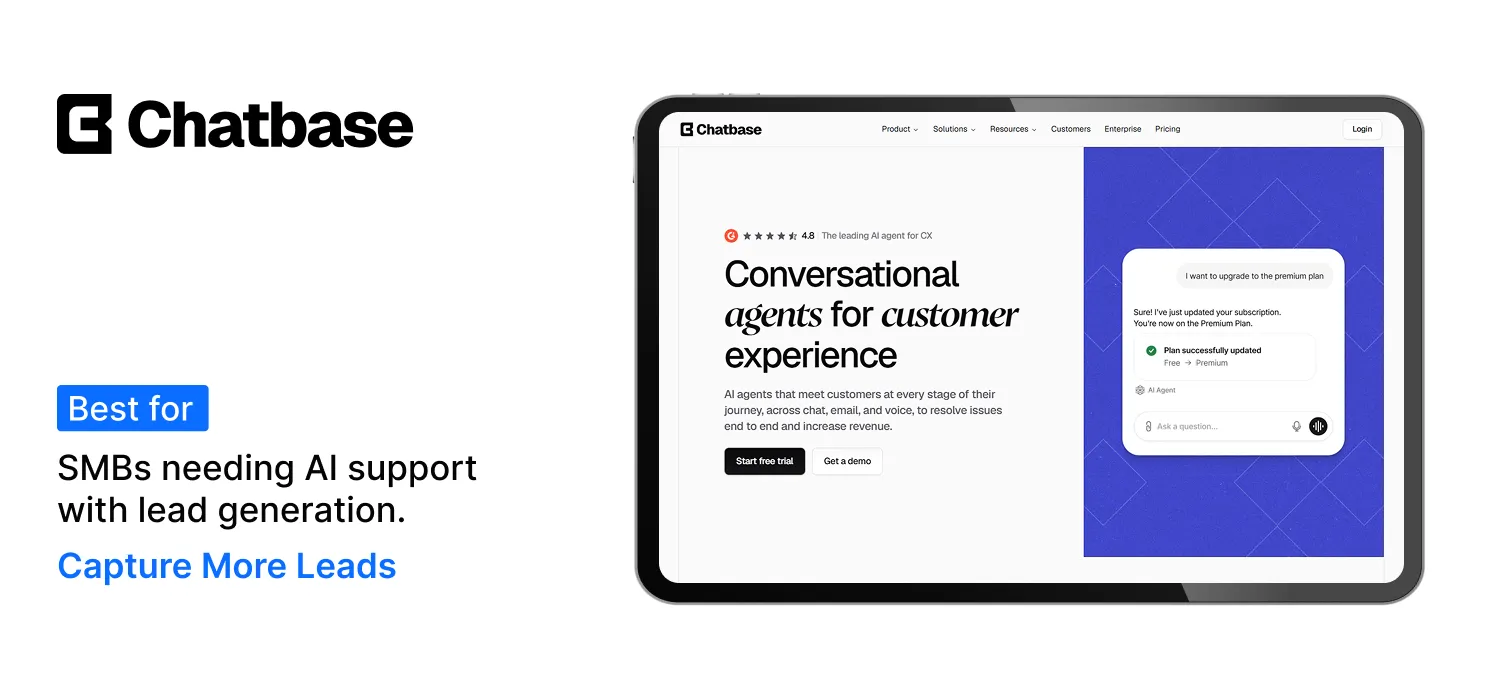
Best for: Teams that want to build a knowledge-based AI chatbot
Chatbase is another option worth considering when the primary requirement is creating an AI assistant around company information.
For B2B companies, this type of chatbot can be useful for:
The important distinction is that knowledge-based answering and B2B lead qualification are not necessarily the same thing.
If the main requirement is “answer questions about our company”, this type of platform can make sense.
If the requirement is “identify which website visitors are sales-ready and route them to the right sales action”, qualification and revenue workflow capabilities become more important.

| Platform | Main focus | Lead qualification | CRM/workflow focus | Best suited for |
|---|---|---|---|---|
| Corvexa | Lead capture + qualification | Yes | Strong | B2B websites |
| HubSpot Customer Agent | CRM + sales + service | Yes | Strong within HubSpot | HubSpot users |
| Qualified Piper | AI SDR + pipeline | Yes | Strong | Enterprise revenue teams |
| Intercom Fin | Support + sales | Yes | Strong | SaaS/product teams |
| Drift | Conversational marketing | Yes | Strong | B2B revenue teams |
| Landbot | No-code AI workflows | Yes | Flexible | Marketing/ops teams |
| Tidio Lyro | Support + lead capture | Yes | Moderate | SMBs |
| Chatbase | Knowledge-based AI chat | Knowledge-based AI chat | Flexible | FAQ/knowledge use cases |
The table should be treated as a functional comparison, not a ranking. Each product is designed around somewhat different use cases.

Choosing a chatbot based only on how naturally it talks can lead to the wrong purchase.
For B2B websites, check these capabilities first.
Can the chatbot ask questions that actually matter to your sales process?
For example:
A chatbot should do more than collect an email address.
Where does the lead go after the conversation?
Look for integrations with tools your sales team already uses.
Examples include:
Corvexa’s supplied integration information specifically lists HubSpot, Salesforce, Zoho, GoHighLevel, custom CRM connections, and webhook/API support.
If a visitor is qualified, the next step should not require another form.
A good chatbot can move the visitor directly toward:
Qualification → meeting
Platforms such as Corvexa support Calendly and Google Calendar connections for this workflow.
AI should not be the end of the conversation.
There will always be situations where a prospect wants to talk to a person.
Check whether the platform can:
This is especially important for B2B.
A visitor asking:
“What is your refund policy?”
has a different intent from someone asking:
“Can you integrate this with our existing Salesforce setup?”
The second visitor may be much further into the buying process.
Your chatbot should be able to recognize those differences.
Before choosing a platform, check whether it works with your website.
Corvexa’s supplied information says it can be deployed on WordPress, Webflow, Shopify, and custom-built websites using a single script tag.
This matters because a chatbot that requires a complete website rebuild creates unnecessary friction.
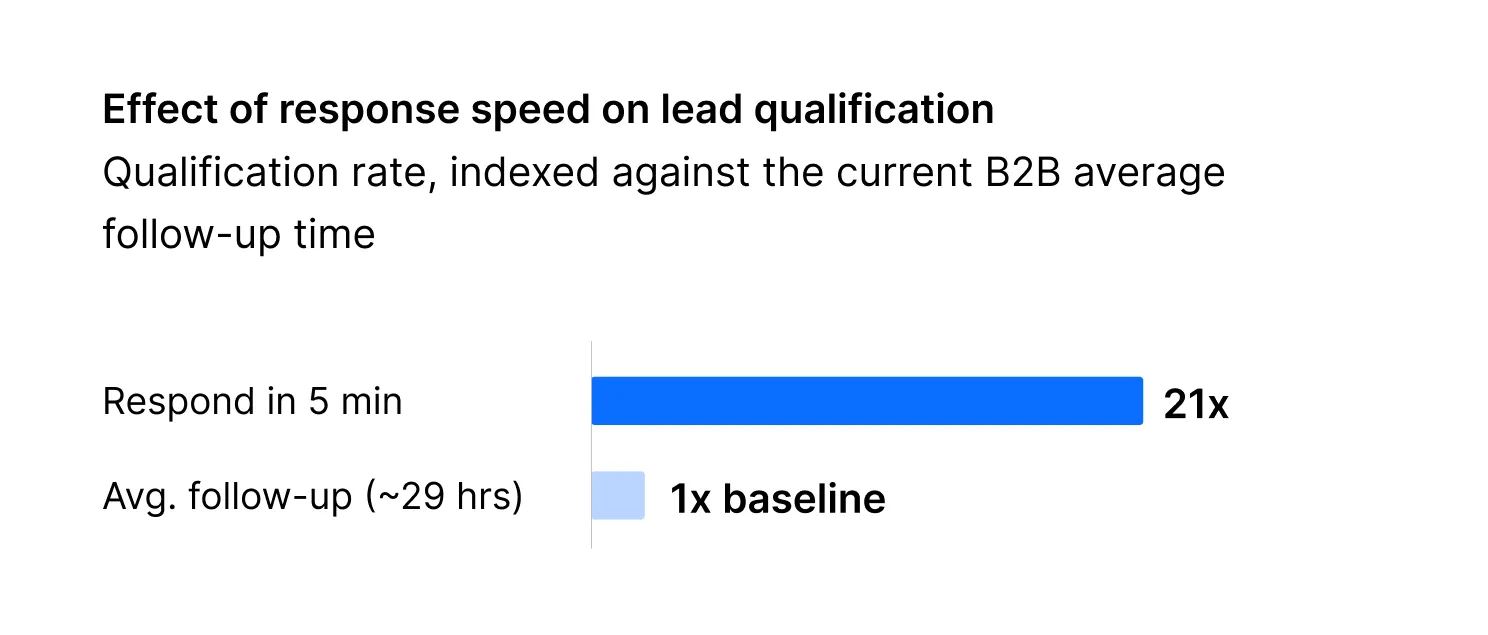
This is where the category is changing.
A traditional chatbot generally does this:
Visitor → Question → Answer
A B2B AI sales agent can go further:
Visitor → Conversation → Intent → Qualification → Lead score → CRM → Meeting
That difference matters.
If your website is primarily a support center, a customer-service-focused chatbot may be enough.
If your website is one of your main sales channels, you may need a system designed around qualification and revenue workflows.
Why Corvexa is built differently
Corvexa’s approach is centered on a specific problem:
Your website already has visitors. The challenge is identifying which visitors have buying intent and turning those conversations into qualified opportunities.
Its supplied product information describes Corvexa as an AI lead-capture system that engages visitors, understands intent, qualifies prospects, and captures leads 24/7.
The platform also supports multiple ways to move a qualified conversation forward, including CRM synchronization, email delivery, Slack notifications, WhatsApp, calendar booking, and custom CRM connections.
That makes it worth considering when your primary goal isn’t simply:
“How can we answer more website questions?”
but:
“How can we identify and act on the buying intent already present on our website?”
There is no single B2B AI chatbot that fits every company.
The right choice depends on what you want the chatbot to accomplish.
If your priority is CRM-connected conversations, HubSpot may make sense for teams already operating inside its ecosystem.
If you need enterprise AI SDR capabilities, Qualified is designed around that use case.
If customer support is a major part of the requirement, Intercom and Tidio offer strong customer-conversation capabilities.
If you want to build highly customized no-code conversational workflows, Landbot is another option.
And if your main requirement is capturing, understanding, qualifying, and routing website visitors as sales opportunities, Corvexa is built specifically around that workflow.
The important thing is to choose based on the job you need the chatbot to perform, not simply on how impressive the chatbot demo looks.
What is the best AI chatbot for B2B websites?
The right AI chatbot depends on your use case. For B2B companies, important factors include lead qualification, CRM integration, meeting booking, visitor intent detection, human handoff, and analytics.
What is a B2B AI chatbot?
A B2B AI chatbot is a conversational AI tool that interacts with business website visitors, answers questions, captures information, and can qualify prospects or move them toward a sales action.
Can AI chatbots qualify B2B leads?
Yes. Modern B2B AI chatbots can ask qualification questions, evaluate visitor responses against defined criteria, collect contact information, and route qualified prospects to sales workflows. HubSpot, Intercom, Qualified, Corvexa, Landbot, and Tidio all describe lead qualification or related capabilities in their current product documentation.
Can a B2B chatbot book meetings?
Yes. Several platforms support meeting-booking workflows through tools such as Calendly or native calendar functionality. Corvexa’s supplied integration information includes Calendly and Google Calendar.
Can AI chatbots replace B2B sales teams?
They are better viewed as an automation layer rather than a complete replacement for sales teams. They can handle repetitive questions, collect information, qualify visitors, and route opportunities, while human salespeople can take over when the conversation requires judgment or a deeper sales discussion.
Should a B2B website use a chatbot or a contact form?
They can work together. A contact form is useful when visitors already know they want to contact sales. A chatbot can engage visitors earlier, answer questions, understand intent, and guide qualified visitors toward the appropriate next step.
What integrations should a B2B chatbot have?
At minimum: your CRM (HubSpot, Salesforce, or similar), a calendar tool for booking meetings, and a way to alert your team in real time, like Slack or email.

| Sources |
Authored by Corvexa
This blog is authored by the Corvexa team, with expertise in AI, B2B sales, lead generation, and conversational marketing. Drawing from hands-on experience building AI-powered lead capture and qualification solutions, the team shares research-backed, practical insights to help businesses better understand their website visitors and convert more opportunities into qualified leads.
Explore Corvexa to see how AI can help capture and qualify leads from your website.
 Best AI Chatbot For B2B Websites: 8 Tools Compared
This blog settles the AI agent vs chatbot debate with real 2026 data rather than marketing buzzwords. You’ll learn the...
This blog breaks down real 2026 pricing for custom AI agent development, from simple single-task agents to full enterprise multi-agent...

Website traffic is one of the easiest marketing metrics to measure. You can see how many people visited your website,...