
 11 Mins Read

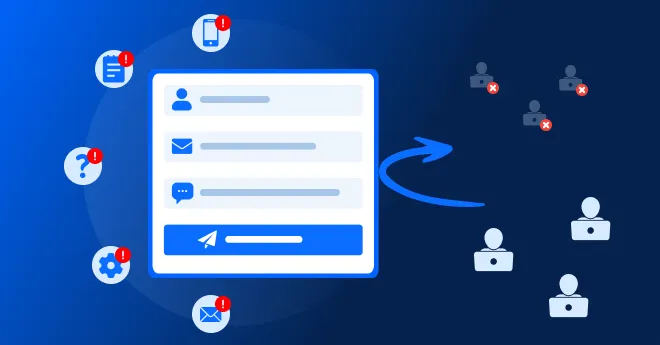
7 Reasons Your Contact Form Is Losing Leads and How to Fix Them
Quick summary Contact forms convert views into submissions at only around 9%, one of the lowest rates of any form...

In this guide, we’ll look at what an AI lead capture chatbot actually is, how it works, what makes one useful for B2B, what information it should capture, how lead qualification works, where human sales teams fit in, how CRM integrations change the workflow, what mistakes to avoid, and how to decide whether your business actually needs one.
A visitor reads your product page, checks pricing, explores a case study and then leaves without filling out a form. To your analytics, they’re just another visitor. But they could have been a potential buyer.
That’s where an AI lead capture chatbot comes in. Instead of simply collecting names and emails, it answers questions, recognizes buying intent, qualifies visitors, and passes valuable leads to your sales team.
For B2B businesses, that difference can be significant.
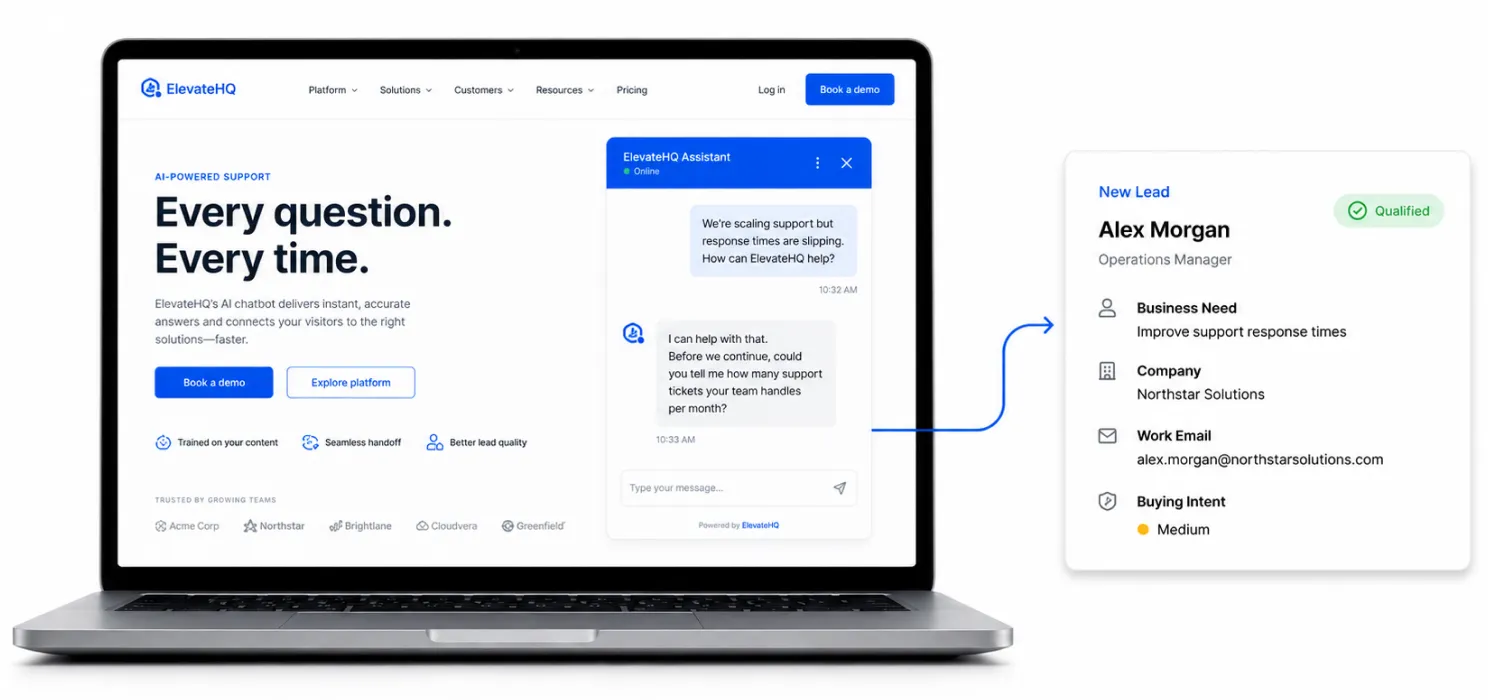
An AI lead-capture chatbot is a conversational system that uses artificial intelligence to engage website visitors, answer questions, identify buying intent, collect relevant information, and convert qualified conversations into sales opportunities.
The important word here is conversation.
A traditional lead form says:
Name
Work email
Phone
Company
Submit
An AI lead capture chatbot can approach the same process more naturally.
The chatbot didn’t simply collect an email address. It learned why the visitor was there.
That context is what makes AI lead capture particularly useful for B2B.

These terms are often used interchangeably, but they don’t necessarily mean the same thing.
A standard AI chatbot may primarily focus on:
An AI lead capture chatbot has another responsibility:
It needs to recognize when a conversation could become a sales opportunity.
That means it should be able to understand signals such as:
Those aren’t just questions.
They’re intent signals.
And in B2B, intent is often more valuable than a simple form submission.

A strong B2B system usually follows a sequence like this:
The visitor arrives on your website, and a website chatbot for lead generation can engage them at the right moment.
The chatbot can remain available for visitors who want it, while also using carefully chosen triggers to engage visitors at relevant moments.
The AI looks at the conversation and the context around it.
What is the visitor asking?
What page are they on?
What are they interested in?
Are they researching or actively evaluating?
The chatbot provides useful answers using your company’s approved information.
That might include:
Once buying intent becomes clearer, the chatbot can ask relevant questions.
For example:
Once the visitor is sufficiently engaged, the chatbot can collect contact information.
The system can classify the lead based on the signals collected.
For example:
High
Strong buying intent + good ICP fit + clear next step.
Medium
Relevant company + meaningful interest, but timing or requirements are unclear.
Low
General research + weak fit + no immediate buying signal.
The qualified lead goes where your sales team already works.
That might be:
Or the visitor may be directed straight to a calendar to book a meeting.
If the conversation reaches a point where human judgment is valuable, a sales representative can take over.
That’s the complete loop.
Engage → Understand → Qualify → Capture → Score → Route → Follow up

This is where many implementations go wrong.
They ask too many questions.
Imagine visiting a website and immediately seeing:
What’s your name?
What’s your company?
What’s your email?
What’s your phone number?
What’s your industry?
What’s your budget?
How many employees?
What’s your timeline?
That’s not a conversation.
It’s a form wearing a chatbot costume.
Instead, questions should follow the conversation.

Not every business needs the same data, but most B2B chatbots should focus on five areas:

Here’s one of the biggest advantages of AI over traditional forms.
Your chatbot can answer questions using your existing business knowledge.
Think about the information already sitting on your website:
A visitor shouldn’t have to search through all of those pages to find one answer.
They can ask. “Do you integrate with HubSpot?”
The AI should be able to answer.
Then, if the conversation indicates genuine interest, it can continue naturally.
This turns your website content into something more interactive.
Instead of: Content → Visitor reads
you get: Content → Visitor asks → AI answers → Intent develops → Lead captured

Capturing a lead is only half the job.
The next question is: Where does the lead go?
If your chatbot captures a qualified lead and leaves the sales team with an email notification buried in someone’s inbox, you’ve created another manual process.
That’s why CRM integration matters.
An AI lead capture chatbot can pass information into systems such as:
The sales team can then receive: Lead → Score → Contact details → Conversation → Intent → Next step
instead of: “Someone filled out a form. Good luck.”

Imagine your salesperson opens HubSpot and sees:
Sarah Patel
Company: ABC Software
Lead Score: High
Interest: AI lead capture
Company Size: 120
Timeline: Within 30 days
Intent: Comparing vendors
Conversation: Asked about HubSpot integration and implementation
Next Step: Demo requested
That salesperson already knows how to approach the conversation.
They don’t need to spend the first five minutes asking:
“So, what brought you to us?”
They can start where the visitor left off.

Visitors rarely say, “I’m a high-intent buyer.” Instead, they reveal intent through their questions.
The AI should understand the meaning and context behind these signals, not just match keywords.
| Traditional Form | AI Lead Capture Chatbot |
|---|---|
| Static | Conversational |
| Same fields for everyone | Questions can adapt |
| Visitor decides to submit | Can engage proactively |
| Captures contact details | Can capture intent + context |
| Limited qualification | Conversational qualification |
| Usually one-way | Two-way conversation |
| Sales receives a form | Sales can receive conversation context |
| Best for direct conversion | Best for discovery + qualification |

Live chat connects visitors with humans, which is valuable—but humans aren’t available 24/7.
Visitors may arrive late at night, on weekends, holidays, or from different time zones. An AI lead capture chatbot can engage them immediately, answer questions, and capture their details until a human can take over.
The result is simple: AI availability + human expertise.

A customer-support chatbot is optimized around existing customers and their problems.
An AI lead capture chatbot is optimized around potential customers and their buying journey.
Support asks: “How do I reset my password?”
Lead capture asks: “Is this product right for my company?”

Treating It Like a Form: Asking for too much information upfront defeats the purpose.
Being Too Aggressive: Constant pop-ups and sales prompts can drive visitors away.
Using Generic Knowledge: The AI needs to understand your products, customers, positioning, and sales process.
Not Defining Your ICP: Without a clear ideal customer profile, effective qualification is difficult.
Capturing Leads Without Context: A name and email alone rarely give sales enough information.
No Human Handoff: The chatbot should know when to bring a sales representative into the conversation.
Ignoring CRM Workflows: Leads should move directly into the right sales workflow.
Measuring Only Lead Volume: Focus on qualified opportunities, not just the number of conversations.
Making It Sound Robotic: Conversations should feel natural, not like a decision tree.
Expecting AI to Close Everything: AI should engage, qualify, and route leads while sales handles high-value conversations.

Before choosing a platform, ask these questions.
Can you provide:
Can you specify:
Not just keywords.
Actual buying context.
Can questions change based on what the visitor says?
Will sales see the conversation or just an email address?
And can they do it without losing the conversation?
Look for systems that fit your existing workflow rather than forcing your sales team to adopt another disconnected dashboard.
For many B2B teams, direct calendar booking can remove an unnecessary step between interest and sales conversation.
This is especially important for pricing, product claims, compliance, and other sensitive information.

This is where the difference between a generic chatbot and a purpose-built B2B lead engine becomes clearer.
Corvexa isn’t positioned simply as a chatbot that answers website questions. Its workflow is built around the complete path from visitor intent to qualified lead.
See how Corvexa works and how the platform connects visitor conversations with lead qualification and sales workflows.
Corvexa’s onboarding begins with understanding who the company sells to, how its sales process works, and what a qualified lead actually means.
That’s important because a B2B chatbot should not be configured in isolation from the sales process.
A lead that is valuable to one company may be completely irrelevant to another.
Corvexa can crawl selected website content and use additional business knowledge, including PDFs and specific Q&A information, so the agent can answer questions using the company’s own information.
That means the chatbot isn’t simply operating as a generic AI assistant.
It has a business context to work with.
Corvexa’s AI Lead Qualification profile lets businesses define characteristics such as:
That creates a qualification layer between:
Visitor and Sales lead
The objective isn’t to treat everyone equally.
It’s to recognize the visitors who are most relevant.
Corvexa can answer visitor questions using the knowledge configured for the business while collecting useful information through the conversation.
The system is designed to capture details such as:
Instead of asking visitors to stop what they’re doing and complete a long form, the information can be collected as part of the conversation.
Corvexa can identify direct buying signals and hot keywords.
For example, a visitor saying:
“I want to book a demo.”
is different from someone asking:
“What does your company do?”
That distinction can affect how the conversation proceeds.
High-intent visitors can be moved more directly toward lead capture or a sales action.
When the conversation needs a salesperson, Corvexa provides a human takeover option.
The sales team can see conversations through the Chat Sessions inbox and take control when necessary.
Once the human conversation is complete, the interaction can be returned to the AI.
This creates a simple division of work:
AI handles scale.
Humans handle judgment.
Corvexa’s workflow can connect with tools such as:
Qualified leads can include contact information, lead scores, page context and conversation history.
That means sales doesn’t just receive:
“New lead.”
They can receive a much more useful picture of why that lead matters.
An AI lead capture chatbot is more than a smarter contact form. It turns your website into an active part of the sales process.
A good chatbot can: Engage → Understand → Answer → Qualify → Capture → Score → Route → Escalate to sales
This matters because B2B buyers increasingly research independently and use AI before speaking with sales.
The goal isn’t AI instead of sales. It’s AI helping buyers get answers faster while helping sales teams identify high-intent opportunities earlier.

 The Definitive Guide to AI Lead Capture Chatbots for B2B

Quick summary Contact forms convert views into submissions at only around 9%, one of the lowest rates of any form...
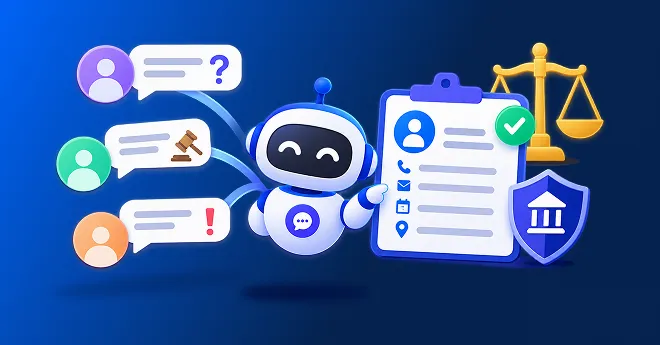
Quick summary: People who need a lawyer often search late at night and contact the first firm that answers. This...
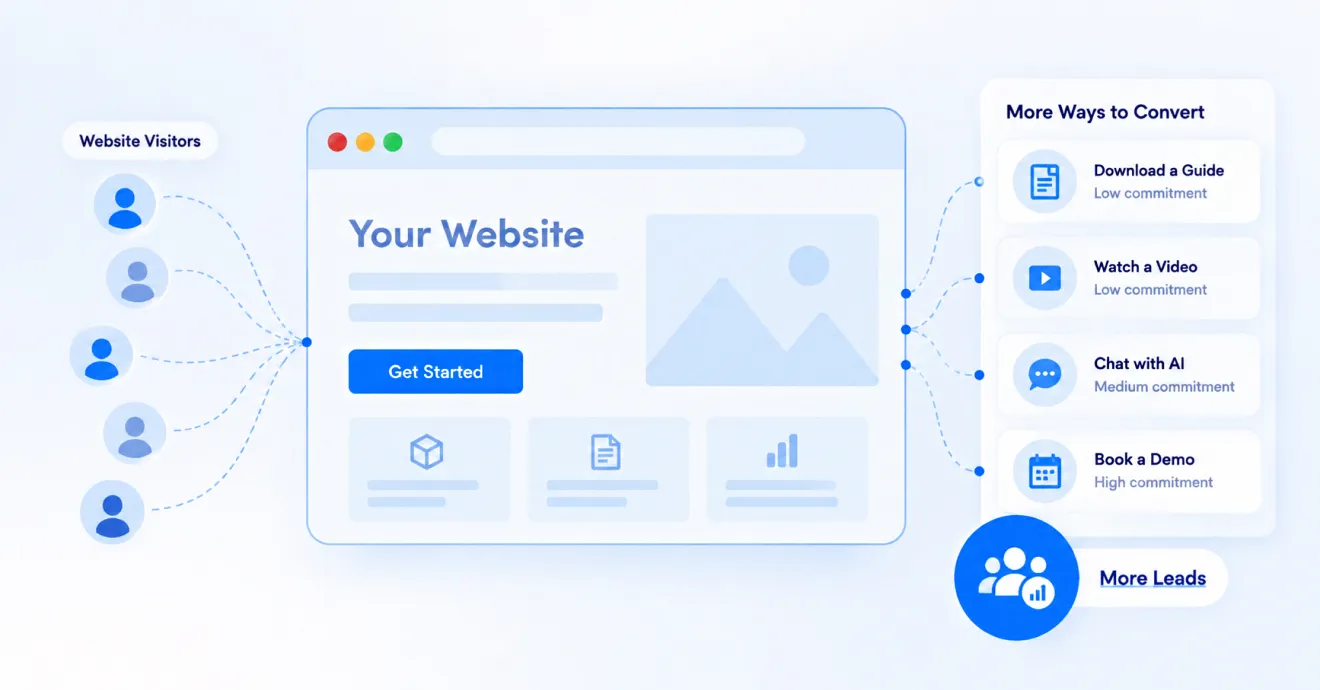
You don’t need a bigger ad budget to get more leads. You need your website to do a better job...