
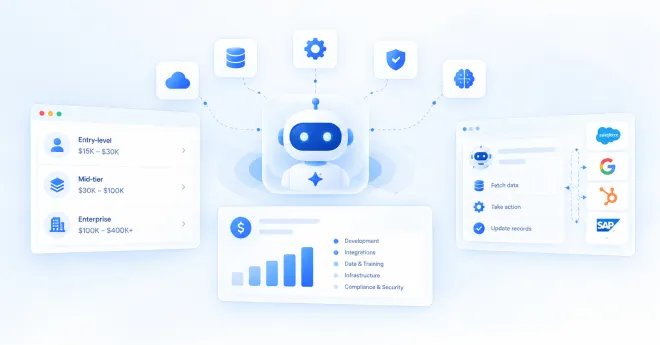
How Much Does It Cost to Build a Custom AI Agent? (Real Pricing Breakdown)
This blog breaks down real 2026 pricing for custom AI agent development, from simple single-task agents to full enterprise multi-agent...

 9 Mins Read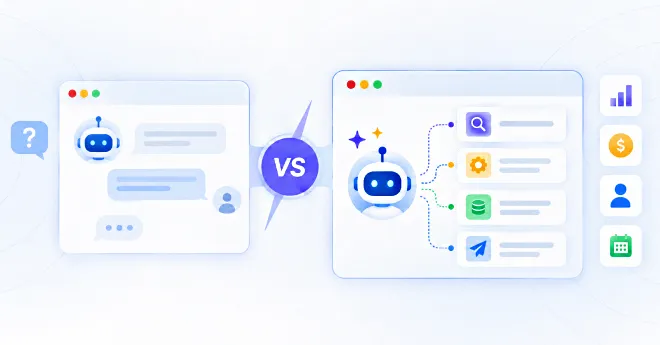
This blog settles the AI agent vs chatbot debate with real 2026 data rather than marketing buzzwords. You’ll learn the actual architectural difference between the two, which one drives measurable revenue growth, when a chatbot is genuinely the smarter budget call, and how to figure out which fits your business before you spend a dollar.
There’s a comparison table, real adoption statistics, and an FAQ section covering the exact questions buyers ask before choosing.
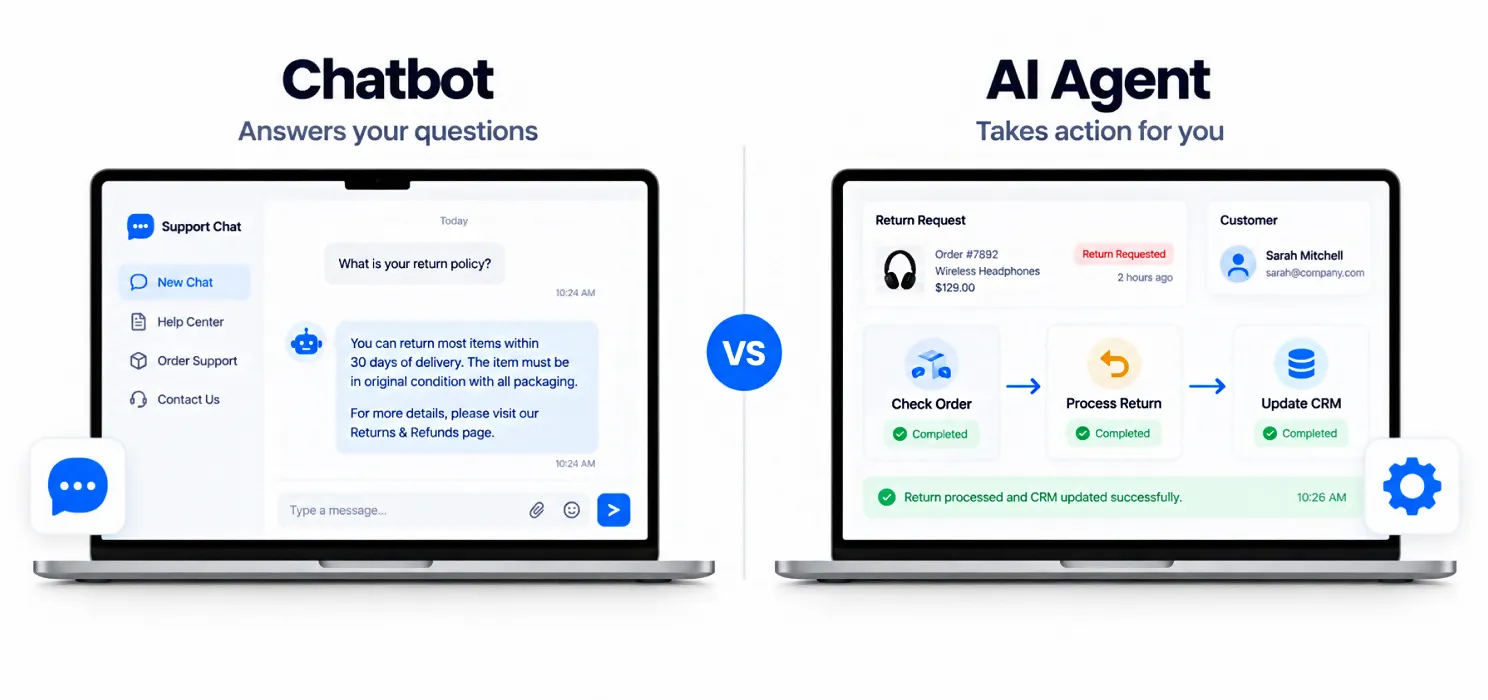
Chatbots talk. Agents work.
That’s the short version, but it’s worth unpacking because vendors blur this line constantly in pitch decks. A chatbot is a reactive system; it waits for input, processes it, and generates a response from a script or a knowledge base. Even a modern AI chatbot for website visitors, powered by a large language model, is still fundamentally answering questions.
An AI agent is different by design. It reasons through a goal, chains multiple actions together, and executes across systems without a human clicking “next” at every step. A chatbot might tell a visitor your return policy. An AI agent can check their order status, process the return, and update the CRM, all in one motion.
Gartner’s framing captures this well: by the end of 2026, roughly 40% of enterprise applications will incorporate some form of agentic AI, up from under 5% just a year earlier. That’s not a rebrand. It’s a genuinely different category of software.
This is where the data gets interesting, and where a lot of budgets have been misallocated.
In 2026, 80% of enterprises that deployed AI agents reported measurable ROI. For enterprises that deployed chatbots only, that number drops sharply. The gap isn’t about model quality; both often run on similar underlying LLMs. It’s architectural. Chatbots reduce a support ticket. Agents can eliminate the need for the ticket to exist in the first place.
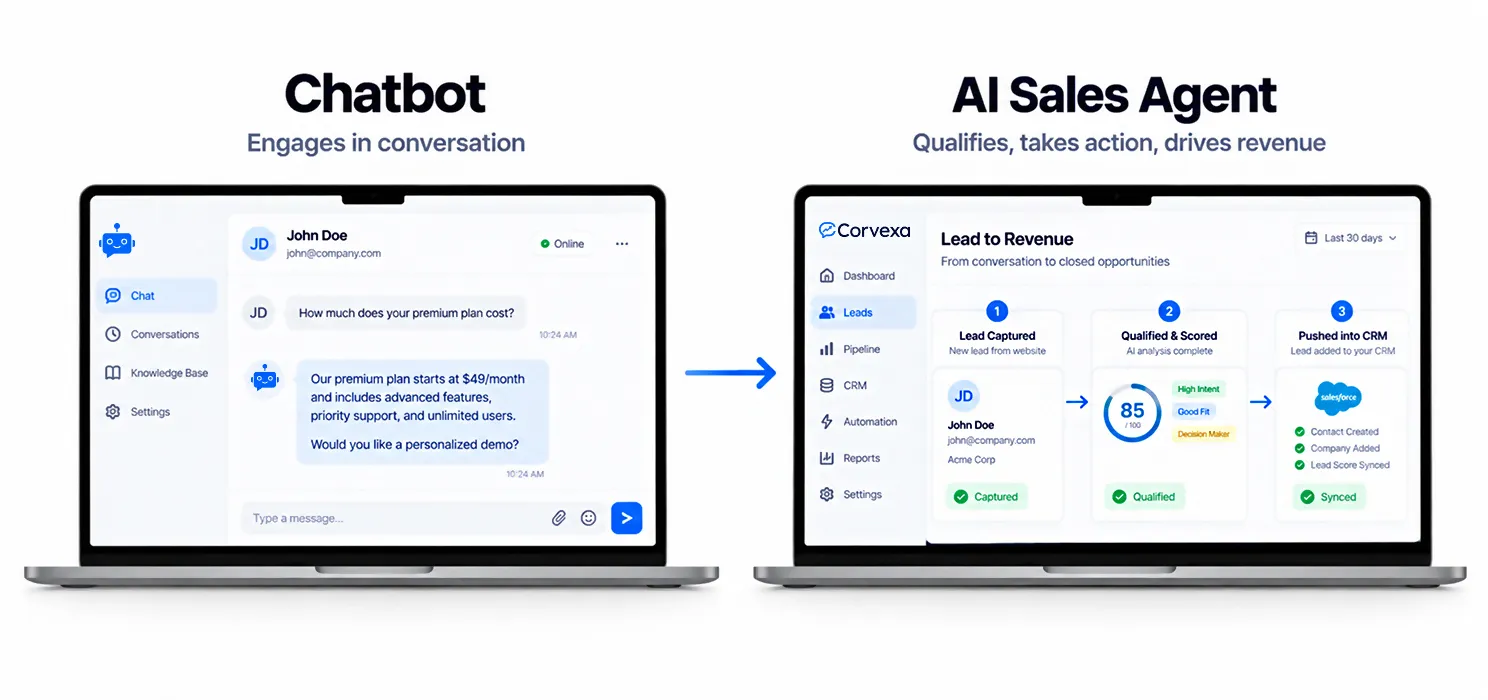
That distinction matters most in revenue-facing roles. A chatbot answering pricing questions might improve engagement slightly. An AI sales agent that qualifies a lead, scores it against your ideal customer profile, and pushes it into your CRM the moment it’s ready is directly shortening your sales cycle, not just improving a conversation.
To be fair, this isn’t a blanket win for agents everywhere. PwC’s 2026 CEO survey found only 12% of CEOs report both revenue gain and cost reduction from AI overall, and over 40% of agentic AI projects are at risk of cancellation by 2027 due to unclear ROI or weak governance. The technology works but only when it’s pointed at the right problem.
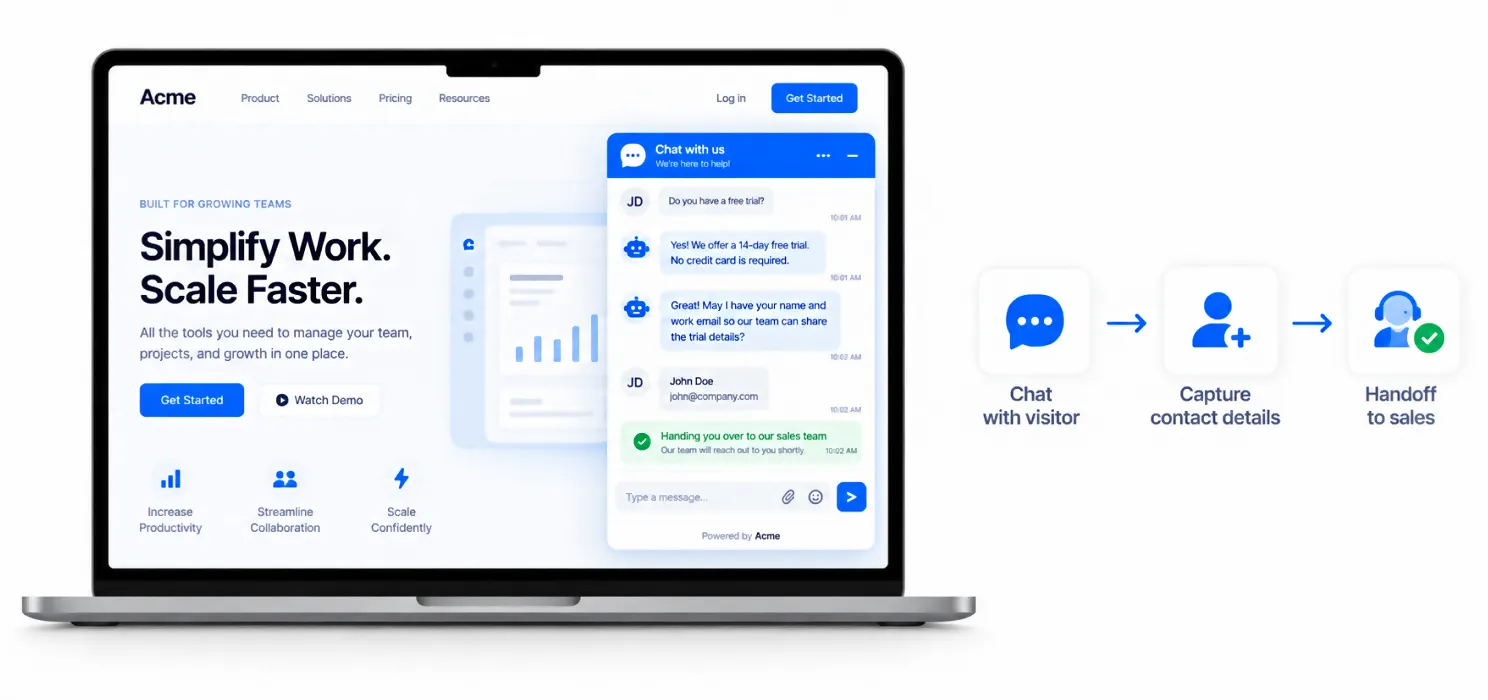
Not every business needs an agent, and pretending otherwise wastes budget just as badly as underinvesting.
Chatbots remain the better fit when the job is genuinely conversational: answering FAQs, capturing contact details, routing conversations, or handling high-volume, repetitive questions. AI chatbots can now manage up to 80% of routine customer inquiries, and adoption has grown roughly 4.7x since 2020 because for that specific job, they’re cheap, fast to deploy, and require no complex integrations.
If your goal is an AI chatbot for lead generation, capturing a name, email, and intent before handing off to a human, a well-built chatbot does that job completely. Bolting on agentic complexity for a task this simple just adds cost without adding value.
The mistake isn’t choosing a chatbot. It’s choosing one when the actual need was multi-step action, or choosing a custom agent when a chatbot would have solved it for a fraction of the price.
Since sales and lead handling is where this decision gets made most often, here’s how the two actually compare on the criteria that matter for revenue:
| Factor | Chatbot | AI sales agent |
| Core job | Answers questions, captures leads | Qualifies, scores, and routes leads automatically |
| Typical setup time | Days | Weeks to months |
| Works inside your CRM | Usually limited | Deep AI chatbot CRM integration as standard |
| Best for | High-volume FAQs, initial capture | Multi-step qualification, follow-up, pipeline movement |
| ROI pattern | Cost savings on support volume | Directly shortens sales cycle, higher deal velocity |
Neither option is universally “better.” The table above is really a diagnostic: if your bottleneck is answering the same ten questions all day, you need the left column. If your bottleneck is leads sitting unqualified in a spreadsheet, you need the right one.
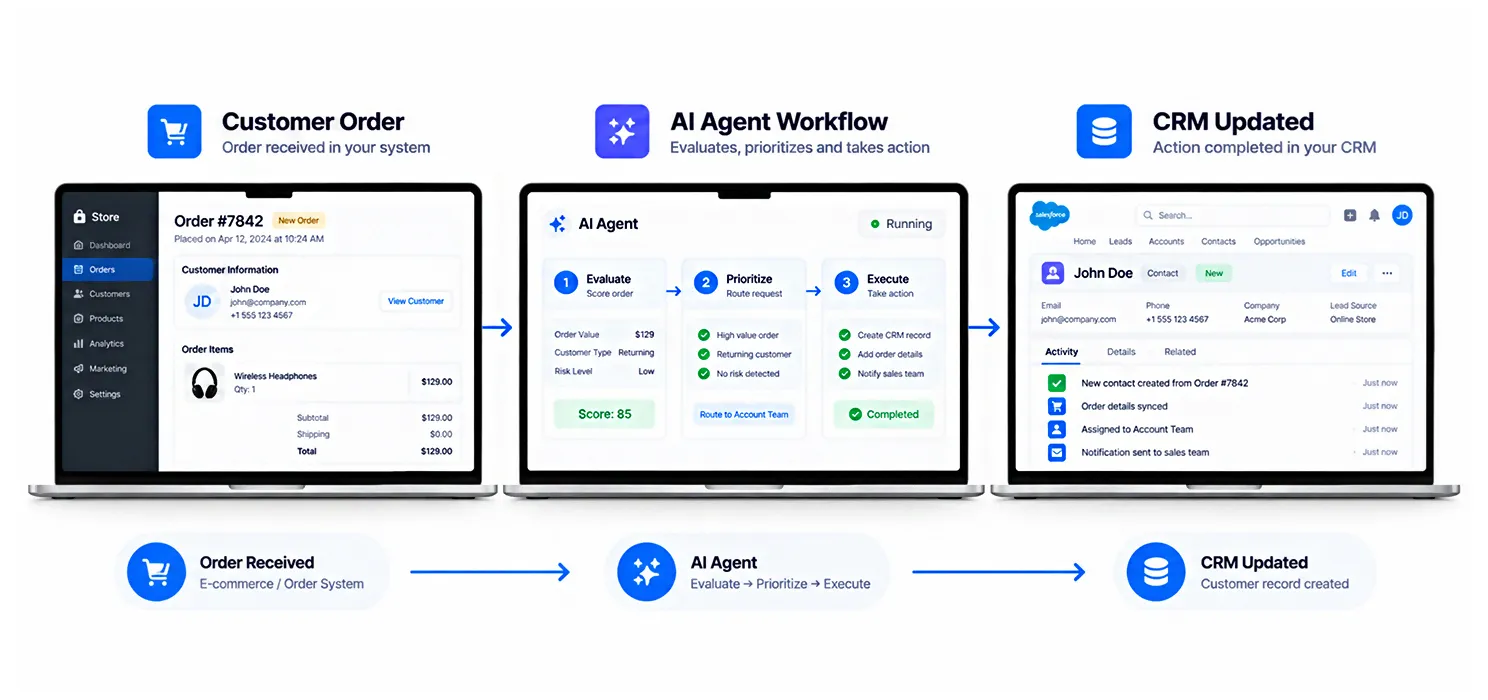
Custom agents cost more to build than a chatbot, so the investment only makes sense when the workflow is specific enough to your business that a generic tool can’t do it well.
A few signals it’s worth the jump:
If those apply, the ROI case tends to hold up. If you’re mainly answering questions and capturing leads at moderate volume, a chatbot solves it faster and cheaper, and you can always layer on AI lead qualification or AI lead scoring capability later without a full agent rebuild.
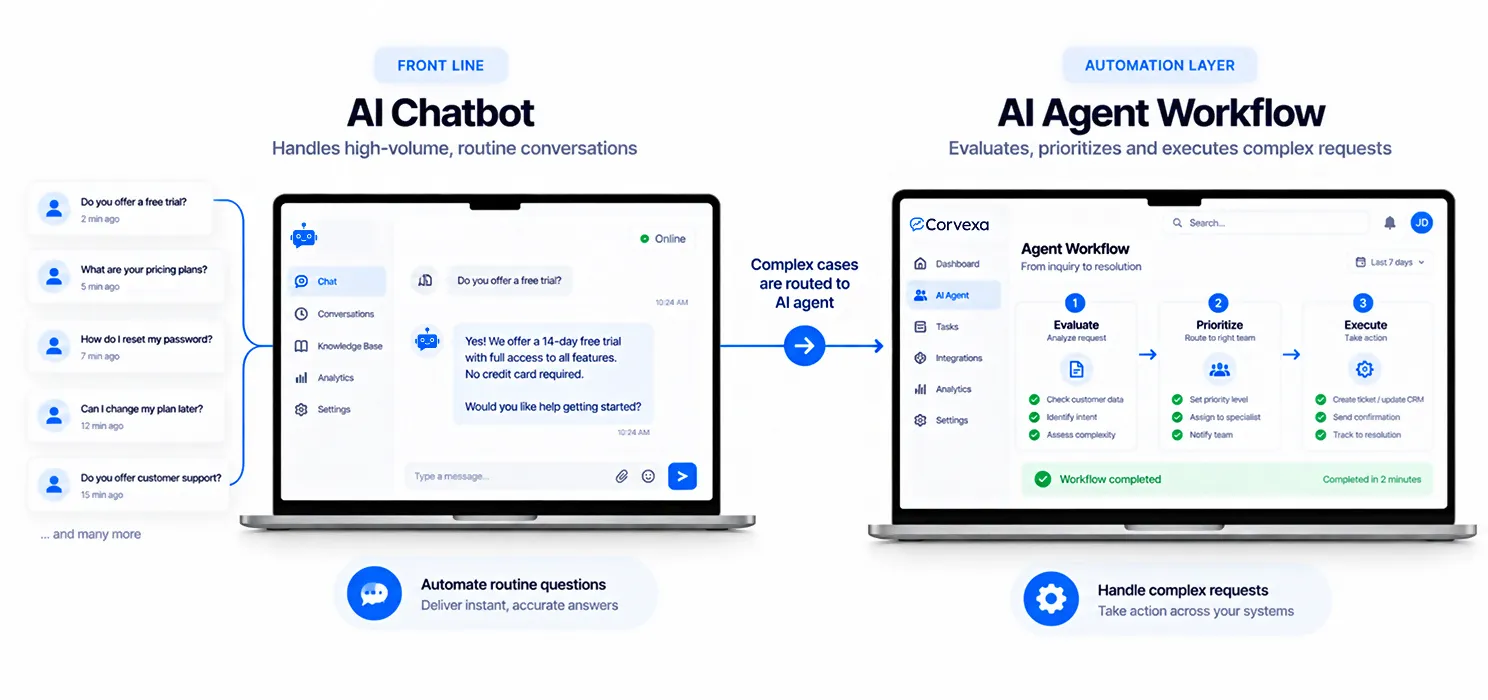
For most enterprises, the honest answer is: both, deployed in the right places, not one replacing the other.
McKinsey’s 2026 research found nearly two-thirds of enterprises have experimented with AI agents, but fewer than 10% have scaled them to deliver tangible value. The gap between experimentation and scale usually comes down to governance and clear business alignment, not the technology itself.
The enterprises seeing real returns tend to follow a consistent pattern: chatbots handle the high-volume, low-complexity front line, while agents are reserved for specific, well-scoped workflows with clear success metrics defined before a line of code gets written. Layering agentic capability onto every process, just because it’s possible, is exactly the pattern behind the 40% of agentic projects at risk of cancellation.
Consider a mid-sized B2B software company fielding inbound demo requests. Originally, a chatbot handled initial contact- a decent job, with a modest lift in captured leads.
The real bottleneck wasn’t the initial contact. It was that qualified leads sat untouched in a shared inbox for two to three days before a rep followed up, and by then, a third of them had gone cold.
Swapping the chatbot’s handoff for an AI sales agent that scored leads instantly and triggered same-day CRM alerts didn’t just improve a conversation; it cut the follow-up delay from days to minutes. That’s the kind of concrete workflow fix that produces the ROI numbers showing up in 2026’s enterprise data, and it’s a completely different outcome than a chatbot was ever built to deliver.
What is the main difference between an AI agent and a chatbot?
A chatbot is reactive; ve it responds to user input with an answer. An AI agent is proactive and goal-driven; it reasons through multi-step workflows, makes decisions, and executes actions across systems without needing a human at every step. Chatbots talk; agents work.
Do AI agents actually grow revenue more than chatbots?
In aggregate, yes. In 2026, 80% of enterprises deploying AI agents reported measurable ROI, compared to a significantly lower rate for chatbot-only deployments. The advantage comes from agents completing entire workflows rather than just answering a question that still requires human follow-through.
Is a chatbot ever better than an AI agent for a business?
Yes, when the job is genuinely conversational FAQs, initial lead capture, and high-volume repetitive questions. Chatbots are faster to deploy, cheaper, and handle up to 80% of routine inquiries effectively. Adding agentic complexity to a purely conversational task usually adds cost without adding value.
What are custom AI agents for business best used for?
Custom AI agents make the most sense for repetitive, multi-step workflows that involve judgment calls, lead scoring, qualification, CRM updates, or cross-system coordination,n especially when you’ve already automated the simpler parts with a chatbot and hit a ceiling.
Chatbot vs AI sales agent: which should a growing sales team choose?
If the bottleneck is answering repetitive questions or capturing initial contact info, a chatbot solves it. If the bottleneck is leads going unqualified or stalling before follow-up, an AI sales agent is built specifically for that; it qualifies, scores, and routes leads automatically rather than just starting the conversation.
What’s the best AI automation for enterprise-scale businesses?
Most enterprises get the best results from a combination of chatbots for high-volume front-line interactions and AI agents for specific, well-scoped workflows with clear success metrics defined upfront. McKinsey’s 2026 data shows fewer than 10% of enterprises have successfully scaled agents, largely due to weak governance rather than the technology itself.
Why do so many AI agent projects fail to deliver ROI?
Gartner projects that over 40% of agentic AI projects are at risk of cancellation by 2027, mainly due to unclear ROI, governance gaps, and immature tooling, not because the underlying technology doesn’t work. Projects succeed when they’re scoped to a specific business problem with measurable outcomes defined from the start.
 AI Agent vs Chatbot: Which One Actually Grows Revenue (And Which Is a Waste of Budget)?
This blog breaks down real 2026 pricing for custom AI agent development, from simple single-task agents to full enterprise multi-agent...

Website traffic is one of the easiest marketing metrics to measure. You can see how many people visited your website,...

Not every website visitor is a potential customer. Some people are browsing. Some are researching. Some are comparing different solutions....