
 8 Mins Read
How AI Sales Agents for Websites Help Convert More Visitors into Leads
Quick summary Most people who visit your website never fill in a form. An AI sales agent for websites talks...

| Quick summary Around 95% to 98% of website visitors leave without contacting you. This guide explains why website visitors don’t become leads, the seven most common conversion problems, and a simple five-step plan to fix them. You will also see how an AI chatbot can catch visitors your forms miss. |
Imagine 1,000 people walk into your shop this week. Twenty-four of them talk to you. The other 976 look around and leave.
You would not accept that in a physical store. Yet it is normal for websites. You pay for ads, write content, and improve SEO, and then most of the traffic quietly disappears.
This guide explains why. More importantly, it shows how to convert website visitors into leads without spending more on traffic.
It is, and if anything, the number is conservative. A 2026 benchmark compilation reports that theaverage website converts at 2.35%, while top pages reach 11.45% or more. At 2.35%, about 97 out of every 100 visitors do nothing.
B2B software is often lower.SaaSHero reports a typical median visitor-to-lead rate of 1.5% to 2.5% for B2B SaaS. So a headline of “95%” is a fair, careful round number. The real figure is often 97% or 98%.
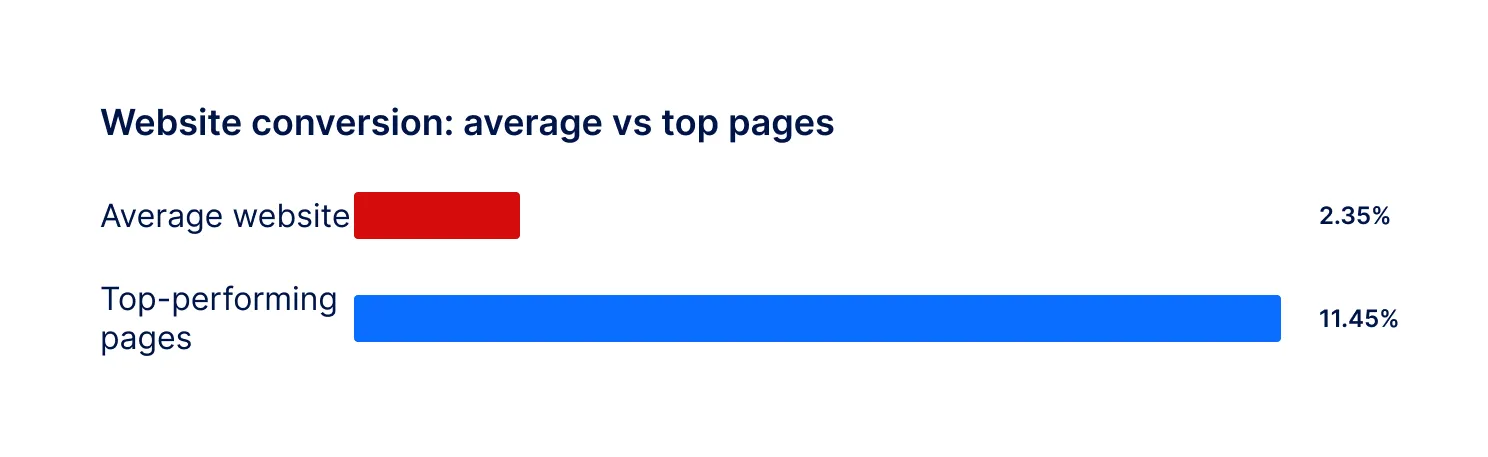
The good news is the gap. Top pages convert about five times better than average, and the difference comes from experience and design, not from more traffic. That means you can improve results with the visitors you already have.
Website visitor conversion problems usually come from a few repeat causes. Let’s go through them.
1. They are not ready to talk yet
Most buyers research first and speak to sales late. G2’s 2026 survey of 1,076 software buyers found that51% now start research with an AI chatbot more often than Google. By the time they reach your site, they want quick, specific answers, not a call booking.
2. Your pages are slow, especially on mobile
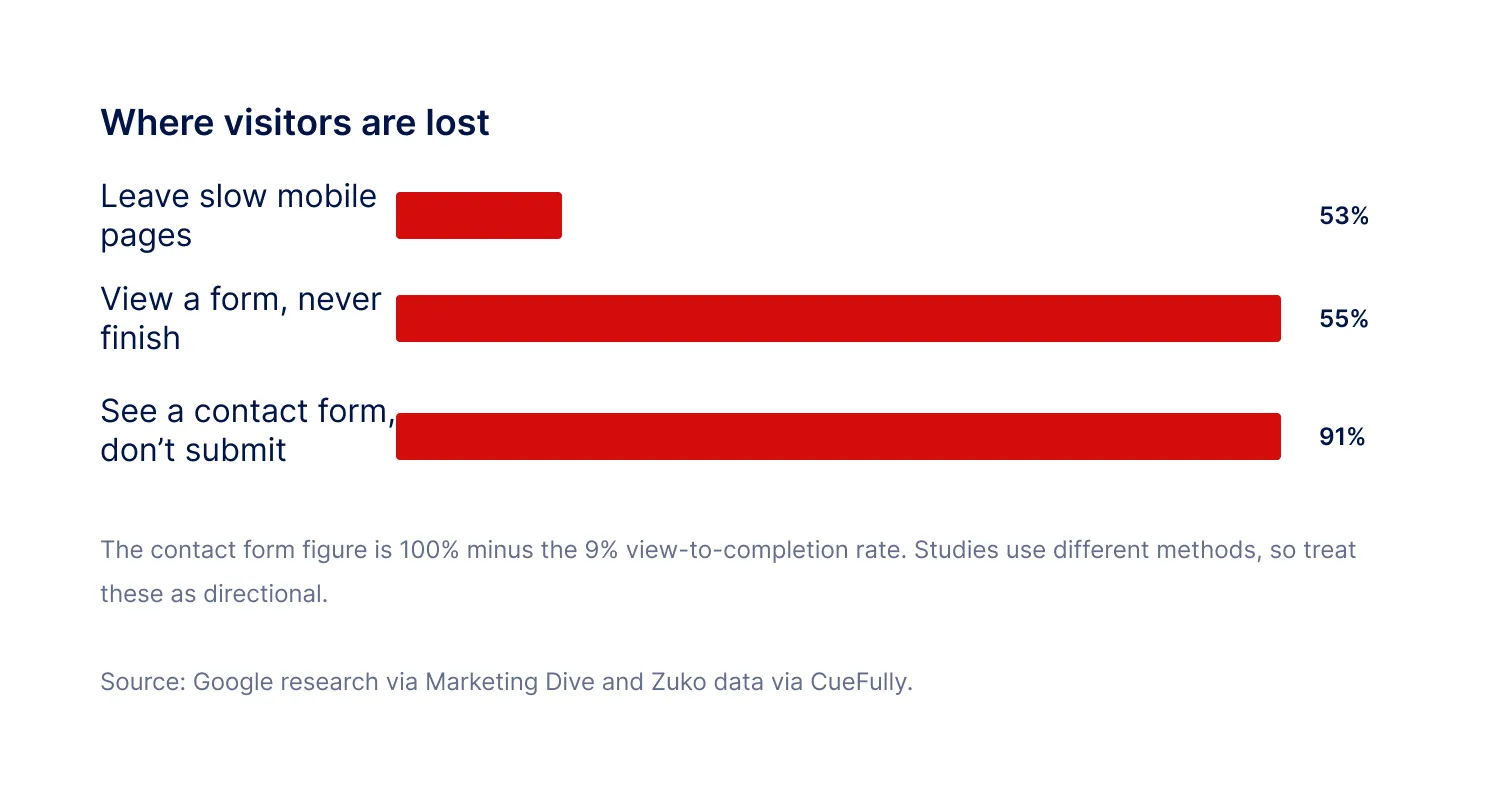
Google research found that53% of mobile visitors leave if a page takes more than three seconds to load. A visitor who leaves in the first three seconds never sees your offer, no matter how good it is.
3. Forms feel like work
A form asks for effort before giving anything back. Data from Zuko, reported byCueFully, shows 55% of people who view a form never complete it, and contact forms have a view-to-completion rate of only about 9%.
4. Nobody answers the question in their head
“Does it work with my tools?” “What does it cost for 20 users?” If the answer is not obvious, the visitor will not send an email and wait. They will check a competitor instead.
5. They cannot tell if you are right for them
Vague headlines and generic pages make visitors think. If they cannot see who you help and how, they leave.
6. They do not trust you yet
No proof, no faces, no clear next step. Trust signals such as customer stories and clear policies matter, especially for B2B buyers spending real money.
7. Your follow-up is too slow
Even visitors who do fill in a form get ignored. Harvard Business Review found that firms that responded to a web lead within an hour werenearly seven times as likely to qualify it, yet the average reply among companies that responded took 42 hours, and 23% never replied.

Use this table as a quick diagnosis. Find the row that sounds like your site.
| Problem | What the visitor thinks | Quick fix |
| Not ready yet | “I am just looking.” | Offer helpful answers, not only a demo request |
| Slow pages | “This is taking forever.” | Compress images, test on mobile |
| Long forms | “That is too much effort.” | Ask for name and email first, the rest later |
| Unanswered questions | “I cannot find the price.” | Add clear answers or a chat that responds instantly |
| Unclear offer | “Is this for me?” | Rewrite headlines around who you help |
| Low trust | “Who are these people?” | Add customer stories and a human option |
| Slow follow-up | “They never replied.” | Set alerts and reply to hot leads fast |
| Did you know? The same visitor can fail for more than one reason. A slow page on mobile with a long form is a double loss. That is why fixing two or three problems together often beats perfecting one. |

You do not need a full redesign. Work through these steps in order.
Check your analytics for the pages with the most exits, split by mobile and desktop. Start with pricing, product and contact pages.
Make pages load fast, and make sure each headline says who you help and what happens next.
Ask only for what you need. Save the harder questions for the conversation.
Add a chatbot to pricing, integrations, and comparison pages, where visitors have questions and are close to deciding.
Set alerts for hot leads, reply within minutes, and track qualified leads, not only form fills.
A chatbot cannot fix a slow page. But it can help with several other reasons why website traffic doesn’t convert.
It answers questions at the moment of doubt
A visitor asks about pricing or integrations and gets a real answer in seconds, from your own content.
It makes contact feel easy
Instead of a form, the visitor chats. Corvexa collects name, work email, phone, interest, and preferred follow-up time inside the conversation.
It works when your team does not
Buyers browse at night and on weekends. The chatbot engages them, captures their details, and notes when they want a call.
It tells you who to call first
Each lead is scored High, Medium or Low, and hot leads trigger an instant alert. Hot keywords such as “book a demo” send strong buyers straight to capture. Learn more in our guide toAI lead qualification.

A form would have caught none of that. Read how this works in more depth in our guide to theAI sales agent for websites, or see thehow it works page.
| Tip Do not remove your contact form. Keep a short one for people who prefer it, and add a chat option for people who want a quick answer. Give visitors a choice. |
Pricing page
The most common place for buying intent and unanswered questions. Start here.
Product or feature pages
Visitors compare what you do with what they need. Help them decide fast.
Integrations page
People checking tool fit are often close to a decision.
Comparison and alternatives pages
Visitors here are actively choosing. Capture their details early.
✔ Your key pages load in under three seconds on mobile.
✔ Every main page has one clear next step.
✔ Your form asks for as few details as possible.
✔ Pricing and integration questions have clear answers.
✔ A chat or quick-answer option is on your highest-intent pages.
✔ Hot leads trigger an alert to a real person.
✔ You review chats or exit pages every week.

Driving more traffic before fixing conversion
More visitors into a leaky page just means more waste. Fix the leaks first.
Making the form longer to get “better” leads
More fields often just means fewer leads. Qualify in conversation instead.
Adding a chatbot with a generic script
A bot that does not know your business will not help. Configure it around your buyers, and re-crawl when content changes.
Hiding that it is AI
Be open, and give visitors an easy way to reach a person.
Only counting form fills
Track qualified leads and meetings, not only submissions.
Track four numbers each month: visitor-to-lead rate, qualified leads, meetings booked, and response time to hot leads.
Here is a simple illustration. With 10,000 monthly visitors, moving from a 2% to a 3% visitor-to-lead rate adds 100 leads a month from traffic you already have. That is an example, not a promise. Your own results will vary. TheCorvexa leads dashboard shows scores, source pages, and chat history, so you can see what is working. See ourcase studies for real stories.
Around 95% or more of your visitors will not contact you. That is normal, but it is not fixed. Most of them are researching, or face a slow page, a long form, or an unanswered question.
Fix the basics, then add a helpful conversation on the pages where buyers have questions. A chatbot like Corvexa can catch visitors your forms miss, at any hour, and hand your team leads that are ready to talk. Plans start at $39 a month. Seepricing.

FAQ
Find answers to common questions about website visitor conversion, including average conversion rates, lead generation problems, AI chatbots, contact forms and how to convert more visitors into qualified leads.
Most visitors are still researching, find forms a hassle, cannot get a quick answer to a question, or leave because a page is slow or unclear. Very few are ready to fill in a form on their first visit.
Roughly 2% to 3% is a common average across industries, and B2B SaaS is often lower. That means around 97 out of every 100 visitors leave without becoming a lead.
Common causes are slow pages, unclear offers, long forms, missing answers, weak trust signals and slow follow-up. Fixing one or two of these often makes a noticeable difference.
Find where visitors leave, speed up and clarify your pages, shorten forms, start helpful conversations on high-intent pages, and follow up quickly on hot leads.
It can help with several of them. It answers questions instantly, captures details inside the chat, works after hours and scores leads. It works best alongside a fast, clear website.
Yes. Some visitors prefer forms. Keep a short form, and add a chat option for people who want a quick answer instead.
Installation is a single script tag. Corvexa can go live within 48 hours of your onboarding call, and plans start at $39 a month.
 Why 95% of Your Website Visitors Never Contact You and How to Convert More of Them

Quick summary Most people who visit your website never fill in a form. An AI sales agent for websites talks...

Most businesses have already seen a chatbot. You visit a website, a small chat window appears, and it asks: “How...
A great lead that sits in an inbox for six hours is barely better than no lead at all. Here’s...