
 8 Mins Read
How to Automate Website Lead Follow-Up After an AI Chat
Quick summary Capturing a lead is only the first step. What happens in the days after the chat ends usually...

| Quick summary “Intent data” and “AI intent detection” are used almost interchangeably, but they are built differently and answer different questions. This guide separates the two clearly: what each one actually tells you, where each fits in a B2B lead generation strategy, and how to use them together. |
Two vendors both say their product tells you which visitors are ready to buy. One shows you a list of companies researching topics related to yours, updated overnight. The other shows you a live conversation with a specific person, happening on your website right now.
Both get called “intent” in marketing copy, and both fall under the broader umbrella of website visitor intent detection. They are not the same thing, and confusing them leads teams to buy the wrong tool for the job they actually need done. Let’s separate them clearly.
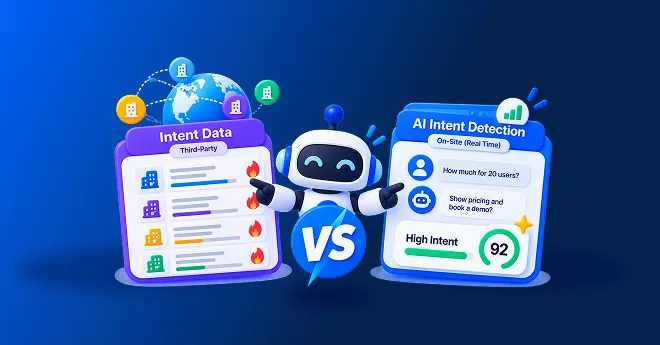
Intent data is typically third-party, aggregated information showing which companies appear to be researching topics related to your product, gathered from content consumption patterns across many websites, not just your own.
It usually works at the account level: a platform observes that Company X has had several employees reading articles about, say, “CRM integration” across various publisher sites, and flags that company as showing intent. You get a list of accounts, not a conversation with an individual.
It surfaces accounts before they ever visit your website, which is valuable for outbound prospecting and account-based marketing. It can tell a sales team, “These fifty companies are researching this category right now,” letting them prioritize outreach before a visitor ever lands on your site.
It rarely identifies which specific person at that company is interested, what exactly they want, or how close they are to a decision. It is a signal about a company’s general research activity, aggregated and often delayed, not a real-time read on an individual visitor’s need.
AI intent detection is first-party analysis that happens on your own website in real time, reading what a specific visitor asks, clicks or types during their actual visit. This is what most people mean when they talk about website visitor intent detection specifically, as opposed to account-level intent data gathered elsewhere.
Instead of inferring interest from browsing patterns across the web, it reads the words a visitor actually uses on your site right now: a pricing question, a comparison search, a stated timeline. The result is not a list of accounts to consider contacting later. It is a live, specific read on one visitor, available to act on immediately.
| Did you know? 6sense studied buyer identification and found that among visitors from identifiable accounts, 70% to 80% still remain anonymous, even to the companies they eventually buy from. This is exactly the gap AI intent detection is built to close: it does not need to identify the company in advance, because it reads intent from the conversation itself. |
| What matters | Third-party intent data | AI intent detection |
| Data source | Aggregated research activity across many sites | A visitor’s own actions on your website |
| Granularity | Usually company or account level | Individual visitor, in real time |
| Timing | Often updated in batches, hours or days old | Instant, during the live conversation |
| Can act immediately | No, feeds a later outreach decision | Yes, can trigger a response in the same visit |
| Best for | Prioritizing outbound and ABM targets | Qualifying and capturing an actual visitor |
| Identifies a named person | Rarely | Yes, once the visitor chooses to share details |
| Tip Ask any vendor one direct question: “Is this based on my website’s own data, or aggregated from other sites?” The answer alone tells you which category you are actually buying. |
Because both are marketed with the same word, “intent,” and both aim at the same underlying goal: finding buyers before a competitor does. The overlap in language hides a real difference in what is being measured and when you can act on it.
It also does not help that some platforms blend elements of both, layering account-level research signals with on-site behavior tracking. That is a legitimate hybrid approach, but it makes the category boundary even blurrier for a buyer trying to compare tools.
This is the practical answer to how you identify buyer intent on website visits: not a dataset lookup, but a live read of the visit itself. Here is the mechanism AI intent detection software uses, distinct from how third-party intent data is compiled.

Notice this required nothing about the visitor known in advance. Visitor behavior and intent were read entirely from what happened during the visit itself, not from any external dataset.
It would be unfair to dismiss intent data entirely. It answers a question AI intent detection cannot: who should we be reaching out to before they ever visit our site?
If your strategy targets specific named accounts, intent data can tell you which of them are showing research activity right now, helping prioritize outbound timing.
For businesses with long sales cycles and high-value deals, surfacing accounts before they self-identify can justify proactive outreach that would otherwise be a cold guess.
Once that account actually visits your website, intent data has usually done its job. It cannot tell you what that specific visitor wants once they are on your pricing page. That is a separate, on-site job.
Because speed decides outcomes. Harvard Business Review analyzed 1.25 million leads and found that firms who contacted a lead within an hour werenearly seven times as likely to qualify it as those who waited even one hour longer. An account-level signal that updates overnight cannot trigger that kind of immediate response. A live, on-site read can.
Gartner also found that61% of B2B buyers prefer a rep-free buying experience. Many of your best visitors will never appear on an outbound call list at all; the only intent signal you will ever get from them is what happens during their visit to your own website. AI intent detection is built specifically to catch that.

The strongest setups do not choose one over the other. They use each for the job it is built for.
Intent data widens the top of the funnel. AI intent detection converts the visitors who actually arrive, regardless of whether they came from a targeted campaign or organic search.
Corvexa reads what a visitor asks or selects, whether that is pricing, a demo, support or just browsing, and adjusts the conversation to match, entirely from first-party, on-site data. SeeReal-Time Intent Detection for more.
AI intent detection is powerful for visitors who actually arrive on your site, but it cannot see anyone who has not visited yet. If your real problem is that too few of the right accounts are reaching your website at all, that is a traffic and targeting problem, closer to what intent data or account-based marketing is built to solve.
Similarly, third-party intent data cannot tell you what a specific visitor wants once they land, and treating an account-level signal as if it were a personal read on an individual visitor is a common and costly mistake.
Website visitor intent data and AI intent detection sound similar and do genuinely different jobs. Intent data tells you which accounts might be worth reaching before they visit. AI intent detection tells you what a specific visitor actually wants, the moment they are on your site, and lets you act on it immediately.
If your gap is not enough of the right traffic, look at intent data and targeted outreach. If your gap is visitors arriving and leaving without a word, on-site AI intent detection is the tool built for that exact moment.

 Website Visitor Intent Data vs. AI Intent Detection: What Is the Difference?

Quick summary Capturing a lead is only the first step. What happens in the days after the chat ends usually...
Quick summary A chatbot that works well at 500 visitors a month can fall apart at 50,000. This guide covers...
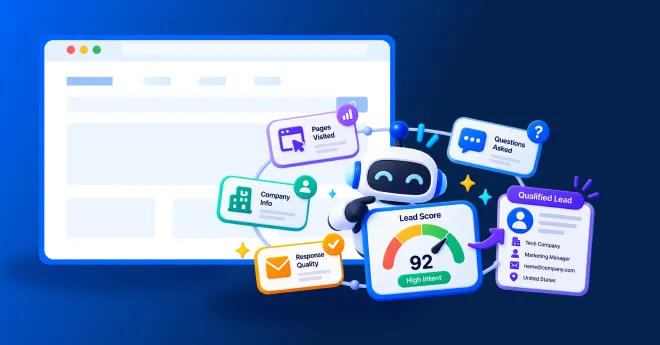
“It scores your leads automatically” is easy to say and hard to picture. This guide opens up the mechanics: what...