
 10 Mins Read

24/7 Lead Generation: How to Capture Visitors While You Sleep
It’s 11:47 PM. Someone is on your website. They’ve read your services, checked your pricing, and they’re seriously considering reaching...

| Quick summary A chatbot that works well at 500 visitors a month can fall apart at 50,000. This guide covers what actually changes at high traffic: performance, lead scoring, pricing, team structure, and the specific features a high-volume B2B site needs that a small-site setup does not. |
A chatbot that answers ten conversations a day looks identical to one that answers ten thousand. The interface is the same chat bubble either way.
What is different is everything behind it: whether it stays fast under load, whether your team can still find the leads that matter in the noise, and whether the pricing model quietly turns your success into your biggest software bill. Choosing the right AI chatbot for high-traffic website conditions is a different exercise entirely from choosing one for a quiet site. High traffic does not just mean “more of the same.” It changes what you should actually be buying.
Because the problems shift entirely. At low traffic, your biggest risk is a chatbot that gives generic answers or misses obvious buying signals. At high traffic, your biggest risks are different: performance under concurrent load, lead scoring that keeps your team from drowning, and pricing that scales sensibly rather than punishing your own growth.
The stakes are also higher. A large B2B SaaS site converting even a modest1.5% to 2.5% of visitors into leads, a typical median range, means thousands of conversations a month at real scale. Every one of those needs to be handled with the same speed and accuracy as conversation number one.
A chatbot handling five conversations at once and one handling five hundred at once are doing very different jobs. If response time slows as concurrency rises, visitors notice immediately, and a slow chatbot loses trust faster than no chatbot at all.
At low volume, a rep can eyeball every lead. At high volume, without strong automatic scoring, your team is handed hundreds of undifferentiated conversations a day, which is barely better than no qualification at all.
Per-resolution pricing models charge more as your chatbot succeeds. At high traffic, this can turn a chatbot that is working extremely well into one of your largest and least predictable software costs.
One person watching a chat inbox works at low volume. At high volume, you need role-based access, so multiple reps can work leads without duplicating effort or missing hot ones.
| Did you know? Gartner found that 61% of B2B buyers prefer a rep-free buying experience. At high traffic, that means a very large number of your visitors will only ever interact with your chatbot, never a person, before deciding whether to engage further. Performance and accuracy at scale are not a nice-to-have here; they are the entire first impression for most of your funnel. |
It should not, if built correctly, and understanding why helps you evaluate a vendor’s claims. Most AI chatbots run as an external, cloud-hosted service rather than software installed on your own web server. Your website loads a small script that calls out to the chatbot’s own infrastructure, so a well-built system scales its own backend independently of how much traffic your website receives.
Where things do slow down is when a vendor’s own infrastructure was not built for real concurrent scale, or when the AI model itself has to process every conversation through a bottlenecked pipeline. This is squarely a vendor engineering question, not something inherent to AI chatbots as a category.
| Tip Ask a vendor directly: “What is your typical response time at 100 simultaneous conversations, and do you have data from an existing high-traffic customer?” A vendor with real high-volume customers will have a real answer, not a guess. |
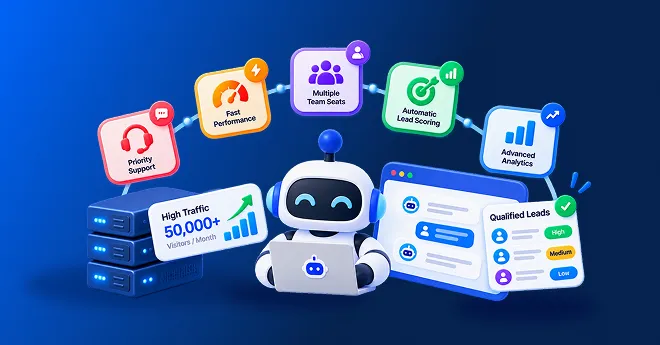
Beyond the basics every chatbot needs, a few features become essential specifically at scale.
| Feature | Why it matters at high traffic specifically |
| Automatic lead scoring | Prevents your team from drowning in undifferentiated volume |
| Multiple team seats with roles | Lets several reps work leads without duplication or gaps |
| Predictable, tiered pricing | Avoids per-resolution costs scaling out of control |
| Custom conversation volume | Avoids hitting a hard cap during a traffic spike |
| Advanced analytics | Surfaces patterns across thousands of conversations, not just individual chats |
| Priority or dedicated support | Gets issues resolved fast when volume makes any downtime costly |

At low volume, a simple High, Medium, Low label is often enough for a rep to act on directly. At high volume, that same three-tier system needs to be paired with automatic routing, or your team simply cannot process the number of High leads arriving each day.
High-volume setups benefit from routing rules on top of scoring: by territory, by product line, or by account size, so leads land directly with the right rep rather than in one shared queue everyone assumes someone else will check.
A scoring model tuned on a hundred conversations can behave differently once it sees ten thousand. Review conversion by score band regularly at high volume, since small inaccuracies compound quickly when the numbers get large.
This is where high-traffic sites can get badly caught out if they choose the wrong pricing model early on.
A rate that looked reasonable at a few hundred conversations a month can become one of the largest line items in your software budget once volume reaches the thousands. The better the chatbot performs, the more expensive it gets.
Predictable, but only if the tier structure actually reaches your volume. Hitting a hard cap during a traffic spike, such as a product launch or a major campaign, can mean a service interruption at the exact moment you need coverage most.
At genuinely high volume, a custom conversation allocation, negotiated directly, is usually the most sensible path. This avoids both the per-resolution cost spiral and the risk of a fixed-tier cap. Corvexa’s Enterprise plan offers custom conversation volume for exactly this reason, alongside white-label branding, a dedicated account setup, and competitive analysis built into onboarding. Seepricing.
Handling volume is only the starting requirement. A genuinely enterprise-ready setup adds a few things smaller sites rarely need.
At scale, generic hot keyword lists miss a lot of nuance. Enterprise setups benefit from custom intent strategy and custom hot keyword mapping tailored to a complex product line or multiple business units.
Larger organizations and agencies managing multiple client sites often need the chatbot’s appearance to match their own brand fully, not carry a third-party badge.
At high traffic, understanding which specific pages drive the most qualified conversations becomes a genuine strategic input, not just a nice dashboard. Page analytics and AI smart journey analytics matter far more once you have enough volume for the patterns to be statistically meaningful.
At scale, a delayed support response has a higher cost. One-to-one onboarding and dedicated support become worth paying for, not just a courtesy.
This depends on how varied your traffic actually is. A single B2B SaaS product with one clear buyer persona can often run one well-tuned chatbot across the whole site. A large site with multiple product lines, regions, or very different buyer types may benefit from tailoring intent paths and knowledge bases by section, even within one platform, rather than trying to make one generic configuration cover everything.

High-traffic sites rarely see perfectly even volume. Product launches, press coverage, seasonal campaigns, and viral moments can multiply normal traffic overnight, and a chatbot setup built only for average load can struggle exactly when the stakes are highest.
Ask directly what happens if you exceed your plan’s typical volume during a single busy week. A graceful overflow policy is very different from a chatbot that stops responding once a limit is hit.
If a major campaign or launch is planned, ask your vendor whether they can support a temporary volume increase, and confirm this in writing ahead of time rather than discovering the answer live.
A spike often brings a different mix of visitors than your normal baseline, sometimes more casual browsers drawn by a headline rather than genuine buyers. Review your High-lead rate during and after a spike, since a sudden shift can mean your scoring rules need a temporary adjustment.
Enterprise plans built around custom conversation volume, like Corvexa’s, exist specifically so a spike does not become a service interruption at the worst possible moment.
Always request a written cost projection at double and triple your current volume before committing to any usage-based pricing.
A configuration that worked fine at a few hundred conversations a month often needs real tuning once it hits several thousand, particularly around scoring thresholds and routing rules.
A shared inbox that worked with one rep quickly becomes a place where high-value leads get missed once several people are meant to be watching it.
At high volume, page-level and journey analytics should be reviewed proactively, not only pulled up after conversion rates unexpectedly drop.
The same fundamentals as any chatbot, but tracked with more rigor given the volume involved.
Response time under peak concurrent load, not just average response time. Qualified lead rate, watched for drift as volume changes. Time to first contact for High leads, especially during traffic spikes. Cost per qualified lead, recalculated regularly as volume shifts your pricing tier.
Harvard Business Review’s finding that firms contacting a lead within an hour arenearly seven times as likely to qualify it applies just as much at high volume, arguably more, since a high-traffic team has less slack to absorb a slow response to any individual lead. See ourcase studies for examples across different traffic levels, and remember results vary and are not guaranteed.
A chatbot built for a low-traffic site and one built for a high-traffic B2B site are not the same product wearing different pricing tiers. High volume changes what actually matters: performance under concurrent load, scoring that scales without drowning your team, pricing that does not punish success, and enterprise features like custom intent strategy and dedicated support.
Before choosing or scaling a chatbot setup, model your real volume, ask vendors directly about performance under load, and choose a pricing structure built for growth rather than one that quietly gets more expensive the better it performs.

FAQ
Here are answers to common questions about handling large visitor volumes, managing qualified leads, and choosing an enterprise-ready chatbot.
A setup that handles unlimited concurrent conversations without slowing down, uses tiered lead scoring so your team is not overwhelmed, connects cleanly to your CRM, and gives multiple team members role-based access to manage the volume.
A well-built one should not, since AI chatbots typically run as external services rather than adding load to your website’s own server. Performance issues usually come from a vendor’s own infrastructure limits, not from your traffic growing.
It is a chatbot designed to handle a rising number of simultaneous conversations without degrading response quality or speed, usually through cloud infrastructure that adds capacity automatically as demand grows.
Pricing models vary. Per-resolution pricing scales directly with volume and can become expensive at high traffic. Flat-tier or custom enterprise plans are usually more predictable for high-volume B2B sites.
Reliable performance under concurrent load, tiered or automatic lead scoring so high volume does not overwhelm sales, multiple team seats with role-based access, and analytics that show patterns across large amounts of traffic.
Some can, if built on scalable cloud infrastructure, but high-traffic B2B sites usually need enterprise-tier features too: custom conversation volume, dedicated support, and advanced analytics, not just raw capacity.
Ask your vendor directly what happens at double and triple your current volume: does response speed hold, does lead scoring stay accurate, and does pricing scale predictably or unpredictably?
 What Is the Best AI Chatbot Setup for a High-Traffic B2B Website?

It’s 11:47 PM. Someone is on your website. They’ve read your services, checked your pricing, and they’re seriously considering reaching...
Quick summary Contact forms convert views into submissions at only around 9%, one of the lowest rates of any form...
Not every AI automation project needs to be a six-month enterprise overhaul. Some of the highest-value workflows to automate with...