
 9 Mins Read
Website Visitor Intent Data vs. AI Intent Detection: What Is the Difference?
Quick summary “Intent data” and “AI intent detection” are used almost interchangeably, but they are built differently and answer different...

| “It scores your leads automatically” is easy to say and hard to picture. This guide opens up the mechanics: what data feeds a score, how the number is calculated, how it changes mid-conversation, and a worked example showing a visitor’s score building step by step. |
“Our AI scores your leads automatically.” Every vendor says a version of this sentence. Almost none of them show you what happens between a visitor typing a message and a number appearing on a dashboard.
That gap matters. A score you cannot picture is a score you cannot trust. This guide opens the mechanism up, piece by piece, using a real conversation as the working example
Because a “High” score means very different things depending on how it was calculated. A tool that scores everyone who views a pricing page as High is very different from one that combines intent, fit, and response quality before deciding.
The stakes are real too. A roundup of industry research fromLandbase found that the average MQL-to-SQL conversion rate sits at just 13% across industries, meaning most “qualified” leads never actually meet sales criteria. A large part of that gap comes from scoring that looks sophisticated but is really just one or two shallow rules dressed up as AI.
Every scoring engine, however it is built, draws from the same four wells of data. Understanding them is the key to understanding any score you are shown.
| Input | Example | What it tells the score |
| Behavioral signals | Pages visited, time on site, return visits | How far along the visitor is in research |
| Conversational signals | Questions asked, phrases used | What the visitor actually wants, in their own words |
| Fit signals | Company size, industry, role, tools used | Whether this visitor matches your ideal customer |
| Response quality | Work email vs personal email, complete answers | How seriously the visitor is engaging |
| Tip Ask any vendor which of these four inputs their scoring actually uses. A tool relying only on behavioral signals is working with a fraction of the picture a conversational tool can see. |
Numbers make this concrete. Here is a simplified version of how a rule-guided scoring engine might weigh signals, similar in spirit to what a well-built system runs behind the scenes.
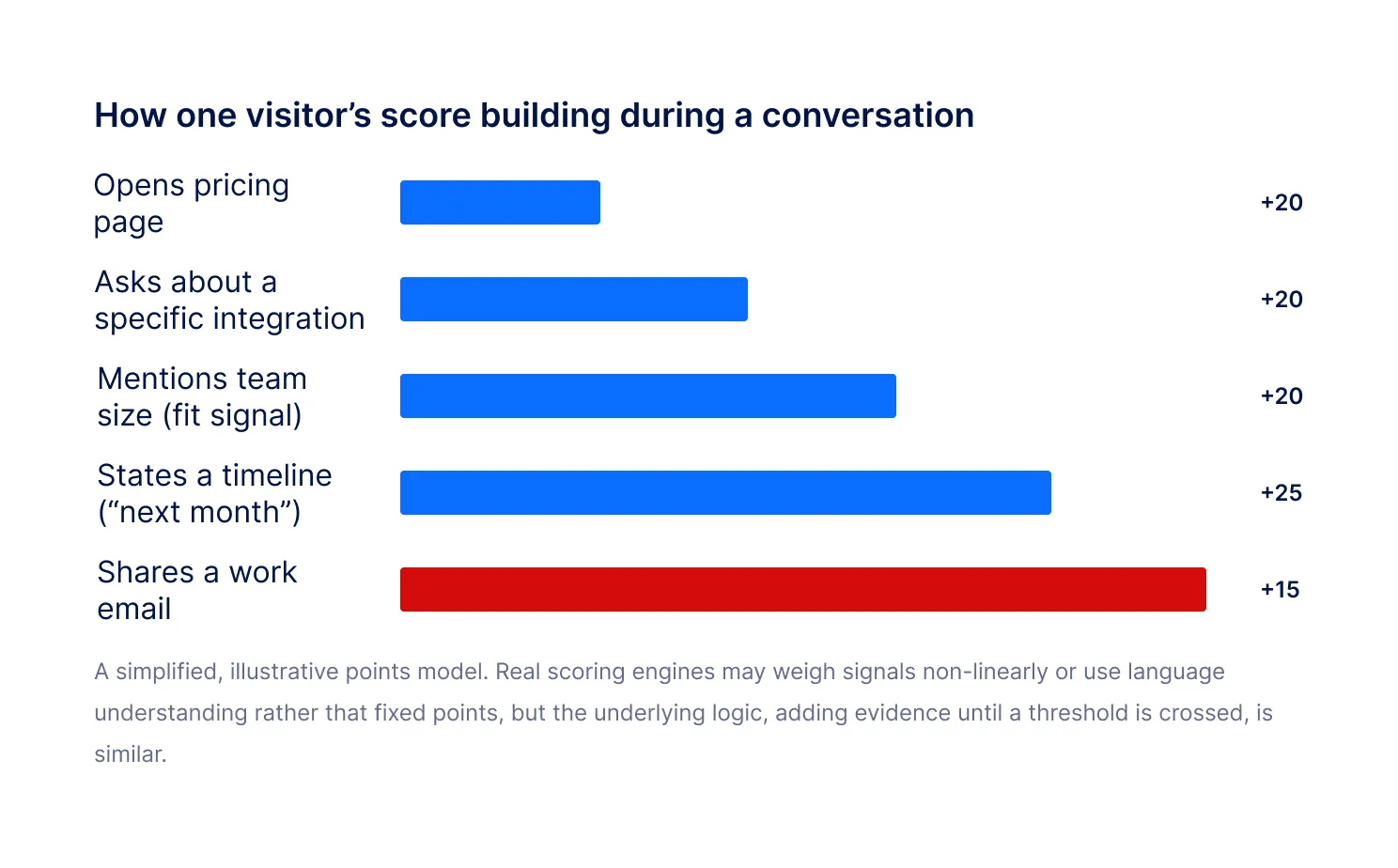
In this illustration, a score above roughly 80 points might be labelled High, 40 to 80 Medium, and below 40 Low. The exact thresholds matter less than the principle: a score is not one signal, it is several pieces of evidence added together, updating as new evidence arrives.
Here is what that looks like from the visitor’s side, with the score building silently underneath.

Notice the score is not a single judgment made at the end. It moves upward as each new piece of evidence arrives, the same way a person listening to the conversation would naturally become more confident with each answer.
A fixed points system, like the illustration above, adds pre-set values for pre-set triggers. It is simple and explainable, but rigid: it cannot understand a question phrased in a way nobody anticipated.
An AI lead scoring software approach reads the meaning behind what a visitor writes, not just whether it matches a keyword. “We’re hoping to roll this out before our Q2 planning” carries the same weight as “we want to start next month,” even though the wording is completely different. This is the practical advantage AI brings to the mechanics: it generalizes to language a fixed rule sheet was never written to catch.
Neither approach works well without a clear, accurate ideal customer profile behind it. A scoring engine, however sophisticated, is only ranking people against the definition you gave it. Get that definition wrong, and a very smart engine will confidently rank the wrong people first.
Because timing decides what happens next. Harvard Business Review analyzed 1.25 million leads and found that firms who contacted a lead within an hour werenearly seven times as likely to qualify it as those who waited even one hour longer.
A score that only finalizes after the visitor leaves the site cannot trigger an instant alert while they are still there, still interested, and still reachable through the same chat window. Real-time scoring is what makes an immediate handoff, or an instant “would you like to book a call now?” possible in the first place.
A good scoring engine subtracts as well as adds. This is what keeps a High list clean rather than full of enthusiastic but poor-fit visitors.
A personal email domain instead of a work one, a role like “student” or “job seeker,” a region you do not serve, or a company size far below your minimum.
Without negative scoring, an eager visitor from the wrong kind of company can still rank above a quieter, better-fit prospect simply because they asked more questions. Negative signals correct for enthusiasm that is not backed by fit.
This is the practical test for any tool claiming to score website visitors with AI: can it show its work, or only its conclusion? Corvexa’s scoring works this way: intent and response quality feed a High, Medium or Low score in real time, based on the rules you define in yourlead qualification profile, including your ideal customer, disqualifiers and hot keywords. Seefeatures for more on how this fits together.
A single accurate score is useful. A system your whole revenue team trusts over months is a bigger achievement, and it usually shares a few traits beyond the mechanics already covered.
The thresholds that separate High from Medium should not be set once and forgotten. As your offers, pricing and buyers shift, the weights behind website visitor lead scoring should be revisited, typically every month or quarter.
The people closest to the deals often spot pattern mismatches before any report does. A rep who says “this High lead never had a chance” is giving you data just as valuable as a conversion report.
A returning visitor who previously scored Low but now asks a High-intent question should be recognized as a different situation than a first-time visitor with the same message. Mature systems account for this kind of context rather than treating every conversation as if it started from zero.
Getting to this point does not require a large team or a long project. It requires treating the scoring engine as something to tune deliberately, using the mechanics in this guide as a starting checklist rather than a one-time setup task.
A tool that only watches page views cannot tell a curious student from a serious buyer asking the same question. It is working with half the picture.
Without it, enthusiasm gets mistaken for fit, and your High list fills with the wrong people.
If the score only finalizes after the chat ends, you lose the chance to react while the visitor is still there.
A black-box score erodes trust quickly. If reps cannot see why, they will eventually stop believing the number at all.
This is where implementations differ most, and it is worth asking about directly. Some systems weigh intent more heavily, prioritizing anyone who asks a buying question. Others weigh fit more heavily, prioritizing company size and industry above enthusiasm.
The right balance depends on your sales model. A team with a narrow, well-defined ideal customer should weigh fit heavily, since a poor-fit lead wastes time regardless of how ready they seem. A team selling to a broad market with flexible use cases can afford to weigh intent more, since almost any enthusiastic visitor might convert.
The four-input model, behavior, conversation, fit and response quality, stays constant. What changes is which inputs carry the most weight for a given business.
Businesses with multi-month cycles often weigh fit more heavily than immediate intent, since a single visit rarely captures true urgency. A visitor who matches the ideal customer profile closely may deserve a moderate score even without an explicit buying phrase yet.
Where deals close quickly, intent signals like a pricing question or a stated start date should carry more weight, since the window to act is short and fit is often more obvious from the traffic source itself.
Here, a single visitor’s score matters less than the pattern across several visitors from the same company. A scoring system built for this context should be able to recognize when multiple people from one organization are engaging, not just score each conversation in isolation.
This is why a scoring mechanism copied wholesale from a different industry can under- or over-rank your leads. The inputs are universal; the weighting should not be.
Automated scoring is not magic, and it should not be treated like a mystery either. Underneath every “High,” “Medium” or “Low” label is a combination of behavioral, conversational, fit and response-quality signals, weighed against your own definition of a good customer, updating in real time as a visitor reveals more.
Understanding this mechanism is not just interesting background. It is what lets you judge whether a tool’s scores deserve your trust, and whether your sales team should actually act on the number they are being shown.

 AI Lead Scoring for Website Visitors: How Automated Scoring Works

Quick summary “Intent data” and “AI intent detection” are used almost interchangeably, but they are built differently and answer different...
Quick summary Every AI lead qualification software vendor claims to find your best buyers automatically. Far fewer can show exactly...
Quick summary A chatbot that captures leads but never reaches Salesforce just creates a second inbox nobody checks. This guide...