
 9 Mins Read

24/7 Lead Generation: How to Capture Visitors While You Sleep
It’s 11:47 PM. Someone is on your website. They’ve read your services, checked your pricing, and they’re seriously considering reaching...

| Quick summary Every AI lead qualification software vendor claims to find your best buyers automatically. Far fewer can show exactly how. This guide gives you a structured way to compare tools: the features that actually matter, the questions to ask, and a simple scorecard to use on every vendor you shortlist. |
Every product page in this category says almost the same thing: “AI-powered lead qualification that finds your best buyers automatically.” Read five of them back to back and they start to blur together.
The differences only show up once you look past the marketing copy and into what the software actually does with a real visitor, a real question and a real CRM. This guide gives you a structured way to make that comparison, so you buy based on capability, not on which demo felt the smoothest.
Because the category is crowded with tools built for different jobs, all using similar language. A rebuilt support chatbot and a purpose-built B2B lead qualification tool can use nearly identical marketing pages while behaving completely differently with a real buyer.
It matters because the cost of choosing wrong is real, not hypothetical. Poor lead qualification automation can quietly waste sales hours for months before anyone notices. A roundup of industry research fromLandbase found that only 44% of companies use lead scoring at all, and that the average MQL-to-SQL conversion rate sits at just 13% across industries. Software that promises to fix this but does not actually score well leaves you exactly where you started, just with another subscription.
| Did you know? Gartner found that61% of B2B buyers prefer a rep-free buying experience. For most of your visitors, the qualification software you choose is the only “salesperson” they will interact with before deciding whether to engage further. That is a lot of weight for a rushed buying decision to carry. |
AI lead qualification software is a tool that automatically judges how well a website visitor fits your ideal customer and how ready they are to buy, using AI to read their questions and behavior, then scores and routes the lead.
You will see it marketed under several names: an AI lead qualification tool, automated lead qualification software, a lead qualification platform, or simply software for qualifying website leads. Strip away the branding and they are all attempting the same core job: replace manual reading and ranking of inbound leads with something automatic and consistent.
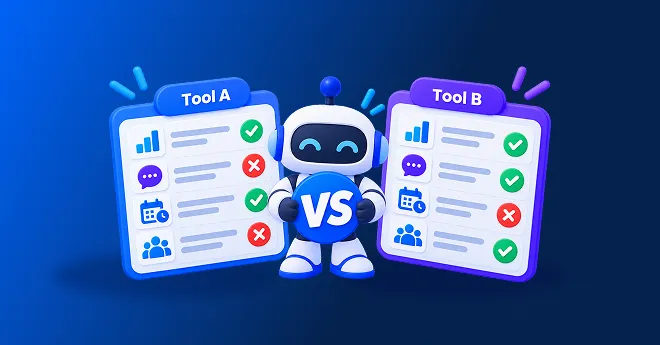
Rather than comparing feature lists line by line, group what you are evaluating into four categories. This makes gaps far easier to spot.
| Category | What it covers | Why it matters |
| Intelligence | Intent detection, fit scoring, hot keywords | Decides whether leads are ranked accurately at all |
| Knowledge | Website crawling, PDFs, custom Q&A | Decides whether answers are accurate and on-brand |
| Workflow | CRM sync, calendar booking, human takeover | Decides whether qualified leads actually reach a rep |
| Trust and oversight | AI disclosure, explainable scores, reporting | Decides whether your team trusts and uses the tool |
| Tip Score each vendor 1 to 5 in each of these four categories rather than judging on a single overall impression. A tool that is a 5 on Intelligence but a 2 on Workflow will frustrate your sales team no matter how smart the AI sounds in a demo. |
The software should read what a visitor asks or clicks as it happens, not rely only on fixed keyword rules. Ask a vendor to show you a pricing question and a general question side by side, live.
Readiness alone is not enough. A very enthusiastic visitor from the wrong kind of company still wastes a rep’s time. Good AI-powered lead qualification checks fit against your ideal customer profile alongside intent.
You should be able to define phrases like “book a demo” that skip straight to lead capture. If a vendor cannot show you this working, treat “intent detection” as a marketing claim rather than a feature.
The tool should read your site, pricing, and FAQs on its own, and stay current when you re-crawl after changes. Manual retraining after every update is a real ongoing cost most buyers underestimate.
You should be able to turn specific pages on or off, so the AI never learns from a checkout page, an old campaign page or outdated pricing.
Spec sheets, brochures, and internal FAQs should be usable as source material, not require retyping into a separate system.
For your most important questions, you should be able to write the precise answer yourself, so the AI never improvises on anything sensitive.
Ask exactly which fields sync automatically, and whether the full conversation and score come with the record, or just a name and email.
A qualified visitor should be able to book a call directly, through Calendly or Google Calendar, without leaving the chat.
A rep should be able to join any conversation with one click and see everything that happened before they arrived.
Email at minimum, and ideally Slack or another channel your team actually watches, so a High-scored lead is not sitting unseen in a dashboard.
A lead scored High should come with visible reasons, not a mystery number. Reps stop trusting scores they cannot understand.
Visitors should always be told they are chatting with AI, with an easy path to a person.
A dashboard should show qualified leads, conversion by score band and source pages, not just a rising chat count that tells you nothing about results.
Use this to score every shortlisted vendor consistently, rather than being swayed by whoever gave the smoothest presentation.

A vendor scoring highly across all four categories is a genuine B2B lead qualification software candidate. One scoring well on Intelligence but poorly on Workflow will frustrate the very sales team it is meant to help.
“Our AI figures it out” is not an explanation. If a vendor cannot describe their scoring logic in plain terms, assume it is a black box you will not be able to trust.
Some tools “integrate” only through a webhook that still needs custom setup on your end. Ask exactly what is native versus what requires extra work.
A tool that cannot be configured around your ideal customer and disqualifiers will treat every business the same way, which rarely matches reality.
If you cannot see conversion by score band after a trial period, you cannot tell whether the software is actually working.
Prioritize ease of setup and a flat, predictable price. A lead qualification tool that needs a developer or a lengthy configuration process defeats the purpose for a lean team.
Prioritize CRM depth and human takeover, since multiple reps now depend on consistent scoring and a clean handoff to avoid duplicated or dropped leads.
Prioritize reporting depth, role-based access and integration breadth, since decisions about the tool will need to satisfy sales, marketing and often IT stakeholders together.
| Note Use this scorecard on every vendor you consider, ours included. A fair comparison protects you far more than any single feature list, ours or a competitor’s. |
Demos are built to impress. Insist on a live test with your own website content before deciding.
A brilliant scoring model that never reaches your CRM cleanly delivers no real value to your sales team.
Ask for a written cost projection at double your current traffic before signing, not just the advertised starting price.
No software can fix a business that has not defined its own ideal customer. Get sales and marketing aligned first.
Track the same numbers you used to compare vendors, now against real results.
Qualified lead rate shows whether scoring is accurate. Sales acceptance rate shows how many leads your team agrees are worth pursuing. Time to first contact shows how well the workflow category is performing in practice. Meetings booked shows the real business outcome.
Review these numbers a month after launch, and again at three months, since real performance takes a few weeks of tuning to settle. See ourcase studies for real B2B examples, and remember results vary and are not guaranteed.
Nearly every AI lead qualification software vendor sounds the same on a landing page. The real differences live in four places: how well it detects intent and fit, how well it learns your actual content, how cleanly it connects to your workflow, and how much your team can trust and understand its scores.
Score every shortlisted vendor against these four categories, ask the questions in this guide, and insist on a live test before you buy. That is how you choose software for qualifying website leads that your sales team will actually use, not just another subscription that quietly gets ignored.

 AI Lead Qualification Software: Features to Compare Before Buying

It’s 11:47 PM. Someone is on your website. They’ve read your services, checked your pricing, and they’re seriously considering reaching...
Quick summary Contact forms convert views into submissions at only around 9%, one of the lowest rates of any form...
Not every AI automation project needs to be a six-month enterprise overhaul. Some of the highest-value workflows to automate with...