
 10 Mins Read

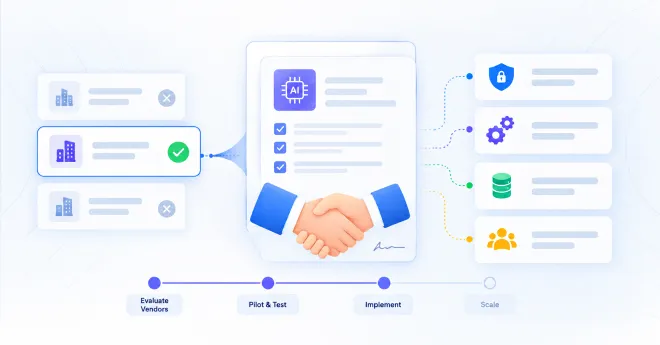
The Enterprise Guide to Hiring an AI Automation Partner (Without Wasting 6 Months)
Choosing the wrong vendor is the single biggest reason enterprise AI automation projects stall, blow past budget, or quietly die...

In this guide, we’ll look at five practical, real-time strategies to capture more B2B leads from responding while intent is still high and removing form friction to using AI conversations, real-time qualification, and instant sales handoffs.
So companies spend more on Google Ads. They publish more content. They post on LinkedIn. They improve their SEO. They download another lead magnet.
And then they look at the number of leads coming in.
But there is a problem with that approach: You can keep increasing traffic and still lose the people who were already interested.
A visitor can be on your website right now, reading your pricing page, comparing your solution with a competitor, or trying to figure out whether your product actually solves their problem.
If your website simply gives them a form and says “We’ll get back to you,” you may be leaving the most valuable part of the buying journey unattended.
The goal isn’t to collect more names. It’s to capture more of the right opportunities while they’re actually happening.
Real-time lead capture doesn’t simply mean sending an email notification the second someone fills out a form.
That’s only one small piece of it.
A genuinely real-time B2B lead process looks more like this:
Visitor shows intent → Website responds → Questions are answered → Visitor is qualified → Contact details are captured → Sales gets the context → Next step happens
The important part is that nothing important is left waiting unnecessarily.
Because buying intent can change quickly.
Someone who is actively researching a solution at 2:14 PM may be back in a meeting at 2:20 PM.
Someone comparing three vendors may have already shortlisted two by the time your sales rep responds the next morning.
And someone who wanted an answer right now may simply move on when the website doesn’t provide one.
| 💡The real B2B lead-generation question |
|---|
| Don’t only ask: “How many people visited our website?” Ask: “How many people showed buying intent while they were here and what did we do about it?” |
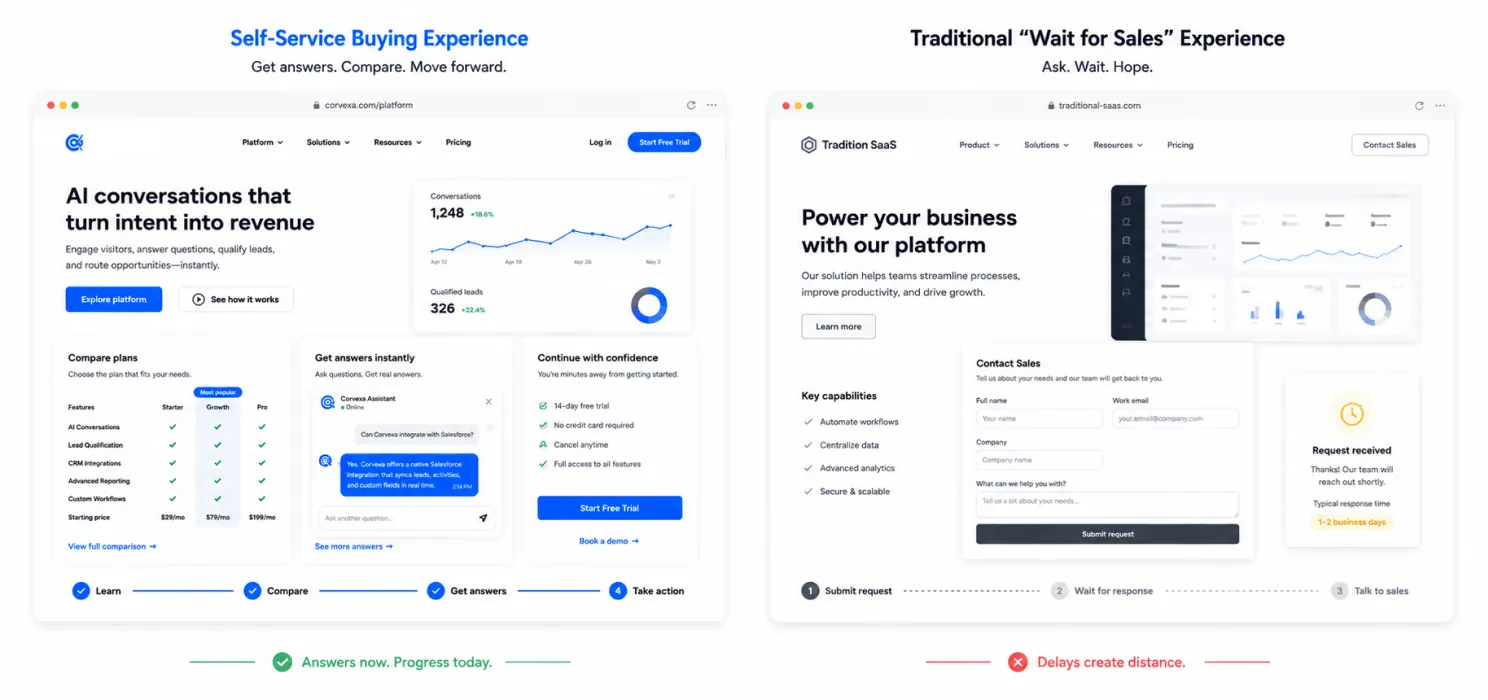
B2B buyers are increasingly comfortable doing research without talking to sales.
Gartner reported in 2025 that 61% of B2B buyers preferred an overall rep-free buying experience. Buyers generally preferred digital self-service for activities such as finding general information and learning about solutions.
That changes the role of your website. Your website isn’t just a brochure anymore. For many buyers, it is part of the sales process.
And if the website cannot answer questions, explain the product, or help a buyer understand whether the solution fits, the buyer doesn’t necessarily wait for someone from sales.
They leave.

Let’s start with the simplest strategy: Don’t make interested visitors wait for an answer.
Imagine this: A prospect visits your website. They’ve already read three pages. They click Pricing. Then they visit Case Studies. Then they return to the product page. Finally, they click Contact Sales. That’s not random traffic. That’s behavior worth paying attention to. But what happens next?
If the website gives them a form:
Name → Email → Phone → Company → Message → Submit
and someone from sales responds tomorrow, you’ve created a huge gap between interest and response.
Research from InsideSales examined more than 55 million sales activities involving 5.7 million inbound leads across 400+ companies and reported that conversion rates were more than eight times higher when the first response attempt happened within five minutes compared with waiting longer.
The exact economics will vary by business, but the underlying lesson is simple: Speed matters when intent is fresh.
When someone shows clear buying intent, your website should help them immediately.
That could mean:
The technology matters less than the principle:
Don’t make a buyer wait for something your website could help them with right now.

Here’s a familiar B2B experience. You want to know whether a product integrates with Salesforce. You find the website.You look around. Eventually, you see: “Talk to Sales.” You click it.
And get a form asking for:
But you weren’t ready to talk to sales. You just had one question. So you leave. This happens more often than companies realize.

Marketing celebrates 500 leads.
Sales complains: “Most of these aren’t qualified.”
Both teams can be right.
The problem isn’t necessarily lead generation. It’s lead qualification. If your website captures every person who submits a form, the sales team has to figure out who is worth contacting. That creates another delay. A better approach is to start qualification during the interaction itself.
It depends on the company.
But you might care about:
You don’t need to ask all of these as a checklist. That’s exactly what creates form fatigue. Instead, use the conversation to uncover the information naturally.
For example:
“What are you currently using?”
Then:“What’s not working with your current setup?”
Then:“Are you actively looking to replace it, or just researching options?”
Those three questions can tell you a lot. You may discover that one visitor is casually researching while another has a problem they need to solve this month.
They shouldn’t receive the same sales treatment.

This might sound obvious, but many B2B websites get it backwards.
They ask for an email address before giving the visitor enough information to make a decision. Imagine walking into a store and hearing: “Give me your phone number.”
before the salesperson even asks what you’re looking for. You’d probably hesitate. The same principle applies online.
Give Something Useful First
Depending on your business, that might be:
Then ask for the information you actually need. This creates a simple psychological exchange:
Value → Trust → Intent → Contact
instead of: Contact → Maybe value later

Here’s where many lead-generation systems quietly break. The website captures the lead.
Then: Marketing gets a notification.
Then someone checks it.
Then someone assigns it.
Then sales sees it.
Then someone opens the CRM.
Then they decide who should contact the person.
Then they send an email.
By the time the process is complete, the visitor may be gone.
Real-time lead capture isn’t truly real-time if the handoff isn’t real-time.
Corvexa
Corvexa turns your website into an AI-powered lead capture and qualification layer. Instead of simply sitting on your website as a chatbot, it can:
Understand your business: Corvexa can crawl selected website pages and use your FAQs, product information, pricing and other content. You can also add knowledge manually and upload PDFs or other business materials.
Understand your ideal customer: You define the industries, company sizes, pain points, qualification signals and disqualifiers that matter to your business.
Talk to visitors: The AI answers questions using the knowledge you’ve provided while keeping the conversation focused on the visitor’s needs.
Capture lead information: During the conversation, Corvexa can collect details such as name, email, phone, interest and preferred follow-up time.
Recognize high intent: Hot keywords and qualification signals can help identify visitors who are more likely to be serious buyers.
Let humans take over: When a conversation needs a person, your team can take over directly.
Send leads where your team already works: Corvexa supports integrations with HubSpot, Salesforce, Calendly, and email, while its dashboard provides lead, score, and conversation information.

If you’re building or improving your own system, here’s a simple framework to follow.
Look for signals that someone is genuinely interested.
Examples:
Don’t immediately ask for their information. Help first. Answer the question. Explain the product. Point them toward relevant information.
Once there’s enough context, understand:
Who are they?
What problem are they solving?
How urgent is it?
What are they looking for?
Are they a good fit?
Now ask for the information required to continue the conversation. At this point, giving an email address feels much more reasonable. The visitor understands why you’re asking.
Don’t leave the lead sitting in an inbox.
Send it to:
And finally, don’t lose the context. The salesperson should know what the visitor already discussed. Otherwise, the buyer has to start over. And nobody likes repeating themselves.

There’s a temptation to overdo this. You shouldn’t turn your website into an aggressive salesperson.
Avoid:
❌ A chatbot appearing immediately
“HEY! WANT TO TALK TO SALES?”
before the visitor has even read the headline.
❌ Asking five questions at once
That just turns your chatbot into another form.
❌ Collecting information without providing value
Visitors notice.
❌ Sending every conversation to sales
Not every visitor is ready to buy.
❌ Giving AI unlimited freedom
Your AI should work from reliable business knowledge and clear qualification rules.
❌ Making human handoff difficult
When a visitor wants a person, let them reach one.
The goal isn’t to hide sales behind AI.
The goal is to make the path to the right sales interaction easier.
| Traditional Lead Capture | Traditional Lead Capture |
|---|---|
| Visitor finds a form | Visitor can start a conversation |
| Asks many questions upfront | Questions adapt to the visitor |
| Captures contact information | Captures context + contact information |
| Lead waits for sales | Lead can be routed immediately |
| Same experience for everyone | Experience adapts to intent |
| Qualification happens later | Qualification starts immediately |
| Mostly captures identity | Captures buying signals |
| Limited after-hours support | Can engage visitors 24/7 |
1. Respond immediately: Don’t let high-intent visitors wait for a sales response.
2. Start a conversation: Give visitors a way to ask questions instead of forcing every interaction into a form.
3. Qualify in real time: Understand the problem, urgency, and fit while the visitor is still engaged.
4. Give value before asking for information; Help first. Capture contact details when the next step makes sense.
5. Connect capture to sales; Route qualified leads directly into the systems and people responsible for following up.
A buyer visits your website. They research. They ask questions. They become interested. They finally decide: “Okay, I want to know more.”
And then you ask them to fill out a long form and wait. That’s not a great handoff. The better experience is:
They show intent → you respond → they get help → you understand their need → you capture the lead → sales gets the context → the conversation continues.
That’s what real-time B2B lead capture should feel like. Not more pop-ups. Not more forms. Not more notifications.
A faster, more useful path from interest to conversation.
And if your website already gets qualified traffic but you’re not capturing enough of that intent, that’s the part worth fixing first.

 Capture More B2B Leads: 5 Proven Real-Time Strategies

Choosing the wrong vendor is the single biggest reason enterprise AI automation projects stall, blow past budget, or quietly die...
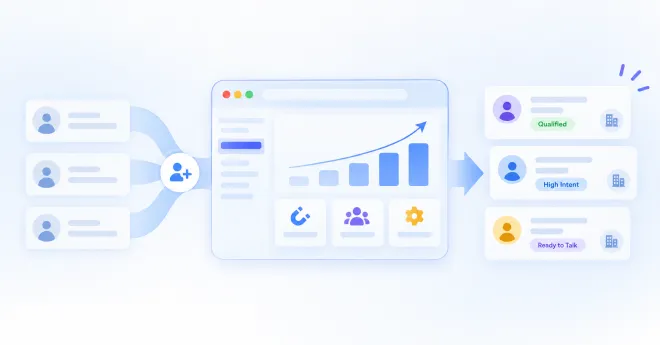
B2B customer acquisition gets harder as a business grows. More website visitors, more leads, more conversations, and more follow-ups can...
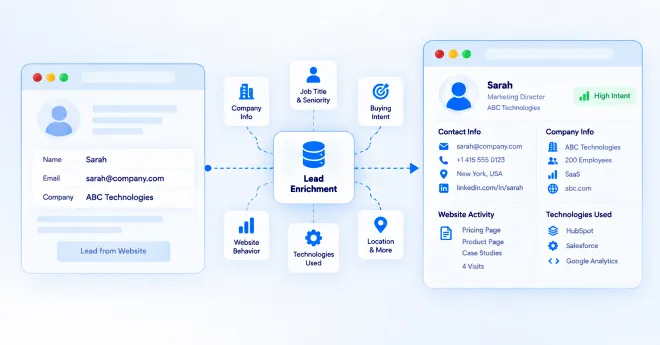
A website visitor can leave behind very little information. They may read a few pages, check your pricing, download a...