
 7 Mins Read
AI Agent vs Chatbot: Which One Actually Grows Revenue (And Which Is a Waste of Budget)?
This blog settles the AI agent vs chatbot debate with real 2026 data rather than marketing buzzwords. You’ll learn the...

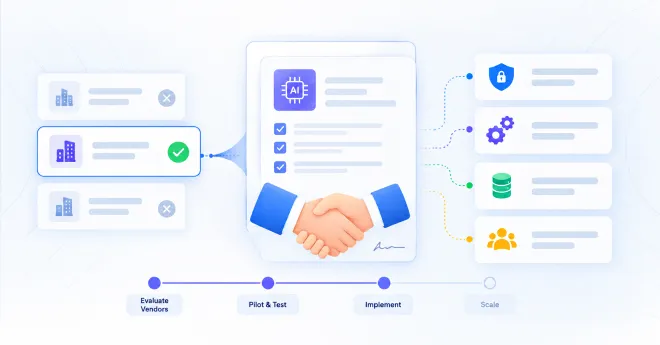
Choosing the wrong vendor is the single biggest reason enterprise AI automation projects stall, blow past budget, or quietly die after a promising pilot. This guide walks through what actually matters when you hire an enterprise AI automation company: the questions to ask, the red flags to watch for, a practical vendor checklist, and a realistic implementation timeline.
If you are evaluating partners for workflow automation, document processing, or AI agents across your organization, this is the framework to use before you sign a contract.
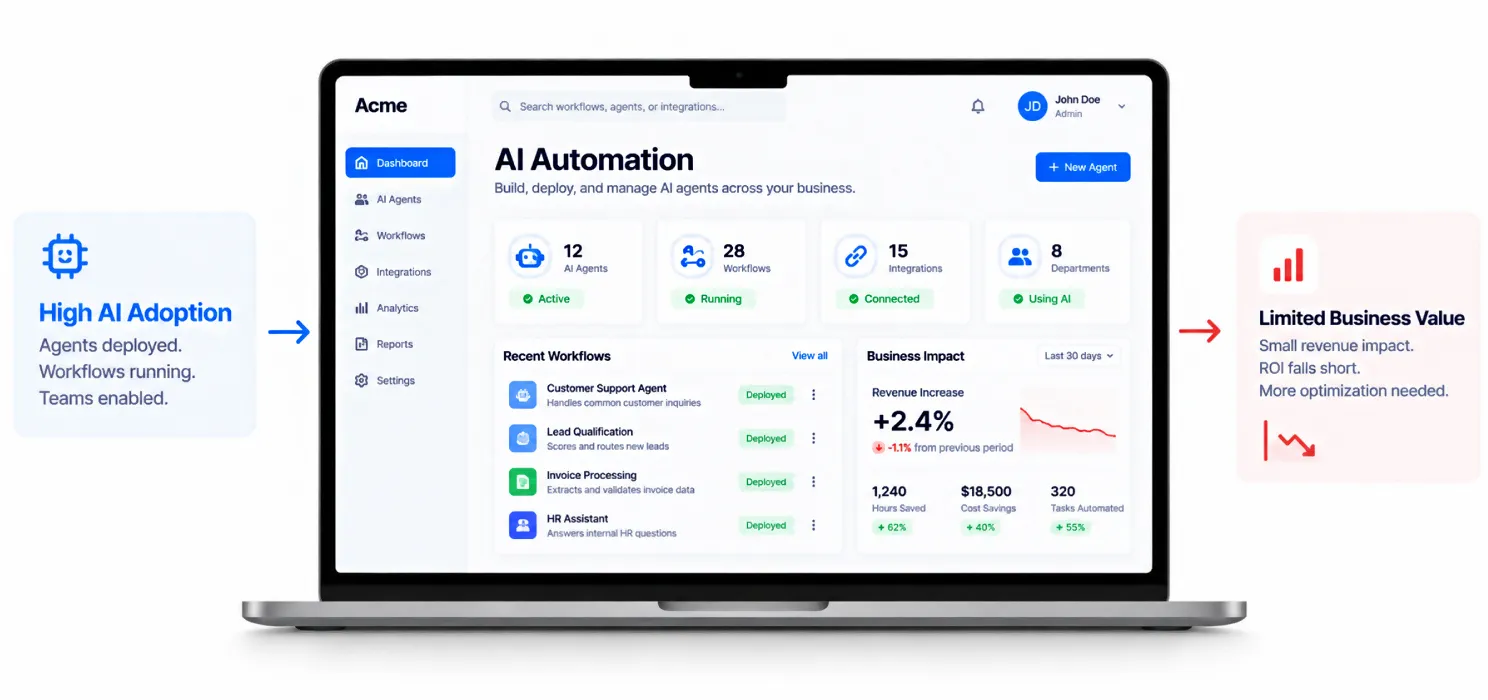
Most enterprises do not fail at AI automation because the technology is immature. They fail because of mismatched expectations, unclear ownership, and a vendor that oversold what could be done in the first quarter.
A McKinsey survey on the state of AI found that a majority of organizations have adopted generative AI in at least one business function, yet very few report meaningful bottom-line impact from it. That gap between adoption and value is almost always a delivery problem, not a model problem.
When you hire an enterprise AI automation company, you are not just buying access to a large language model or a workflow engine. You are buying their judgment about what to automate first, how to integrate with your existing systems, and how to get your teams to actually trust and use what gets built. Get that judgment wrong, and you can lose two full quarters before anyone notices the project is off track.

A genuine automation partner does more than write prompts or connect APIs. Their job typically covers four areas:
If a vendor only talks about the model they will use and skips the first and last points on that list, that is worth noticing. The model is rarely the hard part anymore.

Before you sign anything, run every shortlisted vendor through the same checklist. Consistency here is what lets you actually compare apples to apples instead of comparing sales decks.
Treat this list as a scoring sheet, not a formality. A vendor who cannot answer three or more of these clearly is not ready for an enterprise engagement, no matter how polished the pitch is.
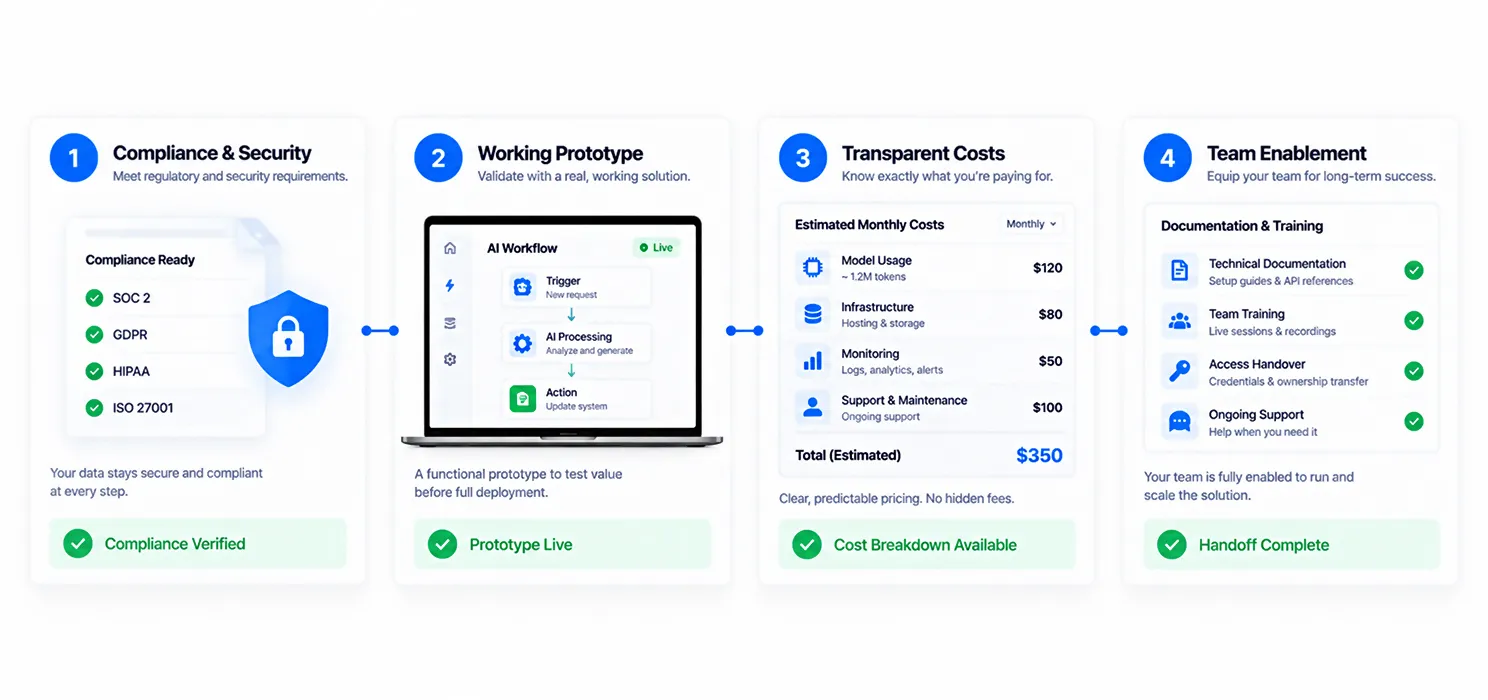
Beyond the checklist, there are baseline requirements that protect you regardless of which vendor you choose.
Enterprises in finance, healthcare, and insurance carry regulatory obligations that a generic automation vendor may not fully grasp. Ask directly whether they have delivered projects under similar regulatory constraints, and ask for specifics rather than reassurance.
Any serious partner should be able to demonstrate a working prototype on a narrow slice of your actual data within four to six weeks. If a vendor insists on a long discovery phase with no visible output, that is a scope and pacing problem you should flag early.
Enterprise AI automation costs are not just the vendor’s fee. There are ongoing model usage costs, hosting, and monitoring costs that scale with volume. A trustworthy partner walks you through this honestly instead of bundling it into a vague “platform fee.”
The goal of automation is not a permanent consulting retainer. A capable partner builds in documentation and internal training so your team can maintain and extend the system without calling the vendor for every small change.
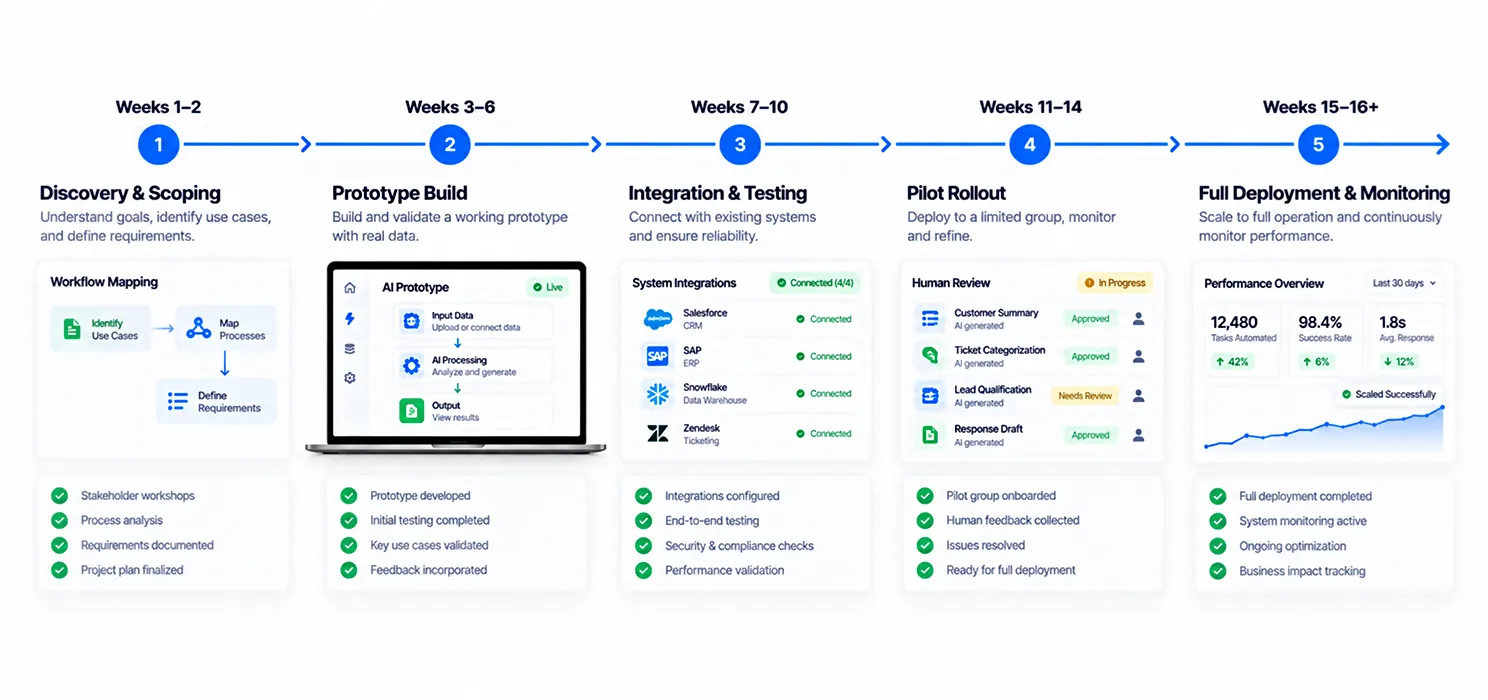
One of the fastest ways to lose six months is accepting a timeline that sounds good in a pitch but ignores how enterprise IT actually works. Here is a realistic structure most well-run engagements follow.
That is roughly four months for a well-scoped project, not six. If a vendor proposes a nine-month timeline before anything is testable, or a two-week timeline for something touching core systems, both extremes deserve scrutiny.
Consider a mid-sized insurance company automating claims intake. A vendor that jumps straight to “we will use AI to read every document” without first mapping how claims actually move through the organization is likely to build something technically impressive and practically useless.
A partner who instead spends the first two weeks understanding where claims get stuck, which document types cause the most manual rework, and what “done” looks like to the claims team is far more likely to deliver something that survives contact with real operations. The technology used in both cases might look similar on paper. The outcome will not be.
Set a small number of metrics before the project starts, not after. Useful examples include reduction in manual processing time, error rate compared to the existing manual process, and time from resolution request. Vague goals like “improve efficiency” are difficult to fail and equally difficult to prove success against.
Review these metrics at the end of the pilot phase specifically, before agreeing to any broader rollout. This is the natural checkpoint to renegotiate scope, pause, or expand.
Hiring an enterprise AI automation company is less about finding the most advanced technology and more about finding a partner who understands your workflows, is honest about timelines and costs, and builds something your team can actually own once the engagement ends. Use the checklist above during vendor evaluation, insist on a realistic phased timeline, and tie every phase to a metric you actually care about. Enterprises that follow this discipline consistently move faster than those chasing the flashiest demo, and they rarely end up as one of the six-month cautionary tales this guide is meant to help you avoid.

FAQ
Get answers to common questions about hiring an enterprise AI automation partner, including costs, pilot timelines, vendor selection, and workflow ownership.
Copy FAQ description
Costs vary widely based on scope, but most enterprise engagements range from a focused pilot in the tens of thousands to multi-year contracts in the hundreds of thousands or more, depending on integration complexity and ongoing model usage costs. Always ask for a cost breakdown that separates implementation fees from ongoing operational costs.
Skipping a scoped pilot and committing to a large, long-term contract before validating that the vendor’s approach actually works on real data and real workflows.
A well scoped pilot, from discovery to a testable prototype on real data, should typically take four to ten weeks. Longer than that without a visible working output is a warning sign.
It depends on the complexity of your systems and the specificity of your industry needs. Specialized vendors often move faster and know their niche deeply, while larger firms may offer broader integration support across many systems at once. Evaluate both against the same vendor checklist rather than assuming size equals capability.
 The Enterprise Guide to Hiring an AI Automation Partner (Without Wasting 6 Months)

This blog settles the AI agent vs chatbot debate with real 2026 data rather than marketing buzzwords. You’ll learn the...

Most businesses have already seen a chatbot. You visit a website, a small chat window appears, and it asks: “How...

Research consistently shows that lightning-fast follow-up drives dramatic gains: contacting a new lead within 5 minutes makes you 100× more...