
 15 Mins Read

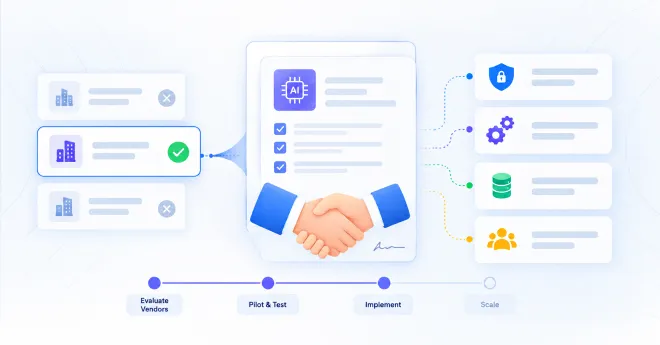
The Enterprise Guide to Hiring an AI Automation Partner (Without Wasting 6 Months)
Choosing the wrong vendor is the single biggest reason enterprise AI automation projects stall, blow past budget, or quietly die...

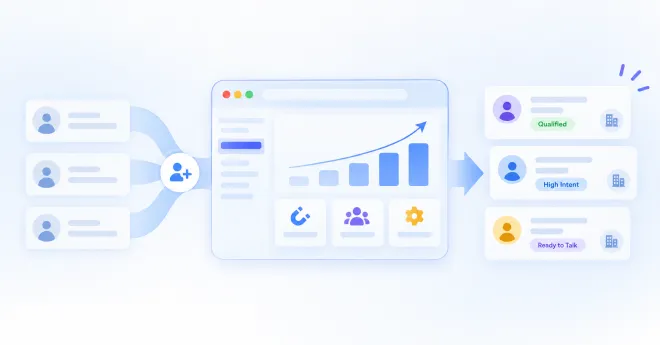
In today’s fast-paced B2B world, responding to every website lead quickly and accurately is critical. Instant lead qualification bots AI-powered chat or voice agents engage inbound prospects 24/7, asking tailored questions (about budget, timeline, role, etc.) to score and filter leads in real time.
By automating this grunt work, companies focus only on high-potential prospects, cutting wasted effort and cost. Studies show businesses using chatbots report ~67% higher sales and up to 2.4× conversion versus forms. Well-qualified leads have ~40% close rates (vs ~11% for unqualified). Case studies highlight big ROI: e.g., one Conversica client saw 7.5× ROI in year 1 and another 25× ROI by year 3, with dramatically faster sales cycles.
This report explains what these bots are, how they work (chat/NLP, scoring, CRM integration), key benefits (time saved, faster response, higher conversion, prioritization, cost savings, better experience), measurable metrics/ROI, implementation steps, best practices, pitfalls to avoid, real examples, and KPIs to track.
A comparison table of four popular solutions (Intercom, Drift, Qualified, Conversica) is included, along with a mermaid chart of the lead flow from capture to qualification to handoff.
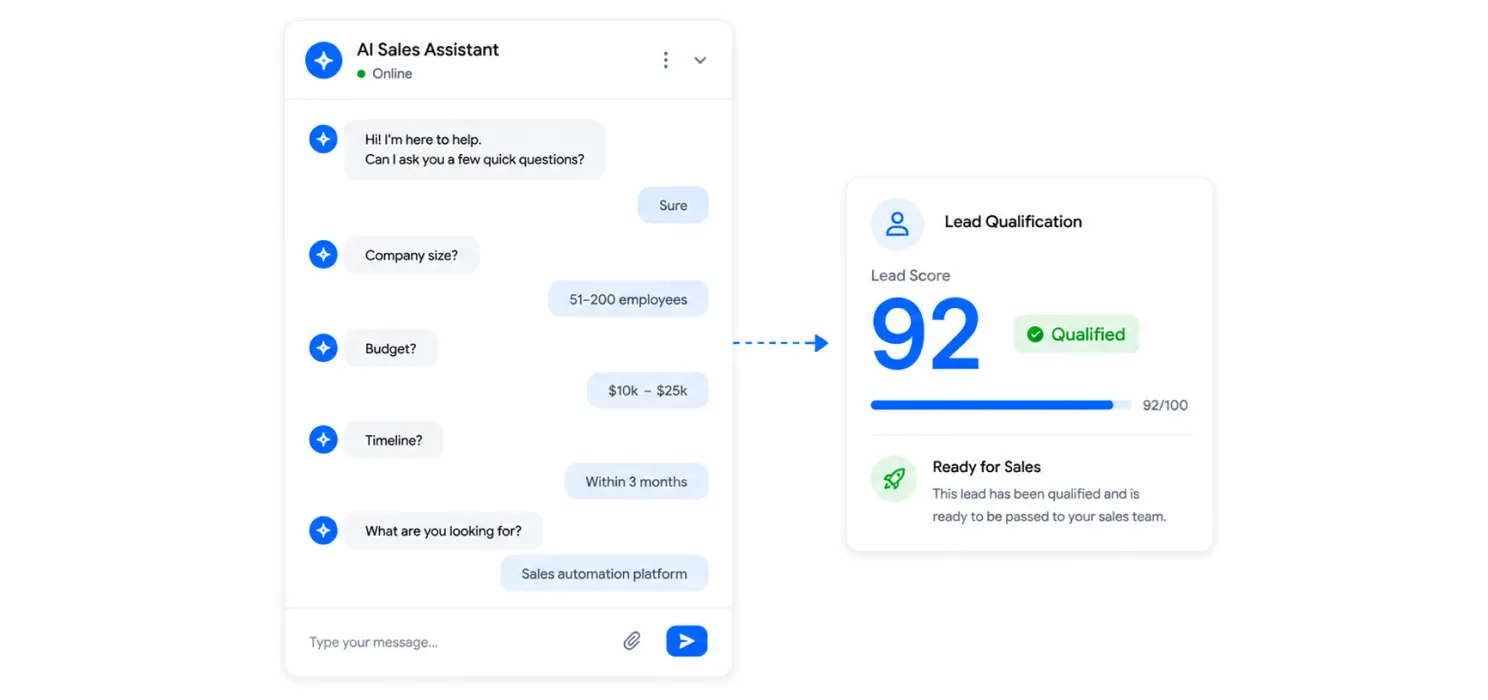
An instant lead qualification bot is an always-on AI assistant (chatbot, voicebot or multichannel agent) that greets website visitors or inbound prospects immediately and asks them predefined or AI-generated questions to determine if they match your Ideal Customer Profile.
Unlike static forms, these bots converse naturally (via text or voice), collect lead data (name, company, needs, budget, timeline, etc.), assign a lead score based on business rules or AI models, and then automatically route “hot” leads to sales.
For example, Zapshere’s tech-focused bot asks about company size, tech stack, budget and timeline to pre-qualify each lead and immediately hand off qualified ones to account executives. In short, think of it as an always-on sales assistant: it engages leads instantly (often within seconds), gathers qualification info, applies your criteria (e.g. BANT, technographics), and routes or schedules follow-up for the sales team without any manual form-filling or delay.
These bots rely on technologies like natural language processing (NLP) or guided chat flows. Some use large language models (GPT-4, Claude, etc.) to understand free-form input; others use simple rule-based menus or AI-driven scoring.
They often integrate with automation engines (Make.com, n8n, Zapier) and CRMs (Salesforce, HubSpot, etc.) so that every conversation is logged and leads are synced into your systems. In practice, a visitor clicking a chat widget triggers the bot to greet them and ask qualifying questions.
The bot then calculates a lead score (based on answers or behavior) and classifies the lead. Qualified leads can be instantly sent to sales or even booked for a meeting via calendar integration, while lower-priority leads are tagged for nurture (email drip, SMS follow-up, etc.).
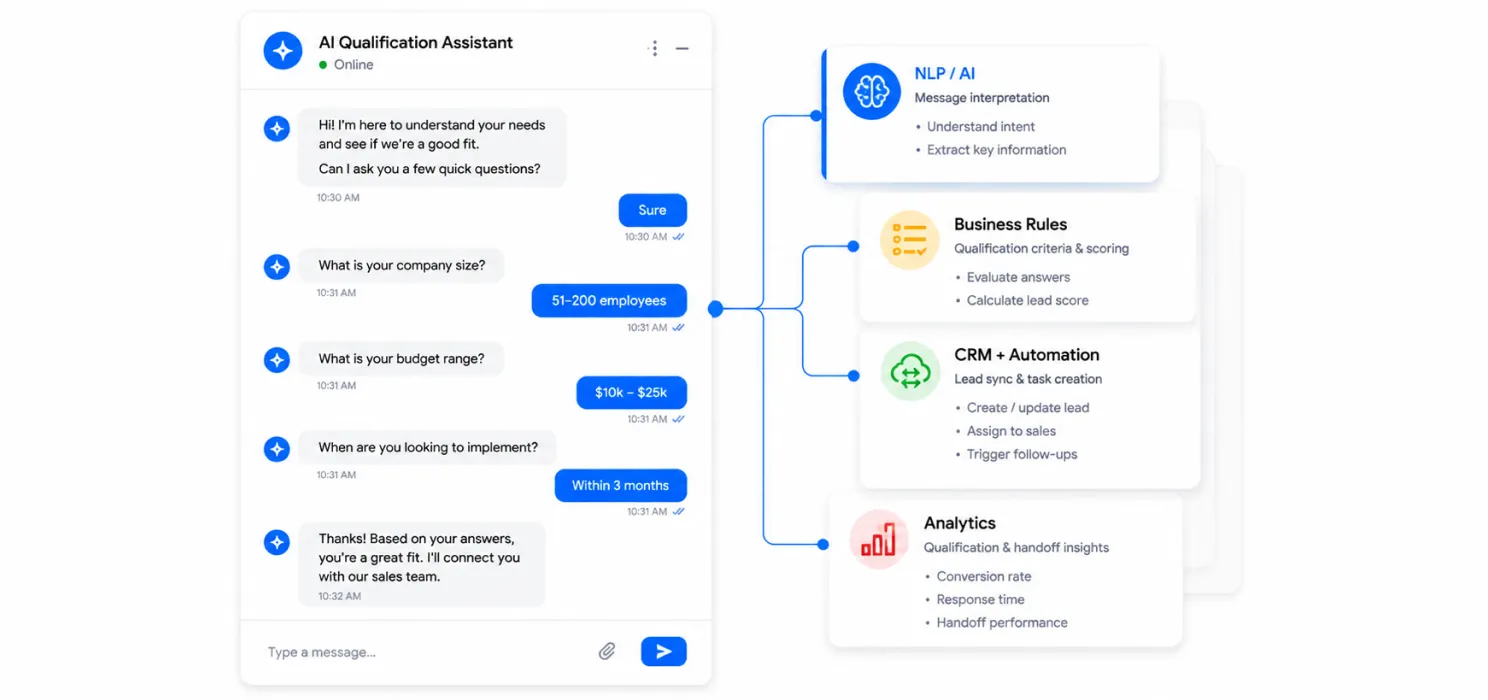
Conversation interface: web chat widget, WhatsApp/SMS, or voice call. (E.g. a real estate bot might text leads or even call them, in addition to website chat.)
NLP/chatflow engine: Understands user inputs and guides the dialog. This can be menu-driven or powered by AI models (GPT, Claude, etc.) for more natural chat. Zapshere, for example, uses GPT-4 and Google Gemini in its qualification flows.
Business rules & scoring: Each answer triggers predefined logic or points. Criteria could include budget, authority, need or timeline (BANT), plus firmographics. Some systems add predictive scoring by analyzing behaviors (page views, link clicks) to estimate buying intent.
Automation & CRM integration: Connectors automatically log lead data to the CRM (Salesforce, HubSpot, Marketo, etc.) and trigger actions. For instance, a high-scoring lead may spawn a “hot lead” task in the CRM, send an email to a sales rep, or book a demo on the calendar. Zapshere’s stack includes HubSpot and Salesforce integration alongside workflow engines like n8n and Zapier.
Analytics & monitoring: Bots provide dashboards or alerts (e.g. conversation transcripts, qualification rates, bot vs human handoff counts) so teams can refine performance. These metrics help measure ROI (more on that below).
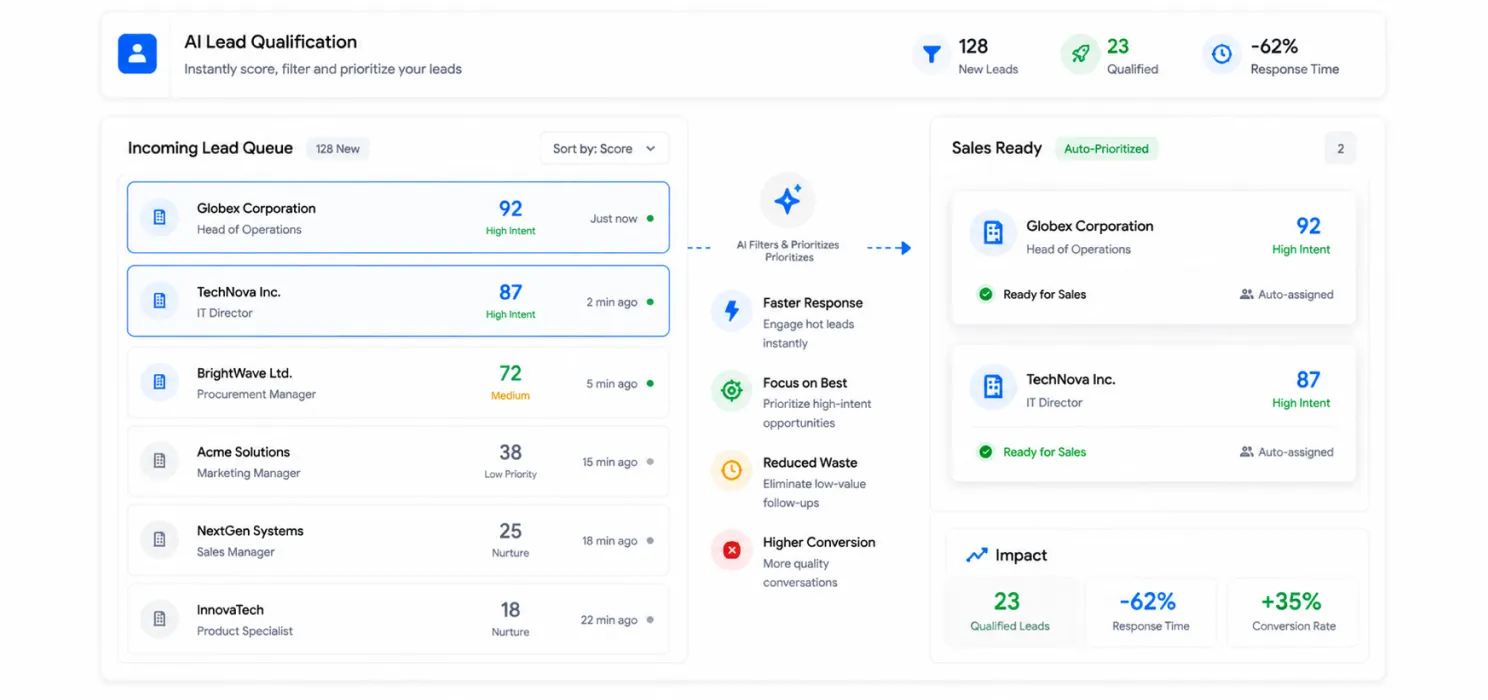
Instant AI lead qualification bots deliver multiple measurable advantages:
Time Savings & Faster Response: Bots engage leads immediately (24/7), eliminating the delay of manual follow-up. Studies show responding within the first hour yields ~7× higher qualification odds than slower follow-up. In practice, bots shrink response times from days to minutes. Faster engagement means fewer cold leads and happier prospects; sales reps can focus on selling instead of chasing. For example, one company cut its sales cycle by 35% after implementing real-time scoring and alerts.
Higher Conversion Rates: By filtering out low-quality leads and giving sales only “sales-ready” prospects, conversion rates jump. Research finds properly qualified leads convert ~40% of the time, versus only ~11% for unqualified leads. Chatbot-led funnels can convert 2–3× higher than traditional form fills. Companies that used instant bots report big lifts: one tech firm saw a +40% conversion increase after deploying an AI qualification bot.
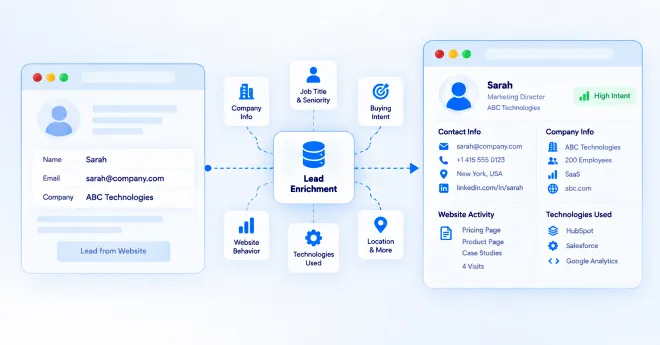
Lead Prioritization: Bots use scoring to rank leads by fit and intent. High-intent visitors (e.g. repeated page views, content downloads) get top priority. This predictive prioritization means reps spend time on the hottest leads first. Tools with AI scoring identify buying signals beyond explicit answers – for example, flagging a long web session as intent even if the visitor hasn’t given budget info. In short, automation ensures the “A” leads don’t languish in the queue.
Cost Savings: Automating qualification reduces the need for large SDR teams. A bot can handle the load of many chats or calls simultaneously, and at all hours, for a fraction of the cost of human labor. This lowers cost-per-lead by filtering out poor leads early. In one case, a company cut its cost per qualified lead from $150 to $80 using automated scoring and prioritization. Resources are reallocated to closing deals rather than handling unqualified inquiries.
Improved Customer Experience: Prospects get instant, helpful responses instead of waiting. Immediate acknowledgement (even of form submissions) makes leads feel valued. Bots can personalize based on the visitor’s behavior (e.g. “I see you downloaded our whitepaper – do you have questions about X?”). This kind of proactive outreach creates a positive impression and nurtures engagement. Additionally, by routing or escalating quickly, bots reduce frustration as Intercom found, simply asking “Are you an existing customer?” upfront avoided long back-and-forth and improved the journey for both new leads and current users.
Consistent Qualification: Bots apply the same criteria every time, eliminating human bias and error. Every lead is evaluated against your ICP automatically, so no qualified prospect is accidentally dropped due to an oversight. This consistency yields a more predictable pipeline. In fact, companies that institute systematic qualification see 33% higher close rates on BANT-qualified deals, underscoring the value of disciplined lead vetting.
Scalability: As traffic grows, bots scale effortlessly. They handle spikes in website visits without additional cost. If more leads come in, the bot just processes them in parallel, whereas a human team would need dozens more reps. This is especially valuable for seasonal peaks or successful marketing campaigns. Plus, the integration with CRM ensures the process scales end-to-end: every new lead still flows into your sales pipeline without human bottlenecks.
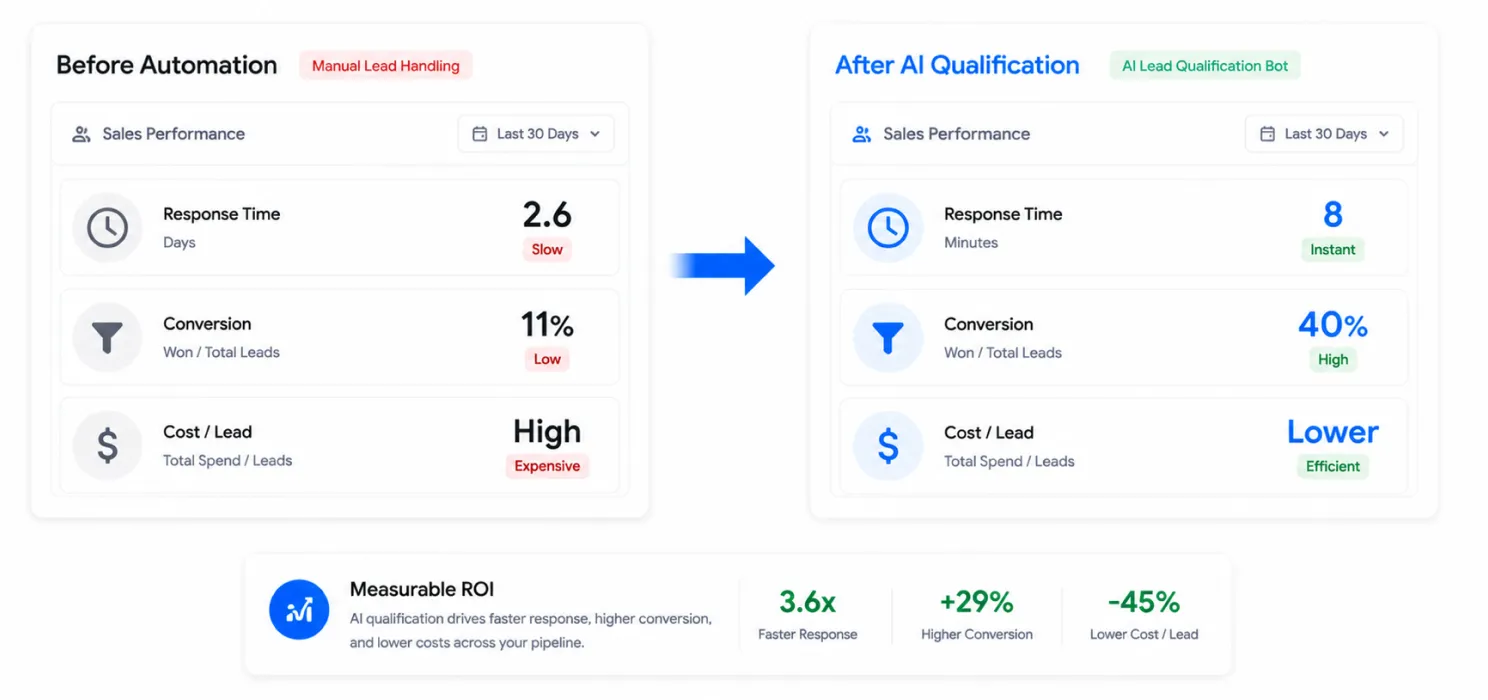
To quantify impact, teams track metrics both pre- and post-automation:
Response Time / Speed-to-Lead: Measure time from lead capture to first human or bot response. Benchmarks suggest <1 hour yields ~7× higher qualification odds. Bots can push that to minutes, dramatically increasing the chance of conversion.
Conversion Lift: Compare conversion rates (lead→opportunity or lead→MQL→SQL) before and after bot deployment. Industry data: chatbot-driven funnels see 2.4× higher conversion than web forms, and overall lead conversion via conversational marketing is +30%. Track metrics like Qualified Lead Rate (qualified leads ÷ total inbound leads) and lead-to-deal %. For example, one company saw the proportion of qualified leads jump (70% of their qualified pipeline came from Conversica AI) and closed deals 3× faster.
Cost per Lead/Opportunity: Calculate total spend on lead gen divided by leads (or qualified leads). Bots often drive this down. Case in point, a service provider slashed cost per lead dramatically by using predictive scoring and automation. Monitor cost per opportunity or cost per closed deal to see ROI.
Lead-to-Opportunity & Lead-to-Customer Rates: See how many bot-qualified leads become opportunities or customers versus baseline. “Properly qualified” leads should convert ~4× better. Tracking the opportunity win rate gives a clear ROI signal.
Pipeline Contribution / ROI: Measure pipeline or revenue directly influenced by the bot. Many vendors provide revenue attribution for bot-engaged leads. Conversica clients report huge ROI: e.g. a sports team saw 7.5× ROI in year one, another 25× by year three. Even one big deal revived by an AI agent (a $500K sale on a holiday weekend) was cited as ROI. Use dashboards or CRM reports to capture new pipeline, deals, or revenue originating from bot interactions.
Engagement & Productivity Metrics: Internally, measure how many leads a rep handles and their selling time. After automation, teams have reported reps shifting from 35% to over 90% of time on actual calls/demos. Track rep activity (calls, meetings) and see if bots free up time.
Customer Experience Indicators: Survey results or NPS for lead inquiries can reflect improved experience due to instant responses.
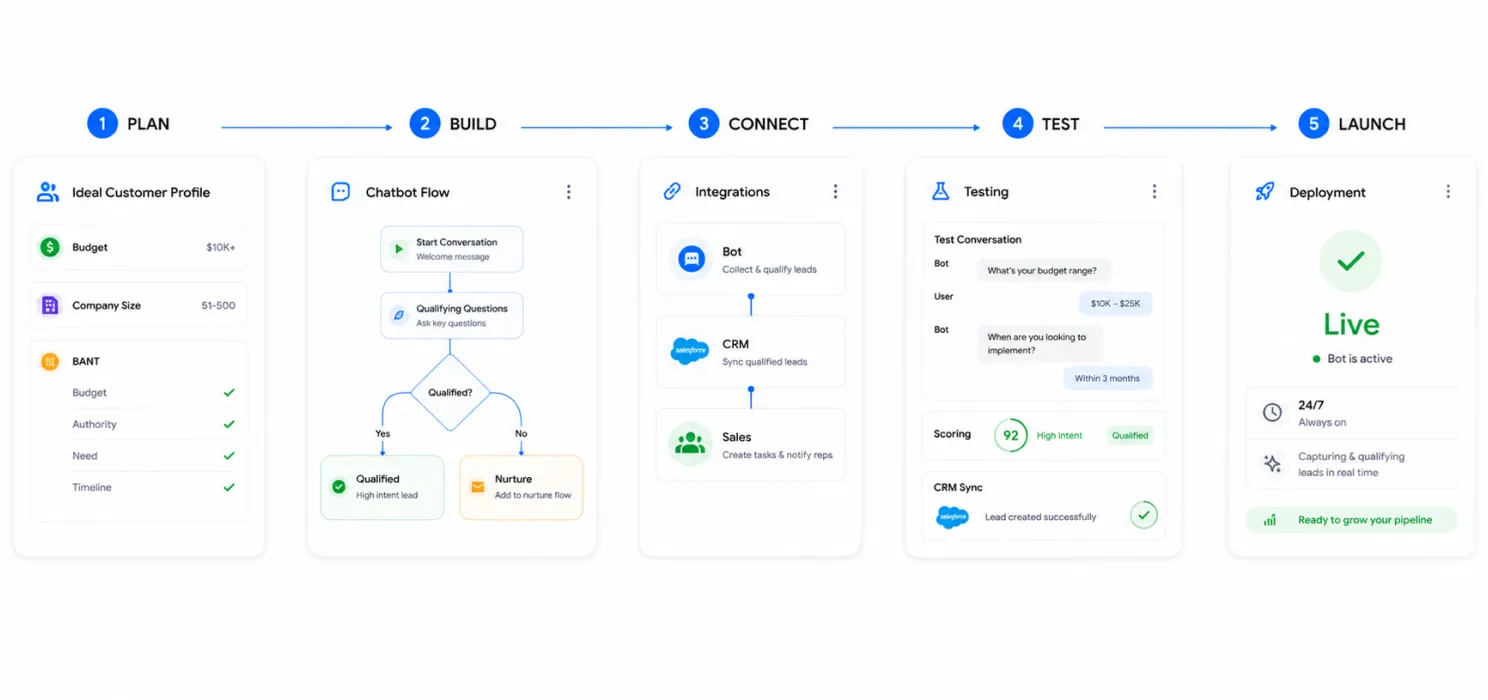
Assess and Plan: Audit your current lead process. Identify bottlenecks (slow scoring, missing info). Define your ideal customer profile (ICP) and qualification criteria (BANT, budget range, company size, etc.). Decide what triggers to use (site visit, form fill, ad click).
Map Buyer Journey: Chart typical visitor paths (pricing page, blog, campaign landing, etc.). Determine where bots should appear (e.g., on high-intent pages like pricing or demo sign-ups) and what questions to ask there.
Build Conversational Flows: Using an AI chatbot builder or AI platform, design the dialog steps. Include key questions to gather lead info and logic branches (e.g., multiple choice or open text). Many platforms (Landbot, Intercom Custom Bots, Drift Playbooks) let you do this with drag-and-drop or simple scripts. Use friendly, concise language and provide quick buttons/options to streamline the chat.
Set Up Scoring & Routing: Define how answers map to scores. For example, assign points for industry fit or budget above threshold. Set a cutoff score for “qualified” versus “nurture.” Then configure integrations: connect your bot to the CRM or email system. Automate actions (e.g., if lead is hot, create CRM record, notify rep or book meeting). Tools often support native integrations (Salesforce, HubSpot) or webhooks. As Zapier shows, common stacks include integration engines (n8n, Zapier) to link chatbots with CRMs.
Multi-Channel Deployment: Consider channels beyond web. Bots can live on websites, in Facebook/WhatsApp messaging, or even answer inbound phone calls with voice AI. Deploy on whichever channels your leads use. For example, text messaging bots can instantly engage SMS leads, and AI voice agents can answer after-hours calls.
Test Thoroughly: Before going live, role-play scenarios. Test edge cases: what if a prospect asks an unexpected question? Ensure graceful fallback (offer to hand off to a human). Verify that the scoring logic works and that data flows correctly to CRM. Check that calendar links work and notifications arrive.
Soft Launch & Train Team: Start by sending a portion of leads to the bot (keeping some manual as backup). Monitor early interactions closely. Review transcripts with sales to catch misunderstandings or language tweaks. Use analytics: conversation completion rate, average chat length, lead score distribution to see if it aligns with expectations. Train sales on reading bot handoffs (the summary context it provides) and on how to handle bot-qualified leads immediately.
Iterate and Scale: Based on feedback and metrics, refine the bot: improve phrasing, adjust questions, tweak scoring. Add more branches or language options if needed. Once confident, route all inbound leads through the bot and retire old forms. Gradually expand coverage (more pages, channels, follow-up sequences). Best practice is to treat the bot like a junior SDR – continuously coach it with new scripts and update qualification criteria as your market evolves.
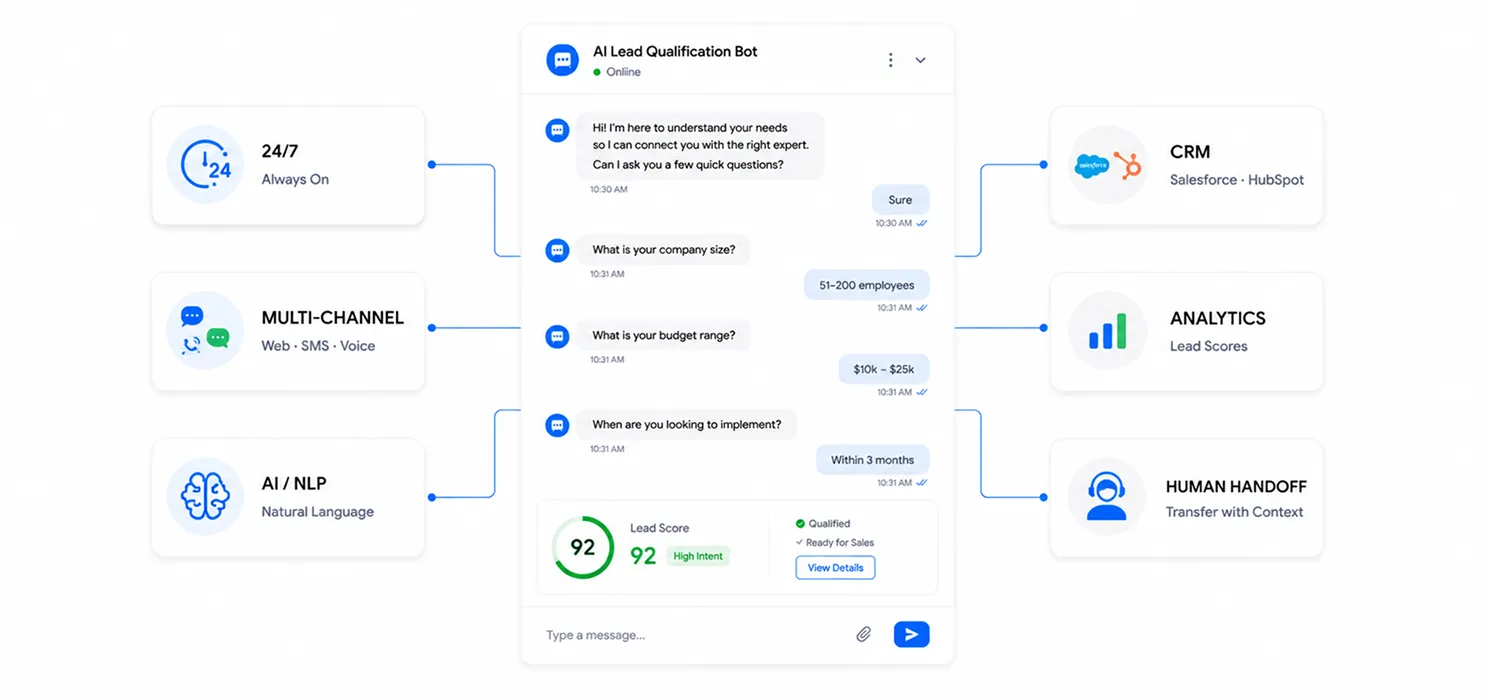
When evaluating or building a lead bot, look for these features:
24/7 Live Engagement: Bot must work round-the-clock on your site or app.
Multi-Channel Support: Ability to run on web, mobile apps, social (Facebook Messenger, WhatsApp), or even outbound SMS/voice. Ideally, the same conversation logic works across channels.
Natural Language Understanding: NLP or AI that can interpret free-text answers (not just rigid form options). This enables more fluid chats and better lead info capture.
Customizable Qualification Logic: You should be able to set your own questions, scoring, and branching logic to match your ICP and sales criteria. Look for platforms that allow both explicit rules and AI-driven scoring.
CRM & Calendars Integration: Out-of-the-box connectors to Salesforce, HubSpot, Marketo, Zendesk, etc., plus calendar tools (Zoom, Calendly) to auto-book meetings. Integrations ensure data flows seamlessly – as Zapshere uses for HubSpot and Google Calendar.
Automated Workflows: Beyond CRM, integrations with email/SMS systems to auto-enroll leads in nurture sequences if not qualified immediately.
Agent Handoff & Human Takeover: Even the best bot should escalate to a human when needed. Choose a bot that can transfer chats to live reps or schedule callbacks without losing context.
Analytics & Reporting: Built-in dashboards for lead scores, qualification rates, response times, conversation volumes, etc. This visibility is crucial for ROI tracking and optimization.
AI Capabilities: Advanced bots (like Conversica’s or Qualified’s) offer generative responses and intelligent follow-ups (multi-turn dialogues). Evaluate if you need that vs. a rule-based chat.
Brand Customization: Ability to train the bot on your company’s tone, FAQs, product information. Conversica highlights that its agents are trained on your policies and tone for “brand-safe” conversations.
Security & Compliance: For enterprise use, ensure SOC 2/GDPR compliance, data encryption, and audit logs, especially if dealing with regulated industries.
Scalability: The solution should handle spikes in volume and multiple languages if needed.
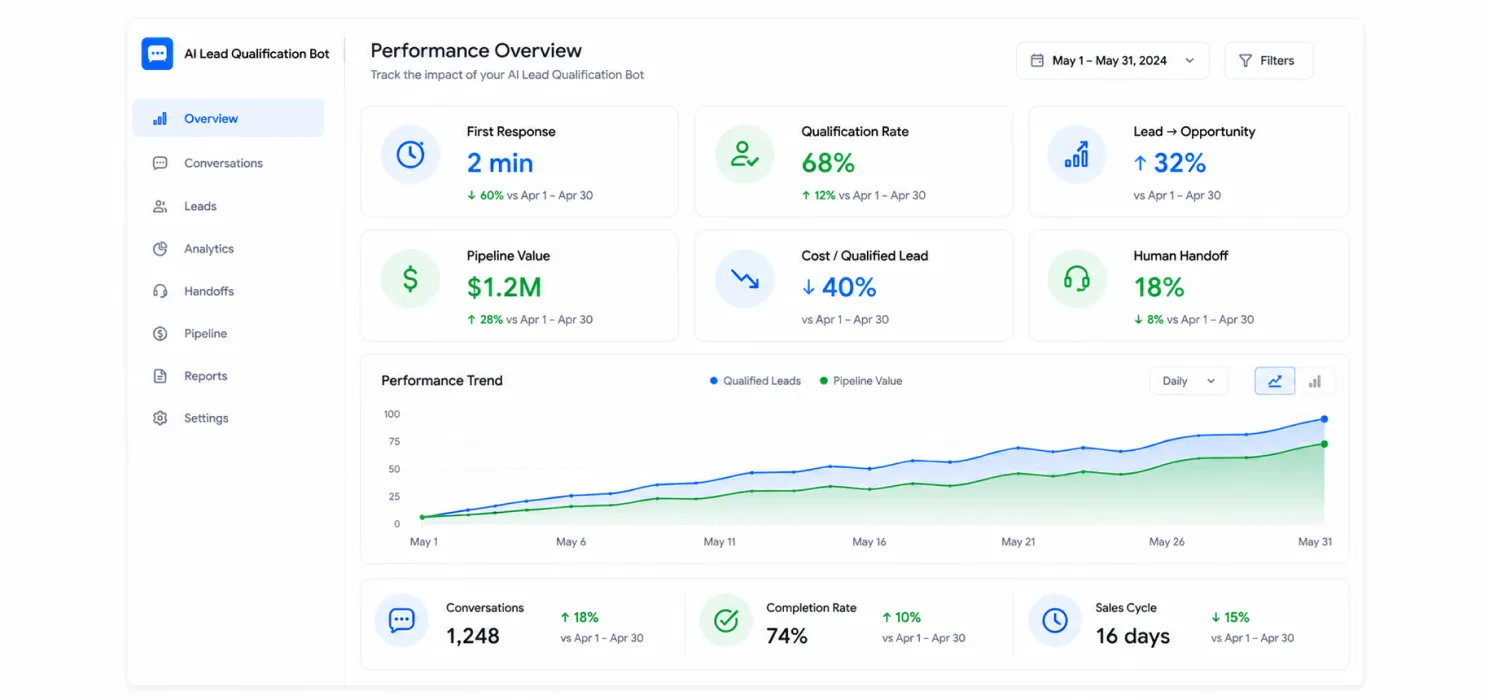
To continually measure success, monitor:
Time-to-First-Response: Aim for seconds or minutes. Track your average bot vs human response time; a drop in this metric should correlate with higher lead response rates.
Qualification Rate: % of leads who meet the bot’s criteria. (Higher isn’t always better if it means missing marginal leads, but track it.)
Lead-to-Opportunity and Lead-to-Customer Conversion: How many bot-qualified leads become pipeline/opportunity, then closed deals? Compare pre-automation and post-automation.
Pipeline Value from Bot: Dollar value of pipeline or deals attributed to bot engagements. Use CRM tagging or attribution models.
Cost per Qualified Lead/Deal: Calculate savings by comparing labor cost vs bot cost per lead acquired or deal closed.
Bot Engagement Metrics: Chat completion rate (how many users finish the qualification flow), number of leads captured, number of conversations.
Human Handoff Rate: % of conversations transferred to reps – helps assess how often buyers needed a human touch.
Sales Cycle Length: Measure if the time from first contact to close has shortened after bot deployment.
Customer/Lead Satisfaction: If possible, collect feedback on the bot interaction (e.g. a quick survey post-chat).
Corvexa: Turn Website Visitors Into Qualified Leads
Corvexa is an AI-powered lead capture and qualification platform designed to help businesses engage website visitors, understand their intent, and identify high-potential prospects in real time.
Instead of relying only on static forms, Corvexa can start a conversation with visitors as soon as they show interest. It can ask relevant questions, collect important lead information, and help determine whether a prospect fits your ideal customer profile.
For example, a business can configure Corvexa to qualify visitors based on factors such as their company, role, requirements, budget, and buying timeline. The AI can then help separate high-intent prospects from visitors who may need further nurturing.
How Corvexa supports lead qualification
Corvexa brings several parts of the lead qualification process together:
- Instant engagement: Engage website visitors 24/7 instead of making them wait for a sales representative.
- AI-powered conversations: Visitors can interact naturally with an AI assistant rather than filling out lengthy forms.
- Lead qualification: Ask customized questions based on your ICP and sales requirements.
- Lead scoring: Identify and prioritize prospects based on the information they provide and their level of intent.
- CRM integration: Send captured lead information to platforms such as HubSpot and Salesforce so sales teams have the necessary context.
- Meeting booking: Qualified prospects can be directed toward scheduling a demo or sales meeting.
- Automated follow-up: Leads that are not immediately sales-ready can be moved into appropriate follow-up workflows.
- Human handoff: When a prospect needs personal assistance, the conversation can be handed over to a sales representative.
The result is a more streamlined journey from website visitor → conversation → qualification → sales handoff.
For B2B teams dealing with a high volume of inbound traffic, Corvexa can reduce the manual work involved in asking repetitive qualification questions while helping sales representatives focus their time on prospects with stronger buying potential.
The key is not simply to automate conversations, but to connect those conversations with your existing sales process. When the AI, qualification criteria, CRM, and follow-up workflows work together, businesses can respond faster while building a more organized and measurable lead pipeline.

Instant lead qualification bots help businesses respond faster, identify high-quality leads, and save sales teams time. They automate early conversations, collect key information, and send qualified prospects to the right reps.
For the best results, set clear qualification criteria, connect the bot with your CRM, and track metrics like response time, conversion rate, and cost per lead.
In short, these bots provide instant engagement, smarter lead filtering, and more efficient sales—helping teams focus less on unqualified leads and more on closing deals.

 Stop Wasting Time: Instant Lead Qualification Bot Benefits

Choosing the wrong vendor is the single biggest reason enterprise AI automation projects stall, blow past budget, or quietly die...
B2B customer acquisition gets harder as a business grows. More website visitors, more leads, more conversations, and more follow-ups can...
A website visitor can leave behind very little information. They may read a few pages, check your pricing, download a...