
 8 Mins Read
From First Call to Launch: What Really Happens When You Hire an AI Automation Agency
Quick summary Sales pitches make AI automation sound instant. Reality involves several distinct stages, and most delays happen in the...

| Quick summary Every business weighing AI has to answer one question: build a team, hire an agency, or buy something ready-made? This guide compares the real cost of hiring AI engineers against outsourcing, shows a simple ROI calculation, and explains when each option, including a ready-built platform, actually makes sense. |
A founder posts a job for “AI Engineer.” The salary line reads $180,000. Benefits, recruiting fees, and a four-month hiring process are not on the job post, but they are coming.
Down the hall, someone else is getting quotes from AI agencies. One wants $40,000 for a three-month build. Another wants $150 an hour with no end date in sight.
Both paths can work. Both can also burn months and budget on the wrong choice. Let’s look at the real numbers, side by side, without the sales pitch.
The salary number is only the starting point. Here is what US employers typically pay for AI and machine learning talent in 2026, based on multiple salary surveys.
| Level | Base salary (US) | Typical scope |
| Junior (0-2 yrs) | $120,000 – $170,000 | Supports senior engineers, wires up existing tools |
| Mid-level (3-5 yrs) | $155,000 – $200,000 | Builds and maintains production AI features |
| Senior (6+ yrs) | $160,000 – $230,000+ | Leads architecture, owns reliability and results |
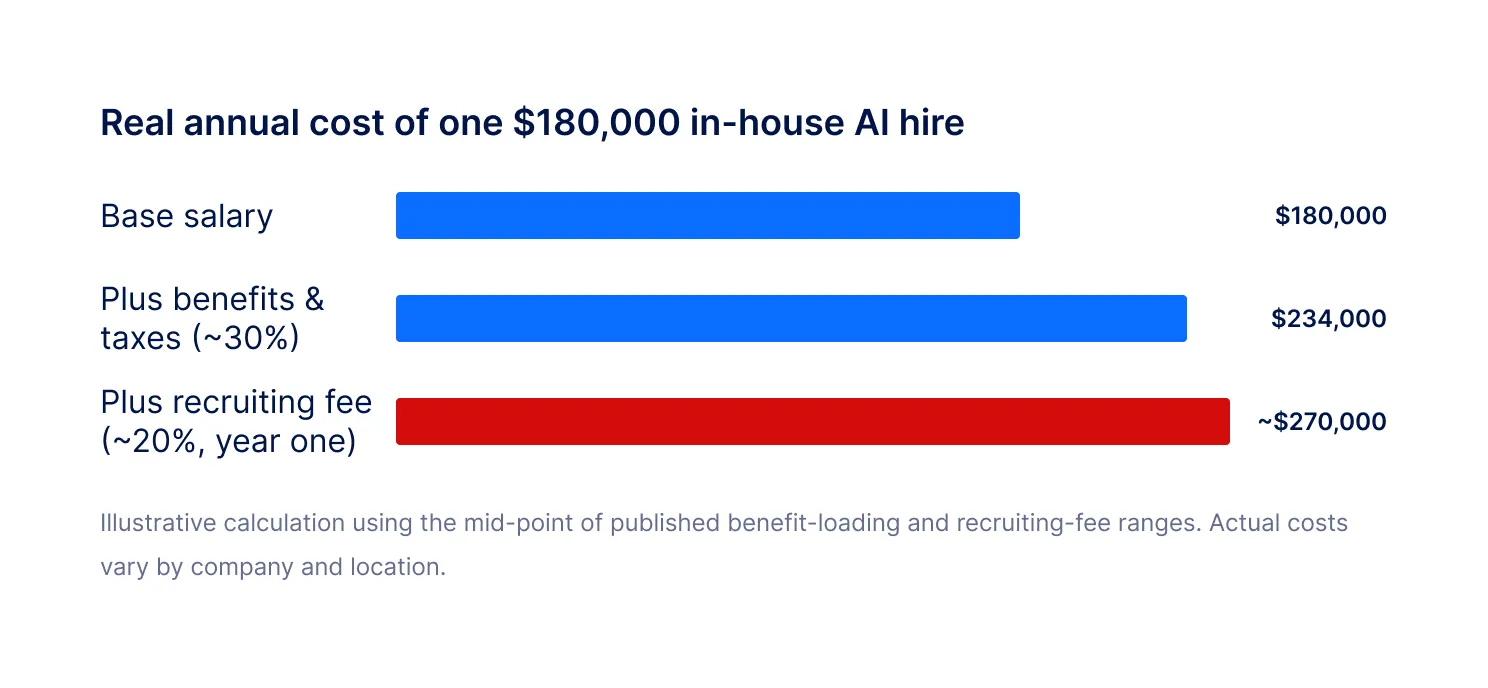
Unico Connect explains that a US in-house hire carries real extras on top of base pay: benefits and payroll taxes commonly add 25% to 35%, recruiting through an agency adds another 15% to 25% of first-year salary, and equipment or cloud access adds a few thousand dollars more per engineer, per year.
Outsourced AI work is priced very differently, and the range is wide. Here is a rough guide to 2026 rates.
| Route | Typical rate | Best for |
| Offshore contractor | $15 – $50/hr | Clearly defined, well-specified work |
| Nearshore team | $40 – $85/hr | Work needing overlap hours and closer collaboration |
| US-based freelancer or agency | $90 – $250+/hr | Complex, high-stakes or fast-moving projects |
| Project-based agency build | $15,000 – $150,000+ per project | A defined deliverable with a clear scope |
Here is the honest comparison, factor by factor.
| Factor | In-house team | Outsourced agency |
| Time to first result | 2 to 4 months to hire, plus ramp-up | Often 1 to 2 weeks to start |
| Cost predictability | Fixed salary, but hidden extras add up | Varies by scope; can run over on open-ended work |
| Long-term cost at scale | Can be lower over several years | Ongoing hourly or retainer fees add up |
| Institutional knowledge | Stays with your company | Can walk out the door with the agency |
| Flexibility to scale down | Hard; layoffs are costly and slow | Easier to pause or end an engagement |
| Risk if AI is not core to your product | High; a costly team may be under-used | Lower; pay only for the work you need |
Before choosing a route, put a number on what you actually expect to gain. A simple AI automation ROI calculation looks like this.

A worked example
Say an AI lead capture tool costs $1,548 a year (Corvexa Pro at $129/month) and helps you close two extra deals worth $10,000 each. Value gained is 20,000.ROI=(20,000 − $1,548) ÷ $1,548 ≈ 12.9, or roughly 13x the cost. Compare that with a $270,000 in-house hire that would need to generate that same value many times over just to break even in year one. This example is illustrative. Your own numbers, deal size and close rate will differ, so run your own math before deciding.
If AI is the product itself, not a feature, deep ongoing ownership usually wins over time.ValueStream AI puts it simply: hire in-house if agents will be core to your product for years, because no external relationship beats a team that lives with the system daily.
Complex, evolving systems benefit from people who understand your data, users and edge cases without being briefed every sprint.
Two to four months of hiring, plus onboarding, is a real cost. Make sure your timeline allows it.
Unico Connect notes that a partner can often share vetted candidates within a week and onboard in about two weeks, compared with two to four months in-house.
A one-off build, integration or proof of concept fits a project-based engagement well.
If nobody on your team can specify, review and manage AI development, a specialist partner brings that structure with them.
Some teams start with an agency partner and hire in-house in parallel once the need is proven, rather than betting on a full hire from day one.
For many common business needs, yes. Not every AI project needs custom development. If your goal is a specific, well-understood outcome, such as capturing and qualifying website leads, a ready-built AI platform can often deliver similar value for a fraction of the cost and time of either route above.
| In-house team | AI agency | Ready-built platform | |
| Time to launch | 2-4 months | 2-8+ weeks | Days |
| Upfront cost | High | Medium to high | Low, often no setup fee |
| Ongoing cost | Salary + overhead | Retainer or hourly | Flat monthly plan |
| Best fit | AI is core to your product | Custom, one-off builds | Common, well-defined needs |
For lead capture and qualification specifically, this is exactly the gap Corvexa is built to fill. Instead of hiring an engineer or briefing an agency to build a custom chatbot from scratch, you get a working AI sales agent, configured to your business, live within 48 hours of your onboarding call. Seefeatures andpricing, which starts at $39 a month.
| Note This is not a claim that platforms replace custom AI development for every use case. For deep, product-specific AI, in-house or agency work is often still the right call. For a common, well-understood job like turning website visitors into qualified leads, a ready-built tool is usually the faster and cheaper path. |
Yes, and many companies do. A common pattern is one experienced AI engineer working alongside your existing team, rather than a separate AI department, brought in through a contractor or agency relationship at first.
Some teams deliberately begin with an agency or contractor to validate that a use case is worth the investment, then bring the work in-house once it is core to the business and the ROI is clear.
A small in-house team can lean on outside specialists for occasional, deep technical work, such as a security review or a one-off integration, without hiring a full-time person for something needed a few times a year.
Even companies with a strong in-house AI team often buy, rather than build, tools for well-solved problems like website lead capture, so their engineers can focus on work that is genuinely unique to the business.
If the work has a clear end date, a full-time hire often sits idle once it is done.
The cheapest rate can mean the slowest delivery and the most rework. Compare cost per outcome, not cost per hour.
Decide what you expect to gain before you decide how to build it. A tool that costs less than the value it creates is worth it, whichever route delivers it.
Reinventing something for a common problem, like lead qualification, usually costs more and takes longer than adopting a proven platform.
If a system needs daily tuning and deep product context, a short-term agency engagement can leave you stuck once the contract ends.
In-house AI hiring gives you ownership and long-term control, at a real cost: often $200,000 or more a year once overhead is included, and two to four months before anything ships. Agencies move faster and can flex up or down, but costs add up over time, and quality varies by who you hire.
For many businesses, the smartest first move is neither. It is checking whether a well-built, ready-made platform already solves the specific problem you are trying to fix, before spending months and six figures building the same thing from scratch.

FAQ
Find answers to common questions about AI team hiring costs, agency pricing, development timelines, ROI, and affordable alternatives to custom AI development.
For most small and mid-size businesses, an agency or a ready-built platform is cheaper upfront, because in-house hiring carries salary, benefits, recruiting and ramp-up costs before any work ships. In-house can become more cost-effective at large scale, over several years, if AI is core to your product.
US base salaries for AI or ML engineers typically run from about $130,000 to $230,000 depending on seniority and location, and the fully loaded cost, including benefits and payroll taxes, is usually 1.25 to 1.4 times the base salary.
Agency and contractor rates vary widely, roughly $50 to $250 or more per hour depending on seniority, specialization and location, with offshore and nearshore rates generally lower than US-based teams.
Hiring in-house in the US typically takes two to four months from opening the role to shipped work, once notice periods and ramp-up time are included. An agency or partner can often start within one to two weeks.
AI automation ROI compares the value gained, such as time saved or leads captured, against the total cost of the solution, including salaries, tools, agency fees or subscription cost. A simple formula is (value gained minus total cost) divided by total cost.
 In-House AI Team vs Outsourced AI Agency: The Brutal Cost Comparison

Quick summary Sales pitches make AI automation sound instant. Reality involves several distinct stages, and most delays happen in the...
Quick summary Gartner predicts that over 40% of agentic AI projects will be canceled by 2027, mostly because of poor...
Not every AI automation project needs to be a six-month enterprise overhaul. Some of the highest-value workflows to automate with...