
 9 Mins Read
How Much Does It Cost to Build a Custom AI Agent? (Real Pricing Breakdown)
This blog breaks down real 2026 pricing for custom AI agent development, from simple single-task agents to full enterprise multi-agent...

| Quick summary Gartner predicts that over 40% of agentic AI projects will be canceled by 2027, mostly because of poor vendor and scope decisions, not bad technology. This guide lays out a clear process for choosing the best custom AI agent development company for your industry, what to ask, which red flags to avoid, and when a ready-built platform is the smarter choice. |
A sales pitch, a slick demo, a confident promise. Six months later, the project is quietly shelved, and nobody wants to explain why in the next board meeting.
This happens more than the industry likes to admit. Gartner predicts thatover 40% of agentic AI projects will be canceled by the end of 2027, citing escalating costs, unclear business value, and inadequate risk controls. The technology usually is not the problem. The vendor decision often is.
This guide walks through how to choose an AI agent development company well, so your project ends up in the 60% that ships, not the 40% that gets quietly canceled.
It helps to understand the failure pattern before you pick a vendor, because it points directly at what to check for.
Gartner analyst Anushree Verma put it plainly: most agentic AI projects right now are early-stage experiments or proof of concepts, mostly driven by hype and often misapplied. That blinds organizations to the real cost and complexity of deploying agents at scale.
A demo is cheap. Production-grade reliability, security, and integration work is not. Vendors who do not walk you through this gap upfront are setting you up for a budget surprise.
Industry analysis notes that many failed projects are judged against narrow cost-savings metrics instead of measuring what agents actually deliver, such as accuracy improvements or compliance benefits. If success is not defined before the project starts, it cannot be measured after.
| Did you know? The same Gartner research found that only 19% of surveyed organizations had made significant investment in agentic AI, while 42% made only conservative investments and 8% made none at all. Most companies are still finding their footing, which is exactly why picking the right vendor matters so much right now. |
Generic AI experience is not the same as experience in your industry. Different sectors need very different things from a vendor.
| Industry | What to prioritize in a vendor |
| SaaS | API integration depth, experience with your tech stack, ongoing iteration support |
| Fintech | Compliance experience, security certifications, audit trail capability |
| Healthcare | Data privacy expertise, relevant regulatory experience, clinical workflow understanding |
| Real estate | CRM and listing platform integrations, lead handling at scale |
| Manufacturing/logistics | Legacy system integration, on-premises or hybrid deployment options |
| Professional services | Custom workflow modeling, confidentiality and data handling practices |
| Tip Ask every shortlisted vendor for two references in your specific industry, not just their two best case studies overall. A brilliant fintech build says little about how they will handle a real estate CRM integration. |
Use these questions in every vendor call. Vague or evasive answers are the clearest red flag you will get.
Ask to see it working, not just a slide. Ask what went wrong along the way, since every real project hits some friction.
A strong vendor will ask you this question before you ask them. If they cannot describe how they will know the project worked, that is a warning sign.
Get this in writing. Some contracts leave you locked into the vendor for every future change.
AI projects often need course correction once real data enters the picture. Ask how change requests are priced and handled.
Especially critical for fintech, healthcare, and any business handling sensitive customer data.
A launch date is not a finish line. Ask how long they expect it to take before the agent performs reliably in production.
SaaS is one of the most common places custom AI agent projects happen, and it has its own checklist beyond the general one above.
A strong AI development company for SaaS should be able to show real integrations with tools like Stripe, HubSpot, Salesforce or your own product’s API, not just a chatbot layered on top of a website.
SaaS moves fast. Look for a vendor used to shipping in short cycles and adjusting based on real usage data, rather than a single fixed-scope handoff.
Self-serve, sales-led, and enterprise SaaS need very different agent behavior. A vendor who asks about your go-to-market model before proposing a solution understands this distinction.
Custom AI agents by industry are not interchangeable. An agent built for a hospital’s clinical workflow and one built for a real estate listing site solve completely different problems, with different rules, risks, and data.
This is why the industry table above matters more than a vendor’s overall AI expertise. A team with ten years of general software experience but no fintech compliance background is a genuine risk for a fintech agent project, however strong their engineering is elsewhere.
Enterprise deals raise the stakes further, since more teams, systems, and compliance requirements are involved. An enterprise AI vendor comparison should go beyond the four factors above and include:
Score finalists against this list in a shared document, and involve your security and legal teams early rather than after a vendor is already chosen.

Score each shortlisted vendor the same way, so the comparison is fair rather than based on who gave the best pitch.
Score each vendor from 1 to 5 on these four factors. A vendor who scores well on industry fit but poorly on scope clarity is a bigger risk than the score alone suggests, since unclear scope is the leading cause of the cost overruns Gartner points to.
No, and this is worth being honest about before you spend months on vendor selection. Custom AI agent development makes sense when your need is genuinely specific to your business, your data, or your industry’s regulations.
It is often the wrong choice for a common, well-understood problem that has already been solved well by an existing platform. Website lead capture and qualification is a good example: dozens of businesses across SaaS, real estate, fintech, and professional services need almost the same thing, which is why a configurable, ready-built AI agent can deliver the same result in days instead of months, without a six-figure project.
| Note This is not a claim that platforms replace custom development for every use case. For deeply product-specific AI, a properly vetted development company is often the right call. For common needs like lead capture, check whether a ready-built tool already solves it before commissioning a custom build. |
Corvexa is one example of this kind of ready-built agent, purpose-built for turning website visitors into qualified leads, configured to your business during onboarding rather than built from scratch. Seehow it works andpricing, which starts at $39 a month.
Write down the outcome, the success metrics, the budget range, and the internal owner before contacting anyone.
Contact three to five vendors with relevant industry experience. Ask the questions above, and request references you can actually call.
Talk to at least two references per finalist. Ask what went wrong, not just what went right. Score vendors against the four factors above.
Before signing a custom contract, confirm the problem genuinely needs custom work. If a configurable platform already covers 80% of what you need, it may be the smarter first step.
Get the deliverables, timeline, data ownership, and success measures into the contract, not left as a verbal understanding.
Choosing an AI agent development company is a high-stakes decision, and the data backs that up: a large share of these projects get canceled, usually from unclear scope, escalating cost, or vague success metrics, not from the technology itself.
Define your outcome before you talk to a vendor. Shortlist for real industry experience, not a generic pitch. Ask hard questions about ownership, security and post-launch support. And before you commit to a custom build, check whether a ready-built platform already solves the problem well. That single check can save months and six figures.

FAQ
Find answers to common questions about choosing an AI agent development company, comparing vendors, understanding development costs, and deciding between custom AI agents and ready-built platforms.
Start by defining the exact business outcome you need, then shortlist companies with proven work in your industry, ask for references, check how they handle data and security, and compare pricing against a clear scope of work, not just an hourly rate.
Ask for examples of similar projects in your industry, how they measure success, who owns the code and data after the project ends, what happens if the project stalls, and how they handle security and compliance.
Gartner attributes most agentic AI project cancellations to escalating costs, unclear business value and weak risk controls, often because projects start as hype-driven experiments rather than a clearly scoped business need.
No. Custom development suits complex, product-specific needs. For common, well-understood problems, such as website lead capture, a ready-built platform is often faster, cheaper and lower risk.
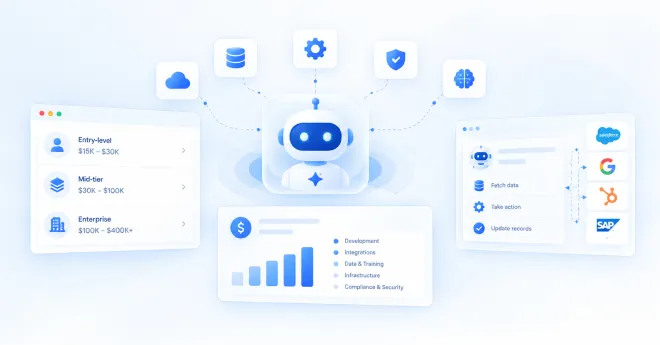
Project-based engagements commonly range from about $15,000 for a small pilot to well over $150,000 for enterprise-grade, multi-agent systems, depending on scope, industry and complexity.
Look for experience integrating with software products and APIs, a track record with SaaS-specific workflows, and a company that can support ongoing iteration, not just a one-time build.
Compare vendors on security and compliance certifications, proven enterprise deployments, integration support, pricing transparency, and a clear plan for governance and risk controls, not just the technology demo.
 How to Choose the Best Custom AI Agent Development Company for Your Industry

This blog breaks down real 2026 pricing for custom AI agent development, from simple single-task agents to full enterprise multi-agent...
Not every AI automation project needs to be a six-month enterprise overhaul. Some of the highest-value workflows to automate with...
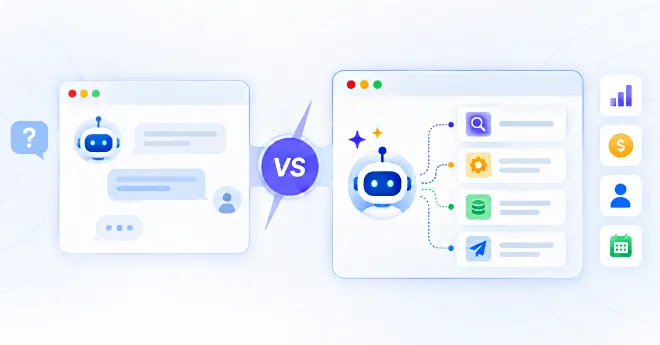
This blog settles the AI agent vs chatbot debate with real 2026 data rather than marketing buzzwords. You’ll learn the...