
 9 Mins Read
In-House AI Team vs Outsourced AI Agency: The Brutal Cost Comparison
Quick summary Every business weighing AI has to answer one question: build a team, hire an agency, or buy something...

| Quick summary Sales pitches make AI automation sound instant. Reality involves several distinct stages, and most delays happen in the same places every time. This guide walks through the real AI automation agency process, stage by stage, what to ask at each step, and a realistic implementation timeline you can hold any vendor to. |
The sales deck says “weeks.” The proposal says “fast-tracked.” Then the kickoff call happens, and a question comes up that nobody had an answer for: which system actually owns the customer data?
That single question can add a month to the project. It is not unusual. It is the normal shape of the process when you hire an AI automation agency, once the pitch is over and the real work begins.
This guide walks through what actually happens, stage by stage, along with a realistic AI agency implementation timeline, so you know what to expect, what to ask, and where most timelines quietly slip.
Because a sales conversation describes best-case scenarios, and delivery deals with your actual data, systems, and decision-making speed.Industry research puts it plainly: the variation in AI agent deployment timelines is not primarily about the AI itself. Model configuration and agent logic are typically the faster parts. The time is consumed by what surrounds them, especially system integration.
This matters because Gartner’s widely cited prediction thatover 40% of agentic AI projects will be canceled by 2027 points to the same root causes: escalating costs and unclear scope, not failed technology. Understanding the real process is your best defense against becoming part of that number.
| Did you know? Research on enterprise agentic AI found that proof of concept deployments can take four to six weeks, while full production rollouts commonly take three to six months. If a vendor promises full production in two weeks with no caveats, that promise deserves a hard second look. |
Strip away the marketing language, and nearly every AI automation agency process follows the same seven stages, whether the vendor calls them this or not.
| Tip Ask every vendor to name these seven stages in their own proposal, with a rough time estimate for each. A vendor who cannot break the project down this way likely has not planned it in enough detail yet. |
This call sets the tone for everything after it. A strong vendor will ask more questions than they answer, about your current process, your data, and what a successful outcome looks like in numbers. Ask them directly: “What usually goes wrong in a project like this?” Their answer tells you more than any pitch deck.
Detailed guidance on this stage describes discovery as a structured review, not a casual chat, that should produce a documented snapshot of your current tools, how leads or data currently move through your systems, and which processes are manual today. If your vendor skips straight from a call to a price quote, scope has not really been defined yet, only guessed at.
This is where access, credentials, and responsibilities are confirmed. Ask who on your side needs to be involved and how much of their time it will take, since slow internal approvals are a common, avoidable source of delay.
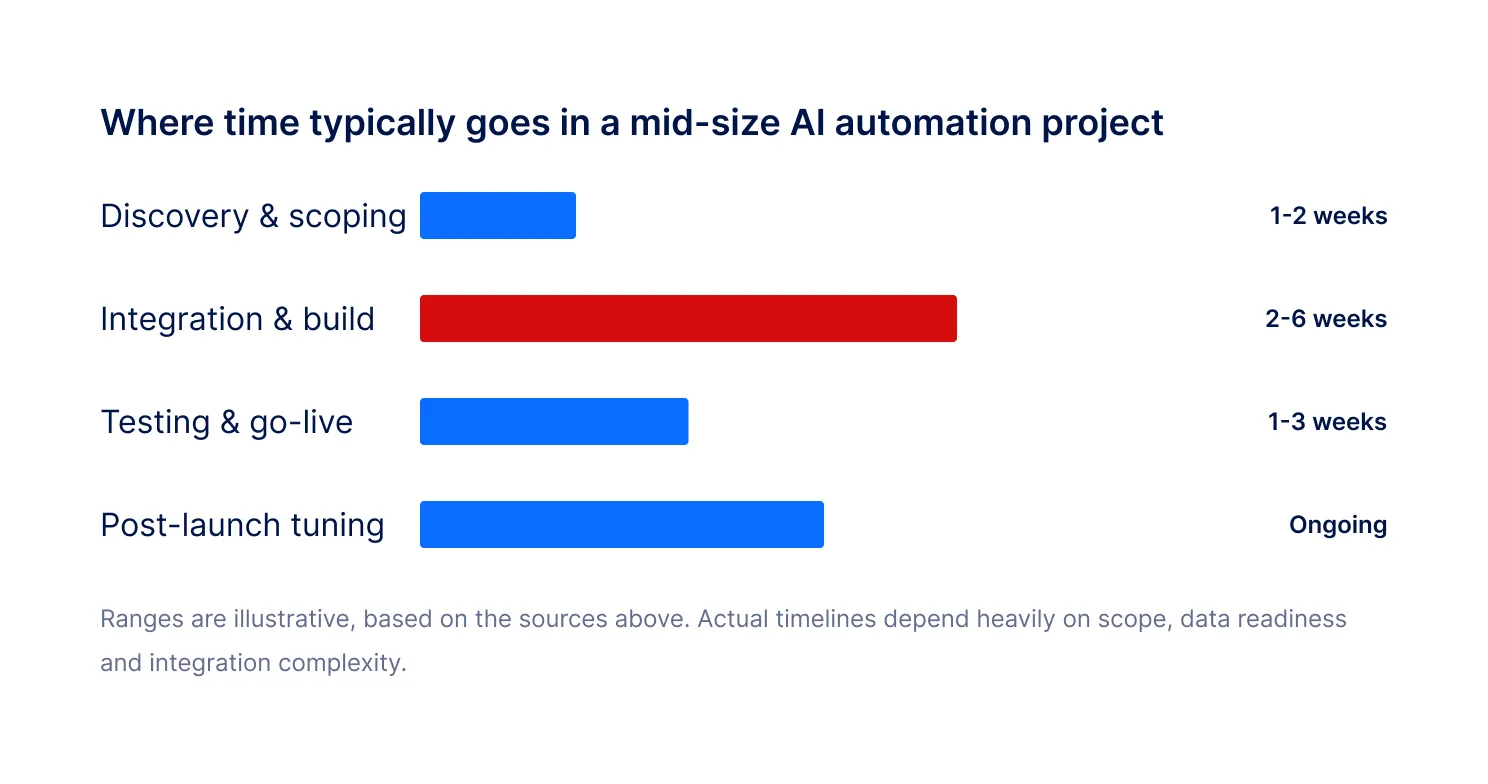
Industry data identifies integration engineering as one of the two primary time drivers in any build, typically consuming two to six weeks on its own. This is where “connects to your CRM” turns into real authentication, data mapping, and edge cases nobody mentioned in the sales call.
A responsible vendor runs real scenarios, including edge cases and failure modes, before anything reaches your customers. Ask specifically what gets tested and who signs off before go-live.
Launch should come with close monitoring, not a handoff and a goodbye. Ask what happens if something breaks in the first week, and who is responsible for catching it.
Nearly every credible source on this topic agrees: the agent is rarely right on day one. Real usage reveals gaps that no amount of planning catches in advance. Ask how tuning is priced, and whether it is included or billed separately.
Timelines vary by scope, but published 2026 research points to consistent ranges. Use this as a reality check against any vendor’s promise.
| Project type | Realistic timeline | Where time usually goes |
| Tightly scoped prototype or proof of concept | 2 to 6 weeks | Discovery, basic build, limited testing |
| Production-ready single agent | 1 to 4 months | Integration engineering, testing, tuning |
| Complex, multi-agent or regulated deployment | 3 to 6 months | Compliance review, governance, multi-system integration |
These are the exact questions to ask an AI automation vendor. They surface the risks a polished proposal tends to hide.
Pricing structures vary, but2026 buyer data gives useful benchmarks. One-time workflow automation projects commonly run $3,000 to $15,000 depending on process count and integration complexity. Custom AI agent development with multi-step reasoning starts around $10,000 and can exceed $50,000 for complex deployments. Hourly advisory work for discovery or vendor selection typically runs $150 to $250 an hour.
| Note The same source notes that compliance-heavy industries, such as healthcare or finance, do not add a fixed dollar amount but consistently push pricing toward the upper end of any range, due to the extra audit, access control, and documentation work involved. |
Industry research cited in implementation planning guides notes that over half of AI projects experience scope creep. This is normal, but it should be managed with a clear change process, not silently absorbed into a shrinking timeline.
An assumed “simple” integration often turns out to need custom development once the real API or legacy system is examined closely.
Disorganized, siloed, or inconsistent data can stall a project before the AI work even begins. Ask early whether your data needs cleanup first.
Vendors are not the only source of delay. Approvals, access provisioning, and stakeholder availability on your side are common, avoidable causes of slippage.
A project that ends the moment the agent goes live, with no tuning period built in, tends to underperform quietly for months.
It helps to see this as a concrete example rather than an abstract list. Corvexa’s own onboarding follows a version of this same structure, built specifically to avoid the common delays above.

The difference between this and a stalled six-month project is not the technology. It is a scoped, well-understood use case with a proven setup process behind it, rather than a fully custom build starting from a blank page. Seehow it works for the full process.
Not always, and it is worth asking honestly. Custom development, with its multi-week discovery and multi-month build, makes the most sense for problems genuinely specific to your business, data, or industry.
For common, well-understood needs, such as capturing and qualifying website leads, a configurable, ready-built platform skips most of the stages above entirely. There is no lengthy discovery phase because the core system already exists; onboarding is closer to configuration than construction. Seepricing, which starts at $39 a month, with no long build phase before you see results.
A proposal should name each stage, its deliverables, and a rough timeframe, not just a total project length.
Someone on your side needs authority to make decisions quickly, or approvals will become the bottleneck.
If you know your data is messy, say so during scoping. It is far cheaper to fix before the build than during it.
Set aside time and budget for the weeks after launch. This is where real performance is won or lost.
Agree on the acceptance criteria that mark the project as complete, so scope does not quietly expand forever.
Hiring an AI automation agency is rarely the instant transformation the first call implies. It is a real process: discovery, scoping, a build that usually takes longer than expected because of integration work, testing, launch, and then ongoing tuning based on what actually happens in production.
Knowing this in advance is your best protection. Ask the right questions before you sign, hold vendors to a realistic timeline, and check whether a ready-built platform already covers your specific need before committing to months of custom work.

FAQ
: Get answers about the AI automation agency process, implementation timelines, project costs, vendor selection, common delays, and faster alternatives to custom AI development.
A structured process usually follows: a discovery call, scoping and a written proposal, a kickoff, an integration and build phase, testing, a go-live, and then a post-launch tuning period. Skipping any of these stages is a common cause of delays and cost overruns.
For a well-defined single use case, proof of concept results can appear in a few weeks, while a production-ready deployment often takes one to four months. Complex, multi-system or regulated projects can take three to six months.
It should cover your specific business goal, your current tools and data, what a successful outcome looks like in numbers, your timeline and budget range, and who owns the decision internally.
Ask how they scope discovery, what typically causes delays in their projects, who owns the code and configuration afterward, what post-launch support looks like, and for two references you can actually call.
The most common causes are integration complexity discovered mid-project, data quality issues not identified upfront, unclear scope, and slow internal decision-making, rather than problems with the AI technology itself.
Launch is rarely the finish line. Most agents need a tuning period afterward, where real usage data is reviewed and the agent’s responses, rules or integrations are adjusted based on what actually happens in production.
 From First Call to Launch: What Really Happens When You Hire an AI Automation Agency

Quick summary Every business weighing AI has to answer one question: build a team, hire an agency, or buy something...
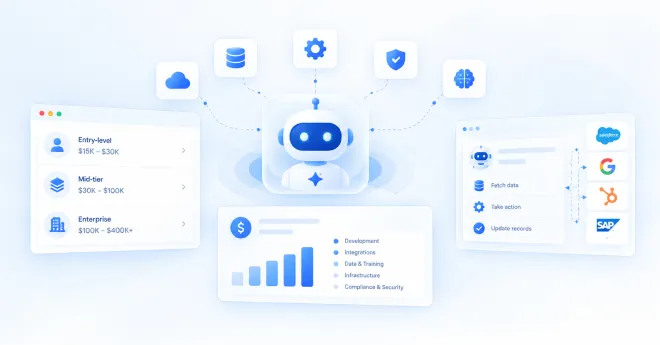
This blog breaks down real 2026 pricing for custom AI agent development, from simple single-task agents to full enterprise multi-agent...

A simple, friendly guide comparing hired lead qualification services and automated AI agents, what each one actually is, and how...