
 9 Mins Read
AI Lead Capture Software: 9 Features B2B Teams Should Demand in 2026
Quick summary Not all AI lead capture software does the same job. Many tools answer questions and stop there. This...

| Quick summary AI chatbot pricing ranges from $39 a month to well over $150,000 for a custom build, and the headline number rarely tells the whole story. This guide breaks down the pricing models B2B companies actually see in 2026, what drives the real cost, and how to work out what you should pay. |
Ask three vendors, “What does your AI chatbot cost?” and you can get three answers that are almost impossible to compare: $39 a month, $0.99 per resolution, or “let’s talk, it depends.”
None of them are wrong. They are just pricing completely different things. This guide breaks down what actually drives AI chatbot pricing in 2026, so you can tell a fair price from an expensive surprise waiting to happen.
Because there is no single unit everyone charges for. Some vendors charge per seat, some per resolved conversation, some a flat monthly fee for a volume band, and some quote a custom project price. Comparing a 39plantoa”0.99 per resolution” plan on price alone tells you almost nothing.
It matters because speed and cost are connected. Harvard Business Review found that firms who contacted a lead within an hour werenearly seven times as likely to qualify it as those who waited even one hour longer. An AI chatbot that is too expensive to run at real volume, or too slow to set up, quietly costs you those hours too.
Nearly every price you will see in 2026 fits one of these four models.
| Model | How it works | Best for | Watch out for |
| Flat monthly plan | Fixed fee for a set conversation volume | Predictable budgeting as you grow | May cap conversations at high volume |
| Per-resolution | Pay for each conversation the AI resolves | Low, occasional usage | Cost rises as the bot performs better |
| Per-seat | Pay per team member with access | Internal tools, small teams | Disconnected from actual conversation volume |
| Custom project | One-off quote for a bespoke build | Deeply specific, one-off needs | High upfront cost, months of build time |
| Tip Ask which model a vendor uses before you ask the price. “How much” only makes sense once you know what you are being charged per. |
Here is what different types of AI chatbot software pricing look like in practice, based on published vendor and industry data.
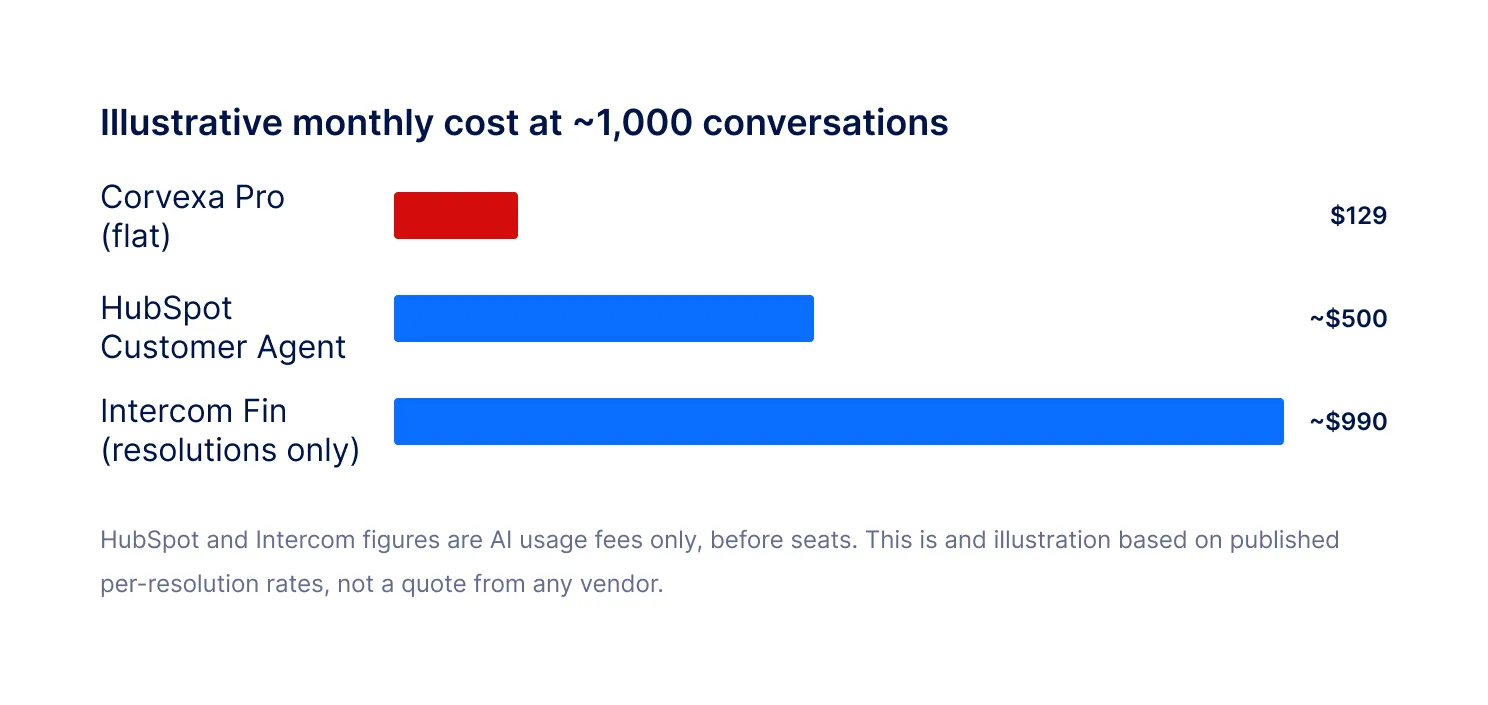
Corvexa’s Starter plan is $39 a month for up to 250 conversations. Pro is $129 a month for up to 1,000 conversations, with CRM integrations, lead scoring, and human takeover. Enterprise starts from $499 a month for custom volume and advanced features. Seepricing.
HubSpot’s Customer Agent charges$0.50 per resolved conversation, on top of a Professional or Enterprise subscription. Intercom’s Fin agent charges around$0.99 per resolution, with seat plans separately priced at roughly$29 to $132 per seat a month depending on tier.
Qualified,now part of Salesforce, does not publish list prices. Third-party comparisons describe it as a significant annual investment aimed at large Salesforce-based sales teams with SDRs.
Published 2026 rate guides put custom AI agent project costs at roughly $15,000 for a small pilot, $50,000+ for a mid-size single-agent build, and $150,000+ for a complex, multi-agent enterprise system.
The sticker price is only one part. These factors quietly move your real bill.
Run the math before you decide. Here is a simple way to think about it.

The uncomfortable truth about per-resolution pricing: the better the AI performs, the more it costs you. A flat plan does not punish success the same way.
Before comparing plans, ask a bigger question: do you need custom AI development at all? For common, well-understood needs like website lead capture, a configurable platform usually costs a fraction of custom development. For deeply specific, product-core AI, custom development or an agency may be the right call.
What questions should you ask before signing?
| Note A vendor who cannot answer these clearly and quickly is telling you something about what it will be like to be their customer. |
The pricing models stay the same across industries, but the value you get for that price can shift a lot.
Whatever your industry, the same rule applies: match the pricing model to your actual traffic pattern, not to whichever plan looked cheapest on the pricing page.
The advertised price is rarely the full picture. These are the costs that tend to appear after you have already signed.
| Tip Before signing anything, ask a vendor to list every possible extra charge in writing. A vendor confident in their pricing will do this without hesitation. |
Often, yes, more than buyers expect. A few approaches tend to work well.
As a rough guide, based on the pricing patterns above: small teams (under 250 conversations/month) can reasonably expect to pay $39 to $130 a month for a capable, flat-rate lead capture platform. Growing teams (up to 1,000/month) typically land in the $130 to $500 range. Larger, Salesforce-centric enterprises often pay a custom, five-figure annual amount for platforms like Qualified. Custom AI development sits apart entirely, as a project cost rather than a subscription.
There is no single right answer to “what should an AI chatbot cost.” There is a right answer for your volume, your model preference, and what you actually need it to do. Convert every quote to a monthly cost at your real traffic, ask what is included, and compare that number, not the headline price.
For most B2B teams solving a common problem like website lead capture, a flat, predictable plan in the $39 to $500 range, with guided setup included, is a fair and sufficient investment. Reserve five- and six-figure custom builds for problems genuinely unique to your business.

FAQ
It depends on the pricing model and your conversation volume. Flat-rate platforms built for lead capture commonly run $39 to $500+ a month. Per-resolution AI agents from CRM-native tools typically cost $0.50 to $0.99 per resolved conversation, plus seat fees. Custom-built agents often start around $15,000 for a small project.
Per-seat pricing charges by the number of team members using the tool. Per-resolution pricing charges for each conversation the AI successfully handles, so costs rise with usage. Flat-rate pricing charges a fixed monthly fee for a set volume of conversations, which is easier to budget as you grow.
It can be fair at low volume, since you only pay when the AI actually helps. It becomes expensive as usage grows, because a better-performing bot directly increases your bill. Compare the cost at double your current volume before committing.
Custom development commonly ranges from $15,000 for a small pilot to over $150,000 for a complex, multi-agent system, plus months of build time. A ready-built, configurable platform for common needs like lead capture typically costs a few hundred to a few thousand dollars a year, with launch in days.
Look for what is included, not just the headline price: number of conversations, integrations, lead scoring, human takeover, onboarding support and whether AI usage is capped or billed separately. Two similarly priced plans can deliver very different value.
It varies. Some platforms include guided onboarding in the plan price, while others charge separately or leave setup entirely to you. Always ask directly rather than assuming.
Ask each vendor for a written cost projection at your current traffic and at double it, including seats, AI usage fees and any setup or onboarding charges, so you can compare total cost rather than the advertised starting price.
 AI Chatbot Pricing in 2026: What Should a B2B Company Actually Pay?

Quick summary Not all AI lead capture software does the same job. Many tools answer questions and stop there. This...
Quick summary Should you put a person or an AI behind your website chat? This guide compares AI chatbot vs....
Quick summary Both live in the same chat bubble, but they do very different jobs. An AI chatbot answers questions....