
 11 Mins Read

Lead Qualification Services vs. Automated Al Agents
A simple, friendly guide comparing hired lead qualification services and automated AI agents, what each one actually is, and how...

| Quick summary Not every lead is worth the same. AI lead qualification reads what visitors say and do, scores their intent, and shows your team who to call first. This guide covers what it is, the signals of a high-intent prospect, how to set it up, and how to measure results. |
Monday morning. Your inbox shows twelve new leads. Two are ready to buy this month. Three are students. Four are competitors checking your pricing. The rest are a mystery.
Which two do you call first? Most teams guess, and while they guess, the best leads cool off.
This is the problem AI lead qualification solves. Let’s walk through how it works and how to use it on your own site.
Because a name and an email tell you nothing about intent. Two visitors can fill in the same form for very different reasons: one wants to buy, the other wants a free ebook.
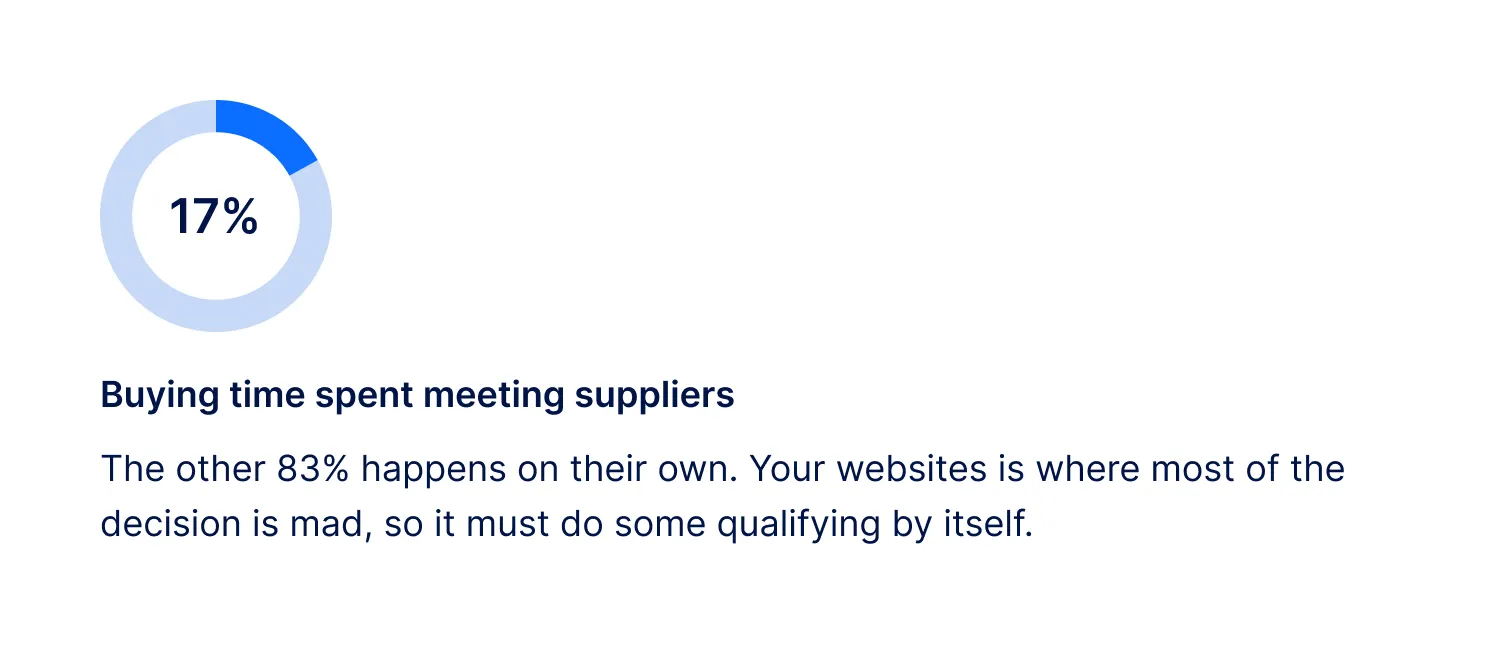
Buyers also do most of their thinking before they talk to you.Gartner researchfound that B2B buyers spend only 17% of their buying time meeting with potential suppliers. When they compare several vendors, each one gets about 5%.
Your sales team pays the price
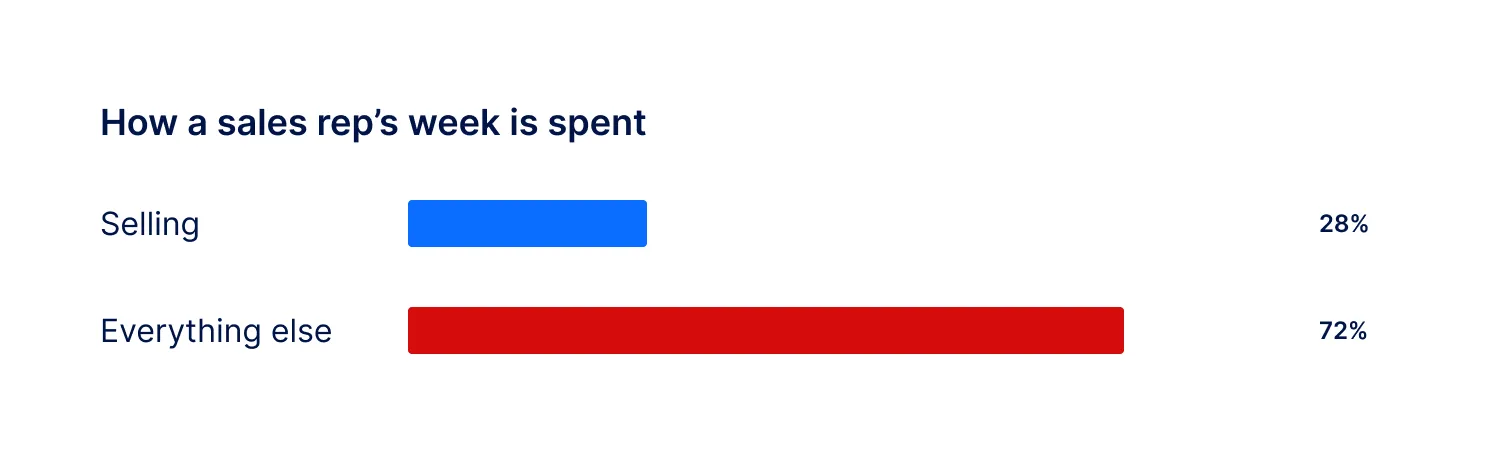
Every unqualified lead takes time. Salesforce surveyed more than 7,700 sales professionals and found that reps spend just 28% of their week actually selling. The rest goes to admin, data entry, and lead handling.
| Did you know? The same Salesforce report says 97% of sales leaders and sales ops professionals believe AI has improved how reps use their time. Scoring leads is one of the tasks AI takes off their plate. |
AI lead qualification is the use of AI to decide, in real time, whether a website visitor is a good fit and ready to buy, so your team only follows up with the right people.
Instead of a static form, the AI holds a short conversation. It looks at what the visitor asks, which pages they read, and what details they share. Then it gives each lead a score.
You may see it called AI website lead qualification, automated lead qualification, or AI lead qualification software. The idea is the same: sort the serious from the casual, quickly and fairly.
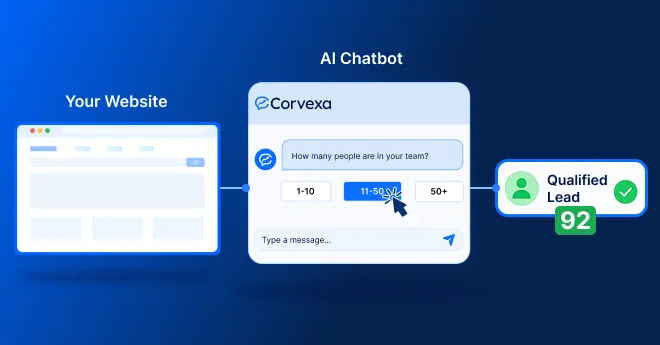
It is the friendly face of this process. A website lead qualification chatbot greets visitors, answers questions, and asks a few simple ones in return, such as company size or timeline. Behind the scenes, the AI is measuring fit and intent with every reply.
High intent is not a feeling. It shows up in small, clear signals. Here are the ones that matter most.
| Signal | Example | What it suggests | Typical score |
| Pricing question | “How much for 20 users?” | Budget is being planned | High |
| Timeline mentioned | “We need this live next month.” | Real urgency | High |
| Comparison question | “How are you different from other tools?” | Actively choosing a vendor | Medium to High |
| Integration question | “Do you connect to HubSpot?” | Checking technical fit | Medium |
| General question | “What do you do?” | Early research | Low |
| Tip Write down the exact words your best customers used before they bought. Add them as “hot keywords,” such as “book a demo,” so the AI treats them as ready to talk right away. |
Here is the path a single visitor takes, from first click to sales-ready lead.
They open a product or pricing page. The AI notices and offers help at a natural moment.
The visitor asks a question. The AI answers using your website, PDFs and approved Q&A.
It checks the topic, the words used and how well the visitor matches your ideal customer.
Name, work email, phone, interest and preferred follow-up time are gathered inside the chat.
High, Medium or Low. Hot leads trigger an instant alert, and everything syncs to your CRM.
By helping first and asking second. Each question should feel like part of the answer, not a hurdle. Here is an example of how a good chat flows.
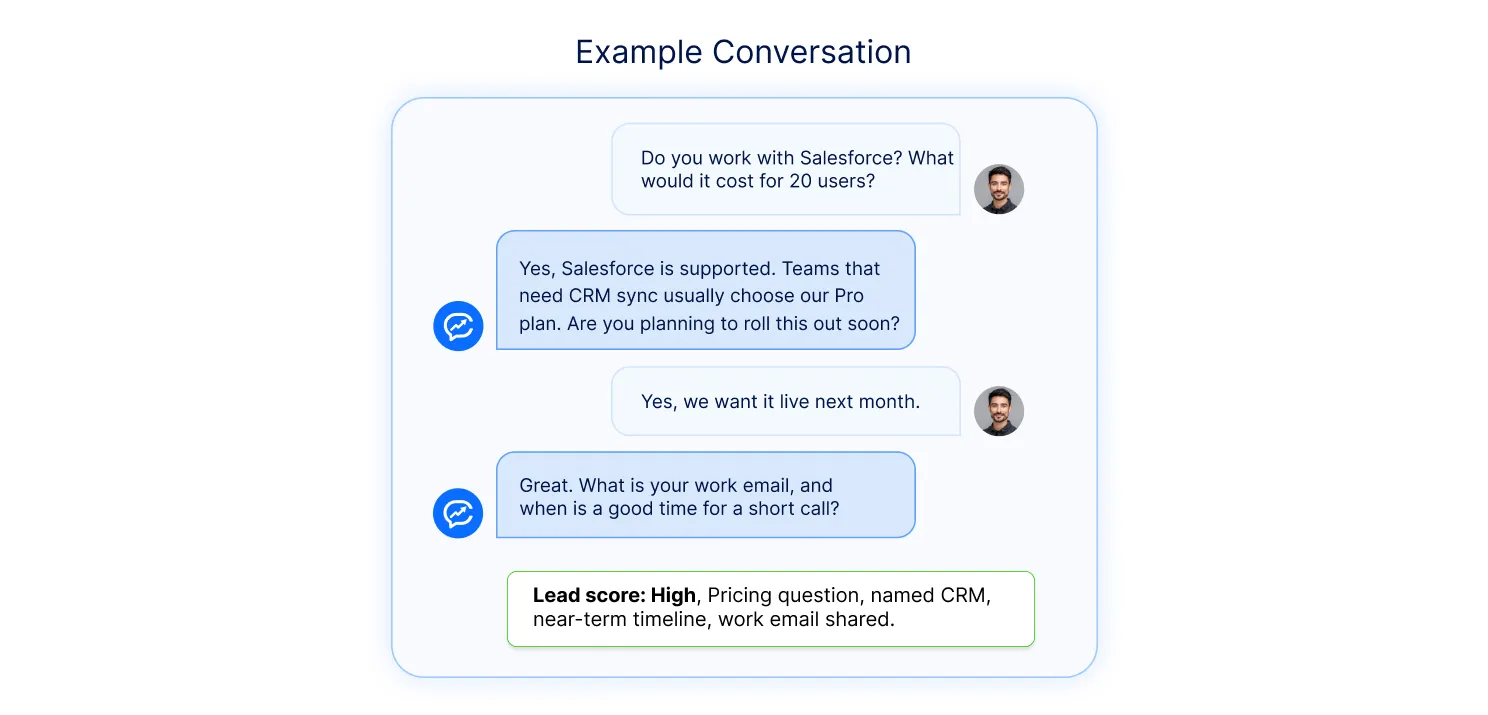
Notice what happened. The visitor got real answers. The AI learned budget interest, tool, timeline and contact details in four messages. Nobody filled in a form.
Can visitors tell it is AI?
They should be told. Trust matters, and being open about it does not hurt results. Make it easy to reach a person, and let your team take over any chat when the deal gets complex.
Forms wait for a decision
A form only catches visitors who have already decided. Everyone else leaves quietly.
Simple scoring looks backward
Point-based scoring adds up clicks and downloads after they happen. It cannot ask “what is your timeline?” in the moment.
AI qualification listens and asks
It works while the visitor is still on the page. It combines behavior with what the visitor says in their own words, which is a much clearer picture.
Any B2B business with a website that attracts researchers. A few examples:
SaaS and software
Product pages, pricing and integrations all send signals. The AI can tell a curious reader from a buyer comparing plans, and offer a demo only to the second.
Logistics and manufacturing
These sales cycles can last 60 to 120 days. One logistics software team in ourcase studies shared that their old chatbot generated leads, but none closed. Better qualification is what fixes that.
Fintech and healthcare tech
Buyers here are careful and skip forms. A guided chat can build trust with clear answers, then invite a conversation once they are ready.
Qualifying is only half the job. The handoff decides whether the lead turns into a meeting or gets lost.
A good handoff gives your rep everything in one place: the score, contact details, the page the visitor came from, and the full chat. Nobody has to ask “what did you want again?” The rep can open with something useful, like “I saw you asked about Salesforce. Let me show you how that works.”
With Corvexa, qualified leads arrive in your CRM through the HubSpot integration or Salesforce, and visitors can book time directly through Calendly. No copying and pasting.
What about visitors who arrive at midnight?
This is where automated lead qualification quietly earns its keep. Serious buyers browse in the evening, at weekends and across time zones. The AI chats with them, captures their details and records their preferred follow-up time. Your team wakes up to a scored list instead of a blank inbox.
Can it recognize returning visitors?
Yes, on some plans. A visitor who comes back three times and reads pricing each time is showing a strong signal. Corvexa’s Pro plan includes returning visitor recognition, so the conversation can pick up where it left off.
The tool matters, but your setup matters more. Work through this checklist before you launch.
✔ Define your ideal customer: industry, company size, budget signals and pain points.
✔ List disqualifiers, such as students, job seekers or regions you do not serve.
✔ Add hot keywords that show a visitor is ready to act.
✔ Train the AI on your site, PDFs and custom answers, and turn off pages it should not learn from.
✔ Connect your CRM, calendar and alert channels.
✔ Decide who takes over a chat and how quickly they should reply.
In Corvexa, these rules live in the lead qualification profile. You can even set an exclusive offer that only hot leads see. Corvexa also reviews your competitors during onboarding, so the AI handles comparison questions well. See how it works for the full process.
Vague definitions of “qualified”
If sales and marketing disagree on what a good lead is, the AI cannot fix it. Agree first, then configure.
Too many questions too soon
Ask only what you need to route the lead. You can learn the rest on the call.
Ignoring hot leads
Speed still matters. Set alerts so a High lead gets a human reply quickly. The Slack, email, and CRM integrations make this easy.
Never reviewing chats
Read a few conversations each week. You will spot missing answers and new buying phrases to add.
You do not need a big project. Here is a realistic plan for a small team.
Week 1: decide and define
Get sales and marketing in one room. Agree on what a High, Medium, and Low lead means. Write down your ideal customer and your disqualifiers.
Week 2: train and connect
Let the AI learn from your site, add PDFs and custom answers, and connect your CRM and calendar. Install the single script tag and go live.
Week 3: read real chats
Review the first conversations. Fix weak answers, add missing hot keywords, and tighten your questions.
Week 4: compare with your old results
Look at qualified lead rate, meetings booked, and reply speed against last month. Keep what works and adjust the rest.
Do not count chats. Count outcomes. Four numbers tell you most of the story.
Qualified lead rate shows what share of leads are a real fit. Sales acceptance rate shows how many your team agrees are worth pursuing. Response time to hot leads shows how fast you act. Meetings booked shows how many move forward.
The Corvexa leads dashboard shows each lead’s score, source page, and chat history, and leads move through Open, 1st Follow-up, 2nd Follow-up, and Closed.
| Note Fewer leads can be a good sign. If your team follows up with 30 well-qualified leads instead of 100 mixed ones and books more meetings, qualification is working. Plans start at $39 a month on the pricing page. |
Good qualification builds trust. Bad qualification feels like being watched. A few simple rules keep you on the right side.
Be open about what you collect
Tell visitors why you ask for details, link to your privacy policy, and use a cookie consent popup where the law requires one. Corvexa’s Pro plan includes one.
Do not shut people out too quickly
A Low score does not mean a bad person. It means “not ready yet.” Keep helping these visitors with useful answers. Many will return when the timing is right.
Keep a person in the loop
AI should sort and suggest. Humans should decide on complex or high-value deals. That balance protects both your buyers and your brand.
Your website already attracts people who want what you sell. AI lead qualification helps you find them, talk to them, and pass them to your team at the right moment. Start with a clear definition of a good lead, add a few hot keywords, and improve from real chats.
Sources
Gartner, “B2B Sales Reps: Maximize Customer Interactions” (Smarter with Gartner):gartner.com
Salesforce, “New Research Reveals Sales Reps Need a Productivity Overhaul” (State of Sales report):salesforce.com
Corvexa product facts:Homepage,Case Studies,Pricing,Integrations andDocumentation.
| Written by the Corvexa Team. Our team has hands-on experience building and deploying AI lead capture and qualification for B2B websites across SaaS, fintech, logistics, healthcare tech, and professional services. About Corvexa |

FAQ
AI lead qualification uses software to talk with website visitors, read their intent, check how well they fit your ideal customer, and score them, so your sales team only spends time on the best prospects.
It starts a natural chat, answers questions from your own content, asks a few smart questions, and captures contact details. It then scores the lead as High, Medium, or Low and sends it to your team.
Lead scoring adds up points after someone acts. AI lead qualification also talks to the visitor in real time, so it learns things points cannot show, such as budget, timeline, and urgency.
No. It handles first conversations and sorting. Your team still runs demos, handles complex questions, closes deals, and can take over any chat at any time
At minimum, your CRM and calendar so leads and meetings flow in automatically. Corvexa connects to HubSpot, Salesforce, Zoho, GoHighLevel, Calendly, Google Calendar, Slack, and WhatsApp, and can email leads if you have no CRM.
It can be, if the tool follows privacy rules, tells visitors they are talking to AI and stores data securely. Always check that any tool meets the rules in your region.
Installation is one script tag. Corvexa can go live within 48 hours of your onboarding call, and tuning continues as you learn from real chats.
 How AI Website Lead Qualification Helps Identify High Intent Prospects

A simple, friendly guide comparing hired lead qualification services and automated AI agents, what each one actually is, and how...

It’s 11:47 PM. Someone is on your website. They’ve read your services, checked your pricing, and they’re seriously considering reaching...

Research consistently shows that lightning-fast follow-up drives dramatic gains: contacting a new lead within 5 minutes makes you 100× more...