
 5 Mins Read

24/7 Lead Generation: How to Capture Visitors While You Sleep
It’s 11:47 PM. Someone is on your website. They’ve read your services, checked your pricing, and they’re seriously considering reaching...

How agencies, consultants, and other professional service businesses use an AI chatbot to qualify website visitors automatically, with real conversion data, a working example, and what to check before adding one.

| WHAT THIS GUIDE COVERS This guide looks at how an AI chatbot qualifies leads for a service business, specifically agencies, consultancies, law firms, and similar businesses where every inquiry needs a different kind of screening than a typical SaaS signup. It covers what makes that qualification different, the adoption and revenue data behind it, a real example of how the conversation flows, and the mistakes that most often undermine it. |
A SaaS company usually qualifies a lead on a fairly standard set of questions: company size, budget, timeline. A service business — an agency, a law firm, a contractor, a consultancy — often needs to qualify on something else first: which service the visitor actually needs, and whether the business is even the right fit to deliver it.
An AI chatbot for service businesses has to handle that branching. A marketing agency’s chatbot might need to ask whether someone needs SEO, paid ads, or web design before it can ask anything about budget. A law firm’s chatbot needs to identify the practice area before a single qualifying question makes sense. Chatbot for professional services isn’t a one-script problem the way it can be for a single-product SaaS company.
Adoption is already mainstream, not early-stage. Research compiled by SchedulingKit found that 64% of service businesses are using at least one AI-powered tool, and 73% plan to increase that investment in 2026. Within that, 33% specifically use AI for customer-facing interactions like chatbots, according to Salesforce’s State of Service research.
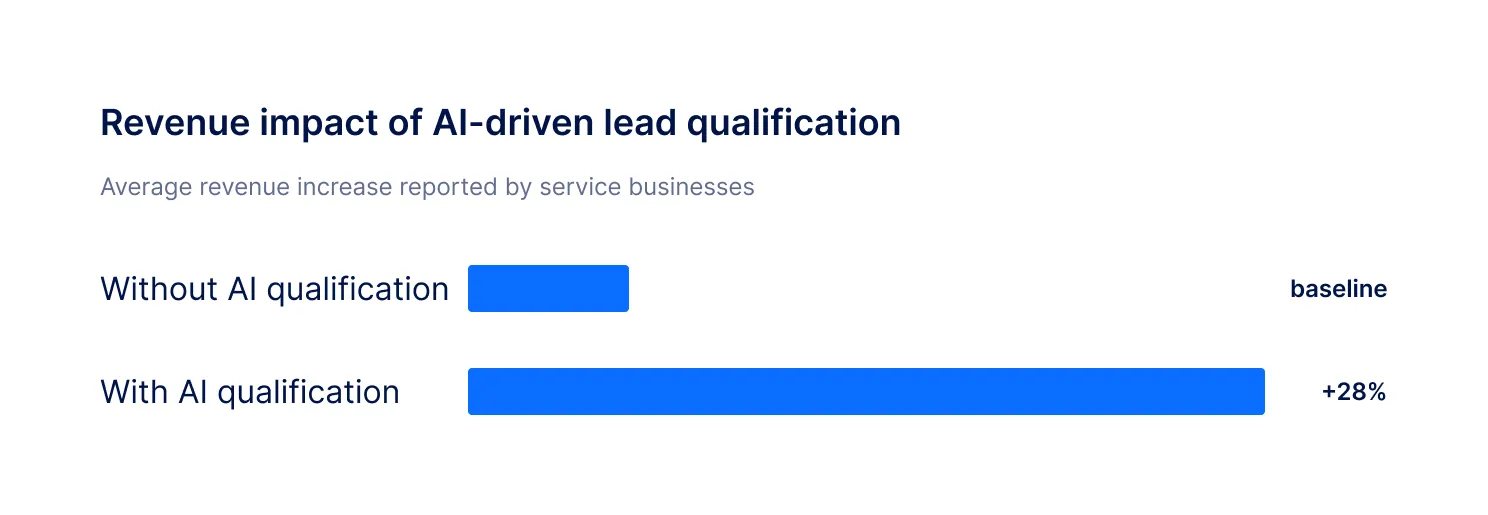
The reason isn’t novelty; it’s return. Forrester’s Total Economic Impact research found that AI investments deliver an average 3.8x ROI for service businesses within 18 months, and HubSpot’s research on AI in sales found a 28% average revenue increase specifically tied to AI-driven lead qualification and follow-up.
The sequence looks similar to other lead-qualification chatbots, but the questions branch by service line before anything else.

| EXAMPLE: A DIGITAL MARKETING AGENCY A visitor lands on a services page unsure whether they need SEO or paid ads. The chatbot asks a clarifying question, narrows it to paid ads, then asks about monthly ad spend and how soon they want to launch. Based on the answers, it either books a discovery call directly on the agency’s calendar or flags the lead as too early-stage for a rep to prioritize immediately, saving a salesperson from a call that wasn’t going anywhere. |
The conversion gap is substantial. 2026 benchmark data from Digital Applied found that chatbot-led qualification funnels convert at 2.4 times the rate of static web forms, a meaningful gap for any agency that’s currently relying on a “get in touch” form as its main lead channel.
Source:Digital Applied, via HelloTars 2026
“The purpose of a business is to create and keep a customer.”
Peter Drucker, management consultant and author
For a service business, that means fewer discovery calls that go nowhere, and more time spent with prospects who already know roughly what they want and what it costs.
Some service categories see a bigger lift than others, mainly because their inquiries vary so widely in scope that pre-qualification saves the most time.
| Business type | What the chatbot asks | What “qualified” looks like |
| Marketing & creative agencies | Which service, monthly budget range, launch timeline | Budget matches minimum engagement size |
| Law firms | Practice area, case type, urgency | Case fits the firm’s specialty and jurisdiction |
| Real estate agencies | Buying or selling, price range, neighborhood or area | Timeline is within the next few months |
| Home services & contractors | Type of job, property location, timeline | Job is within the service area and crew’s scope |
| Business & financial consultants | Business stage, specific challenge, decision-maker status | Visitor has authority to engage and a real budget |
The common thread: each of these needs a different first question before a generic BANT-style script would even make sense.
Beyond general lead-qualification features, a chatbot built for service businesses needs a few things a generic SaaS-focused tool might not prioritize: branching logic by service line, the ability to state a service area or availability, and direct booking for a consultation or discovery call rather than a generic “someone will contact you” message.
Using one script for every service line
A chatbot that asks the same budget question whether someone wants a logo redesign or a full rebrand will qualify neither well. Questions need to branch by what the visitor actually selected first.
Asking for budget too bluntly, too soon
Visitors respond better to a comfortable range offered as options than an open “what’s your budget?” question asked before the chatbot has demonstrated it understands their need.
Ignoring service area or availability
For local or regional service businesses, a lead outside the service area isn’t qualified no matter how good the budget answer is. That question needs to come early, not as an afterthought.
Not offering a real next step
A chatbot that ends with “we’ll be in touch” wastes the momentum it just built. Booking a consultation or discovery call directly, on the spot, is what actually converts the qualification into a scheduled conversation.

FAQ
A form still works for visitors who already know exactly what they want. A chatbot helps the larger group who aren’t sure which service applies to them, or who have a quick question before they’re ready to commit to filling anything out.
Yes, as long as the qualifying questions are set up to branch based on which service the visitor selects first, rather than running one fixed script for every inquiry.
Most AI chatbots can be trained on a business’s own content and common client language, so a law firm’s chatbot can recognize practice-area terms the same way a marketing agency’s recognizes service names.
Typically by asking directly, early in the conversation — a zip code, city, or region — so a lead outside the business’s coverage area is flagged before more time is spent qualifying them further.
Often yes, since a solo operator or small team is least likely to have someone available to respond to every inquiry immediately, which is exactly the gap a chatbot fills.
Most modern lead-qualification chatbots connect to a calendar tool and can book a discovery call or consultation directly inside the conversation, without a separate scheduling step.
 AI Chatbot for Service Businesses: Automate Website Lead Qualification

It’s 11:47 PM. Someone is on your website. They’ve read your services, checked your pricing, and they’re seriously considering reaching...
Quick summary Contact forms convert views into submissions at only around 9%, one of the lowest rates of any form...
Not every AI automation project needs to be a six-month enterprise overhaul. Some of the highest-value workflows to automate with...