
 13 Mins Read
AI Agent vs Chatbot: Which One Actually Grows Revenue (And Which Is a Waste of Budget)?
This blog settles the AI agent vs chatbot debate with real 2026 data rather than marketing buzzwords. You’ll learn the...

| Quick Summary A reactive chatbot waits for website visitors to ask questions. A proactive chatbot starts the conversation first. Both can help businesses engage visitors, but they work differently when it comes to lead generation and conversions. This guide explains the real differences, what research says about proactive chat, where each approach works best, and how to choose the right chatbot strategy without annoying your visitors. |
Imagine walking into a software store.
You spend several minutes comparing two products. You’re interested, but you’re not sure which one fits your needs.
One salesperson sits behind the counter, waiting for you to ask something.
Another notices you’re comparing products and says, “Need help choosing between these two?”
Neither approach is necessarily wrong.
Sometimes you want to browse without being interrupted. Other times, a quick answer is exactly what you need to make a decision.
AI chatbots on websites work in much the same way.
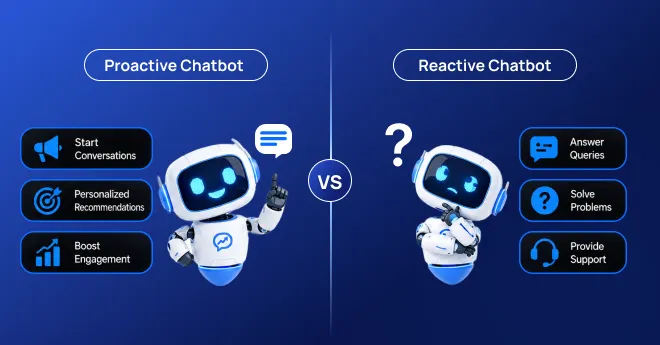
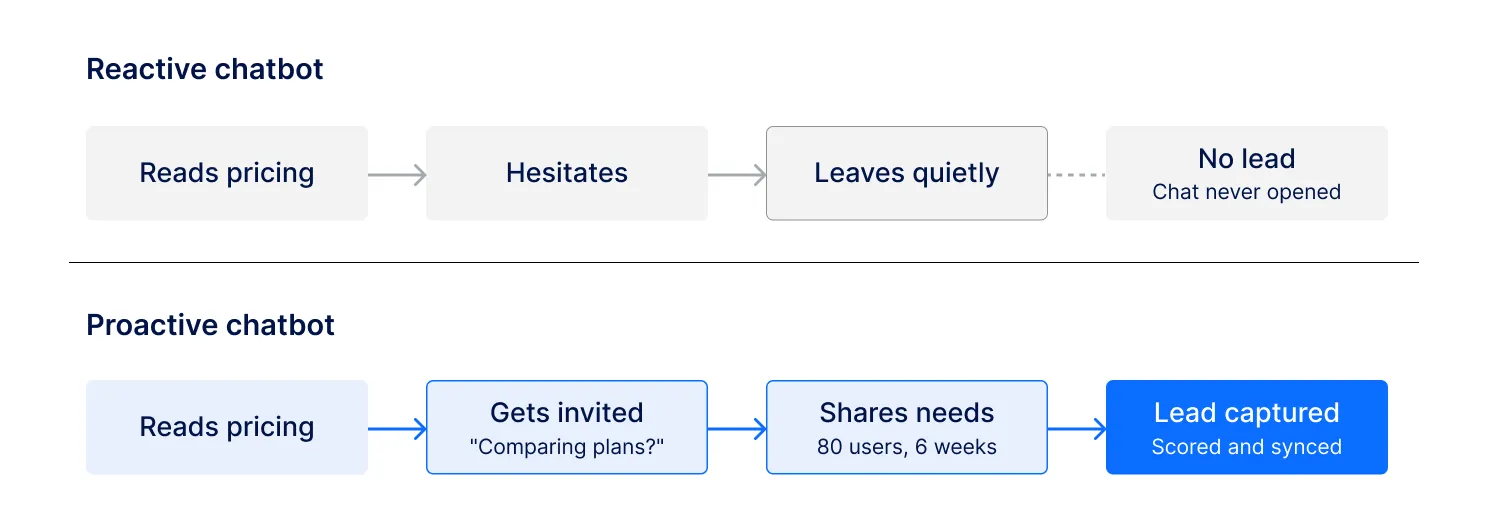
A reactive AI chatbot waits for someone to open the chat window. A proactive AI chatbot reaches out first, inviting the visitor to start a conversation.

But here’s the interesting part.
Starting more conversations doesn’t automatically mean getting more customers.
What matters is whether the chatbot reaches the right visitor, at the right moment, with something genuinely useful to say.
A proactive chatbot is a website chatbot that initiates contact with visitors instead of waiting for them to send the first message.
It can display a greeting, offer assistance, or suggest a relevant next step.
For example, someone visits a project management SaaS website and begins comparing its pricing plans.
A proactive chatbot might say:
“Trying to choose the right plan for your team? I can help.”
The visitor didn’t open the chatbot or ask a question. The website offered help first.
Depending on the software, proactive messages can be triggered by page visits, time spent on a page, visitor actions, or other configured signals.
A proactive AI chatbot can then continue the conversation, answer follow-up questions, and potentially identify whether the visitor is interested in purchasing.
The goal is simple: make it easier for visitors to get help before they give up and leave.

A typical proactive message appears as a small chat invitation near the bottom of a webpage.
The visitor can respond, dismiss it, or continue browsing.
A well-designed invitation should feel like an offer, not an interruption.
For example, a visitor exploring enterprise pricing might appreciate help understanding licensing requirements.
But someone who has just opened a blog article probably doesn’t need a message asking whether they’re ready to book a sales call.
The difference is context.
A reactive chatbot works the other way around.
It waits for the visitor to take the first step.
Usually, the website displays a small chat icon. When someone clicks it, the chatbot opens and responds to their questions.
For example, a visitor asks:
“Does your software integrate with Salesforce?”
The reactive AI chatbot explains the integration using information provided by the business.
If the visitor asks another question, the conversation continues.
This approach works particularly well when people already know what they want.
Someone looking for technical documentation, refund information, or help with a specific feature may prefer to initiate the conversation themselves.
The limitation is that many visitors never open the chat window.
They might have questions but hesitate to ask. They may assume the chatbot won’t understand their problem. Or they might simply leave before realizing help is available.
A reactive chatbot can provide excellent assistance, but only after someone chooses to use it.
The main difference is who starts the conversation.
But for businesses trying to improve website conversions, there are several other differences worth understanding.
| Comparison | Proactive chatbot | Reactive chatbot |
| Who starts the conversation? | The website or chatbot | The visitor |
| How does it engage? | Offers help through a triggered message | Responds after the visitor opens chat |
| Best use cases | Pricing pages, product comparisons, lead generation | Support, FAQs, documentation |
| Lead generation | Can invite visitors who haven’t requested help | Captures leads from visitors who initiate chat |
| Visitor control | Invitation can appear automatically | Visitor decides when to engage |
| Main advantage | Creates opportunities for earlier engagement | Provides help without interrupting |
| Main risk | Poorly timed messages can feel intrusive | Potential buyers may leave without asking questions |
Neither approach is automatically better.
A proactive chatbot can create more opportunities for engagement, while a reactive chatbot gives visitors greater control.
The more useful question is whether the chatbot helps visitors accomplish what they came to do.

There’s research suggesting that proactive chat can increase engagement and conversions.
But the evidence needs to be understood carefully.
A 2015 live chat benchmark report by BoldChat examined the relationship between website chat engagement and conversion behavior.
The report found that website visitors who engaged in chat converted at approximately 2.8 times the rate of non-chatting visitors.
For visitors engaging through proactive chat, the reported figure was approximately 2.9 times.
Reported relative conversion rates in BoldChat’s 2015 benchmark

At first glance, those numbers sound impressive.
But there’s an important detail.
Visitors who choose to chat may already be more interested in purchasing than those who don’t. That means the results don’t prove that adding a chatbot will automatically multiply conversions.
The research is also from 2015, and concerns live chat, not today’s generative AI chatbots.
Still, it supports an important idea: visitors who engage in meaningful conversations can be valuable prospects.
A proactive chatbot works best when there’s a reasonable indication that a visitor might benefit from assistance.
Consider a SaaS website with several subscription plans.
Someone lands on the pricing page, explores the enterprise option, and wants to understand whether the software can support their organization.
A relevant chat invitation could help them find the answer without contacting sales first.
The same approach can work on product comparison pages, service pages, and other areas where visitors often need more information before deciding.
Imagine a company selling HR management software.
A visitor is exploring the Enterprise plan.
A proactive chatbot opens with:
“Need help understanding which plan works for your team?”
The visitor replies:
“We have around 120 employees. Do you support multiple office locations?”
Now the conversation has become useful.
The chatbot can answer the question, explain relevant capabilities, and ask whether the visitor is currently evaluating new software.
If the visitor shares that they’re planning to switch systems next month, the chatbot has identified a potentially valuable sales opportunity.
The business didn’t have to wait for a contact form submission.
A visitor reaches a software integration page.
They’re interested in the product but aren’t sure whether it works with their existing tools.
A proactive chatbot could offer:
“Checking compatibility with your current software? I can help you find the right integration information.”
This message works because it addresses a likely concern on that page.
It’s different from showing everyone the same generic sales message.
However, these are suggested use cases, not proof that a particular trigger will improve conversions. Businesses should test whether the invitation genuinely helps their audience.
Reactive chatbots are useful when visitors want to explore independently.
Think about a developer reading API documentation.
They may be concentrating on an implementation problem and don’t want a message appearing every few minutes.
If they need help, they’ll open the chatbot.
The same is true for people reading educational blog posts, reviewing detailed support articles, or troubleshooting an existing product.
A reactive chatbot keeps assistance available without taking control of the experience.
It can also be a sensible starting point for businesses that haven’t yet learned which visitor behaviors indicate genuine buying interest.
Instead of guessing when to interrupt visitors, they can begin by studying the questions people voluntarily ask.
Those conversations can reveal where proactive engagement might eventually be useful.
Absolutely.
Imagine opening a website and immediately seeing a chatbot message.
You close it.
Then you visit another page, and the chatbot appears again.
You dismiss it a second time.
By the time you reach the pricing page, you’re more interested in leaving than learning about the product.
That’s the risk of poorly designed proactive engagement.
A visitor engagement chatbot should understand when to offer assistance and when to stay quiet.
For example, if someone has already dismissed a chat invitation, the website shouldn’t repeatedly display the same message during that visit.
Messages should also be easy to close and should not block important content, especially on mobile devices.
And the opening message needs to be useful.
“Hello! How can I help you?” might be acceptable.
But “Comparing our Business and Enterprise plans? I can explain the differences” is much more relevant when someone is actually evaluating those plans.
A good proactive chatbot respects the visitor’s attention.
It doesn’t treat every page view as permission to start selling.
Both approaches can support chatbot lead generation, but they collect opportunities differently.
A reactive chatbot captures information after someone decides to ask for help.
A proactive chatbot creates an additional opportunity by inviting someone to engage.
However, the conversation itself matters more than who initiated it.
Imagine two visitors asking about enterprise software.
The first opens a reactive chatbot and asks whether the product supports 200 users.
The second responds to a proactive invitation and asks the same question.
Both visitors could become valuable leads.
In either case, the chatbot can ask a relevant follow-up question, understand the business requirement, and offer an appropriate next step.
This is where automated lead capture becomes more useful than simply asking for an email address.
The chatbot can collect information naturally during the conversation, with the visitor’s knowledge, rather than forcing them through a long form before answering their question.
Yes, provided they’re configured to ask appropriate questions and evaluate responses against meaningful qualification criteria.
For example, an AI chatbot for lead qualification might identify whether a visitor is researching a product, comparing vendors, or actively planning a purchase.
It can ask about business requirements, company size, purchasing timeline, and other relevant details.
A visitor asking about enterprise pricing for 150 employees might deserve a different follow-up from someone asking whether a free trial is available.
But qualification should never rely on one keyword alone.
Someone mentioning “enterprise pricing” isn’t necessarily ready to purchase.
The chatbot needs to consider the conversation, product fit, and the information the visitor actually provides.
The most practical answer is often a combination of both.
A website can keep a reactive chatbot available for visitors who want to ask questions independently.
At the same time, it can use proactive invitations in carefully selected situations where additional help may be valuable.
For example, a software business might keep reactive chat available throughout its knowledge base while offering proactive assistance on its pricing and product comparison pages.
This gives visitors more control without leaving every potential conversation to chance.
The next question is how to measure whether the strategy works.
Imagine your website receives 20,000 visitors each month.
You want to know whether proactive chat invitations improve conversions.
Instead of enabling invitations everywhere, run a controlled experiment.
One group of visitors sees a reactive chatbot only.
Another group sees the same chatbot with a proactive invitation on a selected page.
Keep the groups comparable and measure what happens.
Don’t stop at counting how many people open the chatbot.
Look at how many visitors complete meaningful conversations, become qualified leads, book meetings, and eventually become customers.
Also monitor whether visitors dismiss the invitation, leave the page, or report frustration.
A proactive chatbot that produces more conversations but fewer qualified leads might not be the better option.
A useful metric is the qualified-lead conversion rate:

Suppose 5,000 visitors see the reactive-only experience and 40 become qualified leads.
Another 5,000 see the proactive experience and 65 become qualified leads.
That would mean qualified-lead conversion rates of 0.8% and 1.3%, respectively.
These are hypothetical numbers, not a reported case study. A real experiment would also need sufficient sample size and statistical analysis before concluding that the difference was caused by proactive chat.
The challenge with many traditional chatbots is that they wait for visitors to take the first step.
But some interested visitors never open the chat window.
Corvexa approaches this differently.
Its AI chatbot websitesolution can initiate conversations through welcome prompts and quick-action options, helping visitors engage without first having to type a question.
As visitors interact, Corvexa uses their selections and messages to understand intent and guide the conversation.
For example, someone interested in pricing can receive relevant information and continue toward qualification.
Someone asking about a particular service can receive an answer based on the business’s website content.
Corvexa also supports lead scoring, contact capture, CRM integration, and human takeover when a conversation needs personal attention.
Corvexa+1
The important distinction is that Corvexa’s documented intent detection uses what visitors click, select, or type. It shouldn’t be confused with tools that infer buying intent purely from scrolling or mouse movements.
Businesses can also define what a qualified lead looks like for them.
That means a company selling enterprise software can use different qualification criteria from a business offering services to small companies.
For a closer look at the process, explore how Corvexa works as an AI lead qualification chatbot.
The goal is to help businesses recognize useful conversations earlier and give sales teams better information when they follow up.
Proactive and reactive chatbots aren’t really competing solutions.
They solve different problems.
A reactive chatbot is there when visitors need help.
A proactive chatbot offers help before someone asks.
Both can support website conversion, but neither guarantees better results simply by being installed.
A chatbot that interrupts visitors constantly can damage the experience. A chatbot that never makes itself useful may miss opportunities.
The strongest approach is to understand what your visitors are trying to accomplish and make assistance available at the right moment.
Because the best chatbot isn’t the one that starts the most conversations. It’s the one that helps turn the right conversations into meaningful business opportunities.
Want to see how proactive AI conversations could work on your website?
Contact Corvexato explore a chatbot strategy built around visitor engagement, lead qualification, and your existing sales process.

FAQ
A proactive chatbot initiates conversations with website visitors through configured prompts or triggers. A reactive chatbot waits until someone opens the chat window and asks a question. Both can provide AI-powered responses and support lead generation.
Proactive chatbots can improve engagement by offering assistance before visitors ask for it. However, their effect on conversions depends on timing, relevance, visitor intent, and the quality of the conversation. They aren’t automatically better than reactive chatbots.
Yes. A website can allow visitors to open chat whenever they want while also displaying proactive invitations in selected situations. This combines visitor control with opportunities for earlier engagement.
They can if messages appear too frequently, interrupt important tasks, or aren’t relevant. Clear dismissal options, sensible frequency limits, and helpful messages can reduce unnecessary interruptions.
A proactive AI chatbot invites visitors to engage, answers questions, and can collect contact details and business requirements during the conversation. When configured for qualification, it can also identify potential buying signals and recommend appropriate next steps.
The best choice depends on the website’s purpose. Reactive chatbots work well for support and documentation. Proactive chatbots may be useful for pricing, product evaluation, and lead generation. Many SaaS websites can benefit from combining both approaches.
Track qualified-lead conversion rates, sales-accepted leads, meeting bookings, customer conversions, and visitor satisfaction. Chat invitation acceptance rates can help diagnose engagement, but they shouldn’t be the only measure of success.
 Proactive vs Reactive Chatbots for Website Conversion: Which One Actually Works Better?

This blog settles the AI agent vs chatbot debate with real 2026 data rather than marketing buzzwords. You’ll learn the...

Most businesses have already seen a chatbot. You visit a website, a small chat window appears, and it asks: “How...

Live chat, chatbots, popups, session replay, AI conversational agents the category is crowded, and the feature lists all start to...