
 9 Mins Read

What Happens to Your Website Visitors After 5 PM and How to Capture Their Leads
Quick summary Your office closes at 5 PM. Your website does not. This guide looks at what happens to evening...

| Quick summary Somewhere in your traffic right now is a visitor close to buying. This guide shows the clearest buyer intent signals to watch for, how to spot high intent visitors before they leave, and how a chatbot can catch them in the moment instead of after the fact. |
Two visitors land on your site at the same time. One reads your homepage for ten seconds and leaves. The other reads your pricing page twice, checks your integrations, then opens a comparison search in a new tab.
Your analytics treats them the same. Two visits, two bounces, nothing captured. But one of them was ready to buy, and you never knew she was there.
This is the cost of not identifying high intent visitors. Let’s look at how to spot them, and what to do the moment you see one.
Because most of them will not come back on their own. Gartner surveyed 632 B2B buyers and found that61% prefer a rep-free buying experience. Many buyers research quietly, compare options, and leave without any signal that says “call me.”
Speed also matters once you do spot one. Harvard Business Review found that firms who contacted a lead within an hour werenearly seven times as likely to qualify it as those who waited even one hour longer. A high intent visitor caught in the moment is worth far more than the same person contacted a day later.
| Did you know? G2’s 2026 survey of 1,076 software buyers found that40% of buyers now spend the most time in the evaluation stage of their journey, comparing vendors closely before deciding. That stage is exactly when intent signals are strongest and easiest to miss. |
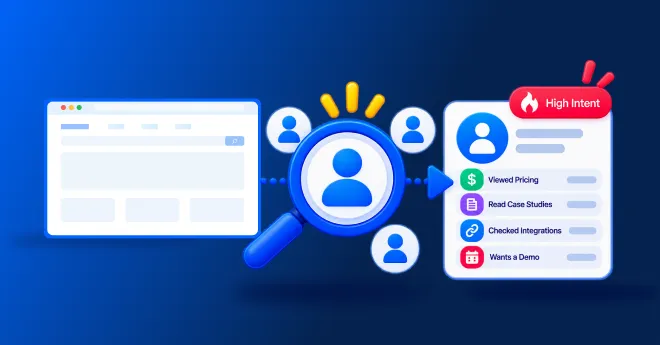
A high intent website visitor is someone showing clear signs they are close to a buying decision, rather than casually browsing. They ask specific questions, check pricing, compare options, and often show urgency about timing.
Not every visitor with intent looks the same. It helps to think of intent as a spectrum, not a single moment.
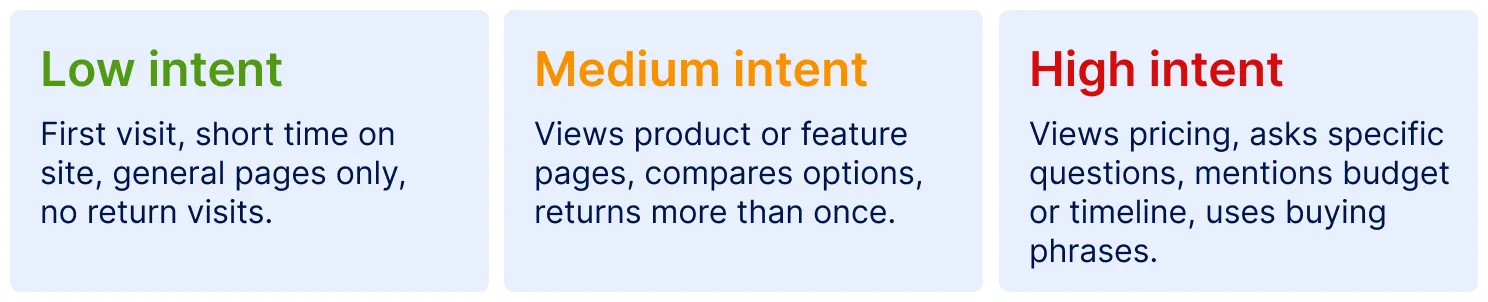
You do not need to guess. A handful of signals repeat across almost every B2B website. Watch for these.
| Signal | What it usually means | Typical intent level |
| Pricing page visit | Weighing the cost | High |
| Repeat visits, same pages | Active evaluation | Medium to High |
| Comparison page visit | Choosing between vendors | High |
| Integration question | Checking technical fit | Medium |
| Case study read | Seeking proof | Medium |
| “Book a demo” or similar | Ready to talk | High |
| Single homepage visit only | Early curiosity | Low |
| Tip Combine signals rather than judging on one alone. A single pricing page visit is a hint. A pricing visit plus a comparison search plus a return visit is a visitor worth talking to right now. |
Exit-intent popups watch for signs a visitor is about to leave, usually a fast mouse movement toward the browser’s close button on desktop. When triggered, they offer a last message before the tab closes.
They work, to a point.Research reports that well-implemented exit-intent popups recover 10% to 15% of visitors who would otherwise leave, with an average conversion rate of around 3.94% across more than a billion popup displays.Other analysis puts the typical range at 2% to 4%, with top performers reaching 10% or higher.
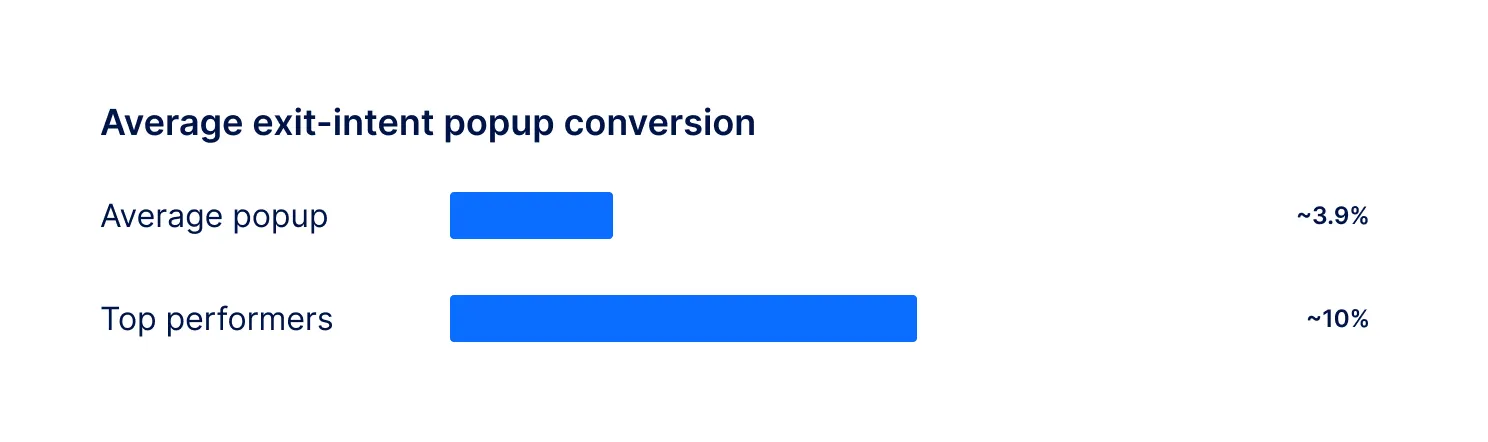
The honest read is this: even a good exit-intent popup misses roughly 90% of visitors. It is a useful last catch, not a full solution. It works best on pricing or checkout pages, and worst when it interrupts someone still reading.
Page views tell you where someone went. They do not tell you why. A visitor on your pricing page could be a buyer, a student researching, or a competitor checking your rates. Behavior gives you a guess. A conversation gives you an answer.
Budget range, timeline, team size, and the actual reason someone is looking. These are the details that turn “someone visited pricing” into “someone is ready to buy in six weeks, for 20 seats.”
This is why website visitor intent detection works best as a mix: watch the behavior, then ask a simple, well-timed question and read the answer. Our guide to AI lead qualificationgoes deeper into how scoring works.
Here is the path from a signal to a captured lead.
Here is what that can look like in practice.

This visitor never had to click “book a demo” or fill a form. The signal itself started the conversation, and the answer confirmed the intent before she could leave.
Watching behavior should stay respectful. Track pages and patterns, not personal details, until a visitor shares them willingly in a conversation. Be clear in your privacy policy about what you track, and always tell visitors when they are talking to AI.
✔ List your top three or four highest-intent pages, starting with pricing.
✔ Define the hot keywords and phrases your best leads actually use.
✔ Set up a chatbot or trigger that reacts to those pages and phrases.
✔ Ask one simple qualifying question, not five.
✔ Score the lead and alert your team the moment it is High.
✔ Review what triggered each High lead weekly, and refine your signals.
In Corvexa, this lives in thelead qualification profile and thecrawl manager, where you choose which pages the AI focuses on and which hot keywords count as strong signals.
Track outcomes, not just signals. Four numbers matter most.
High intent visitors identified shows how many you are now catching. Conversion rate of High leads shows if your scoring is accurate. Time from signal to first contact shows how fast you act. Meetings booked from flagged visitors show the real payoff.
TheCorvexa leads dashboard shows each lead’s score, the page that triggered it, and the full conversation, so you can see exactly which signals turn into real business.
Somewhere in your traffic today, a visitor is showing you exactly how close they are to buying. The signals are there: the pricing page, the comparison search, the specific question. Most websites let those signals pass by unnoticed.
Watch the pages that matter, ask one smart question when a signal appears, and act while the visitor is still there. That is the difference between a lead you catch and one you only find out about after they have gone.

FAQ
Find answers to common questions about identifying high intent website visitors, recognizing buyer intent signals, using AI chatbots, and capturing leads before they leave your website.
Copy FAQ description
A high intent visitor is someone showing clear signs they are close to a buying decision, such as viewing pricing, comparing you with competitors, or asking a specific question about your product or service.
Watch for specific signals: pricing page visits, repeat visits, time spent on key pages, comparison searches, and direct questions about cost, timeline or fit. A chatbot can also ask a question and read the answer in real time.
Pricing page views, product comparison pages, integration or feature questions, case study reads, and phrases like ‘book a demo’ or a specific budget number are strong signals.
They can help. Exit-intent popups convert a few percent of leaving visitors on average, and higher for pricing or checkout pages. They work best combined with other signals, not alone.
 How to Identify High Intent Website Visitors Before They Leave Your Website

Quick summary Your office closes at 5 PM. Your website does not. This guide looks at what happens to evening...
Quick summary Around 95% to 98% of website visitors leave without contacting you. This guide explains why website visitors don’t...
Quick summary Intercom is excellent at customer support, but sales teams often need something different. This guide explains why, what...