
 8 Mins Read


Conversational Marketing for B2B: The Lead Gen Secret
Here’s a guide to the marketing shift that’s quietly changing how B2B companies fill their pipeline Somewhere on your website,...

| Quick summary More website traffic feels like progress, but if only 2% to 3% of visitors ever become leads, extra traffic just means extra people leaking out the same holes. This guide explains what a website conversion gap actually is, how to measure your own, and a 5-step plan to convert more website visitors into leads without spending another dollar on ads. |
Traffic is the easiest number in marketing to feel good about. It goes up, the dashboard turns green, and it feels like growth. Then you check the leads column, and it barely moved.
That gap between “visitors” and “people who actually contacted you” is not a traffic problem. It is a website conversion gap, and it is usually far cheaper to close than it is to out-advertise.
It is natural to assume that low leads means low traffic. So the instinct is to spend more on ads, publish more content, or chase more keywords. But if your website conversion rate is the real issue, doubling your traffic does not double your leads. It doubles your losses.
Traffic measures attention, not intent. One analysis of B2B lead generation put it bluntly: research shows thatonly 2% to 5% of website visitors typically convert into leads, meaning over 90% of traffic generates no direct business value. If that is true for your site, the traffic was never the bottleneck. The path from visit to contact was.
A website conversion gap is the difference between the volume of traffic a site earns and the number of people that traffic actually turns into leads. Every site has one. The question is only how big it is, and whether anyone is tracking it.
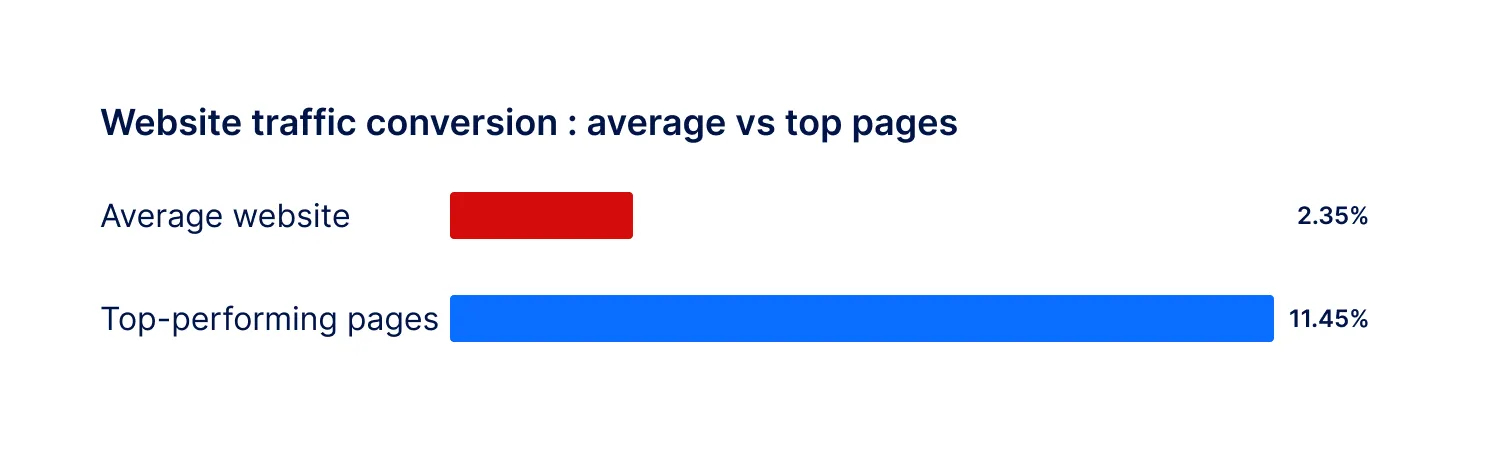
That five-times gap between average and top pages is not explained by traffic quality alone. It is explained by what happens after someone arrives. Sites that close their conversion gap get more out of the same visitors. Sites that ignore it need to keep buying new ones just to stand still.
You likely have a conversion gap if
traffic is flat or rising, but leads have not moved with it, most sessions last only seconds, your contact form gets views but few submissions, and your team says the leads that do arrive are “not a great fit.”
You likely have a traffic problem if
your visitor-to-lead rate is at or above your industry benchmark already, but total visits are too low to hit your pipeline targets. That is a smaller group of sites than most teams assume.
1. You’re optimizing for clicks, not intent
Ad and content strategies are often judged by traffic volume, so teams chase keywords and audiences that click, whether or not they were ever going to buy. High traffic with low website visitor to lead conversion is often a sign the wrong visitors are arriving in the first place.
2. The funnel leaks before anyone decides
A visitor who hits a slow page never gets far enough to see your offer. Google research found that53% of mobile visitors leave if a page takes more than three seconds to load. That is pure gap, closed before your copywriting even had a chance.
3. There’s no fast way to answer a buyer’s question
“Does it work with my stack?” “What does this cost for my team size?” If the answer is buried or missing, the visitor does not email and wait. They quietly check a competitor.
4. Forms filter out real interest
A form asks for effort before it gives anything back. Data from Zuko, reported byCueFully, shows 55% of people who view a form never complete it, and contact forms convert views at only about 9%.
5. Slow follow-up wastes the leads you already paid for
Harvard Business Review found that firms responding to a web lead within an hour werenearly seven times as likely to qualify it, yet average reply time across companies was 42 hours. Other research cited bySHNO puts it even more starkly: 79% of leads never convert into sales due to poor nurturing and qualification.
6. Every visitor gets the same path
Ready-to-buy visitors and early researchers usually land on the same page with the same single call to action, “book a call.” Visitors who are not ready to talk to sales yet have nowhere to go, so they leave instead of staying in reach.
7. Nobody is actually measuring the gap
Most analytics dashboards report sessions and traffic sources in detail, but stop short of visitor-to-lead rate by page. Without that number, the gap stays invisible, and traffic keeps getting the blame and the budget.

You do not need special software to find your gap, only two numbers you likely already have: your visitor-to-lead conversion rate, and the rate a well-run page in your industry achieves.
For example, a site with 10,000 monthly visitors converting at 1.2%, against a 2.35% industry average, is leaving roughly 115 extra leads a month on the table, from traffic it has already paid for. Run this on your top three pages first. That is where a small fix produces the biggest jump in leads.
| Did you know? Multi-channel lead sources compound this problem further. If your best-converting channel and your worst-converting channel feed the same leaking page, more spend on the good channel still gets diluted by the same broken experience. |
Use this table to see where your next dollar and hour are better spent.
| If you assume it’s a traffic problem | What usually happens | If you treat it as a conversion gap |
| Spend more on ads | Cost per lead rises, close rate stays flat | Fix the page those ads already land on |
| Publish more content | More sessions, same tiny conversion rate | Add a fast answer option on existing high-traffic pages |
| Chase new keywords | More visitors who were never a fit | Sharpen the offer for visitors already arriving |
| Add more form fields “to qualify better” | Fewer submissions overall | Qualify inside a short conversation instead |
| Hire more SDRs to chase traffic | Same 42-hour average response time | Alert the team instantly on hot leads |
A chatbot cannot manufacture traffic, and it should not try to. What it can do is stop qualified visitors from leaking out of a funnel that already reaches them.
It captures intent a form would have missed
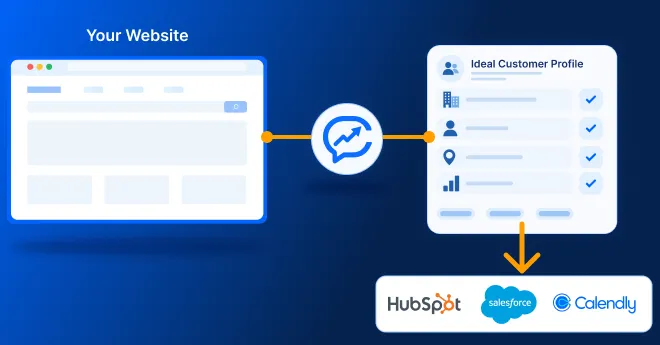
Instead of asking a visitor to commit to a form, Corvexa starts a conversation, answers their real question, and collects name, work email, phone and interest naturally inside the chat.
It runs after your team logs off
B2B research buying happens at night and on weekends. A chatbot keeps that traffic from leaving empty-handed just because no one was online to answer.
It tells your team who to call first
Each conversation is scored High, Medium, or Low, and hot leads trigger an instant alert, so your fastest response goes to your best-fit visitor, not whoever filled out a form first.

None of that would have shown up in a name-and-email form. See how the scoring works in more depth on ourhow it works page.
Buying more traffic before measuring the gap
If you do not know your current visitor-to-lead rate, you cannot tell whether more visitors will help or just leak faster.
Treating conversion rate as a vanity metric too
A conversion rate without context is easy to misread. Track it by page and by traffic source so you can see exactly where the gap is widest.
Assuming every visitor wants the same thing
A ready-to-buy visitor and a first-time researcher need different paths. One call to action for both loses one of them.
Only counting form fills as leads
Chats, replies and saved pricing pages are all signals. Counting only submitted forms hides most of your real conversion gap.

Traffic is easy to celebrate and hard to fix cheaply. A conversion gap is the opposite: less visible, but usually far cheaper to close. Before spending more to bring people to your site, spend a little time finding out how many of the people already there are leaving because of a slow page, a long form, or a question nobody answered.
Corvexa helps close that gap by turning high-intent visitors into scored, qualified leads inside a conversation, on the pages where they’re already asking questions. Plans start at $39 a month. Seepricing.

FAQ
Find answers to common questions about website conversion gaps, visitor-to-lead conversion rates, improving lead generation, and using AI chatbots to convert more website visitors.
A website conversion gap is the difference between the traffic your site attracts and the leads it actually produces. Most sites do not have a traffic shortage, they have a gap between visits and contacts, caused by slow pages, unclear offers, long forms or no fast way to get an answer.
Traffic measures attention, not intent. Only 2% to 5% of visitors typically convert into a lead, so adding more visitors to a leaking funnel mostly adds more people who leave the same way the current traffic does.
Find where visitors drop off, fix page speed and clarity, shorten forms, add a fast way to answer questions on high-intent pages, and follow up with hot leads within minutes instead of days.
Around 2.35% is a common average, while top-performing pages reach 11.45% or higher. B2B SaaS sites often sit between 1.5% and 2.5%. Anything meaningfully below your industry average points to a conversion gap.
Yes. Because the gap is a leak, not a shortage, fixing speed, forms, answers and follow-up usually produces more leads from existing traffic, often faster and cheaper than buying more visitors.
Installation is a single script tag. Corvexa can go live within 48 hours of your onboarding call, and plans start at $39 a month.
 Your Website Traffic Is Not the Problem. Your Conversion Gap Is.

Here’s a guide to the marketing shift that’s quietly changing how B2B companies fill their pipeline Somewhere on your website,...
Quick summary Most people who visit your website never fill in a form. An AI sales agent for websites talks...

It’s 11:47 PM. Someone is on your website. They’ve read your services, checked your pricing, and they’re seriously considering reaching...